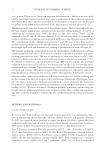
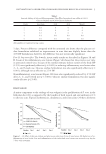
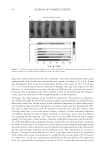
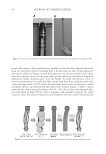
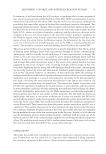
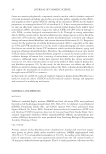
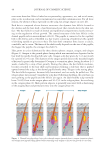
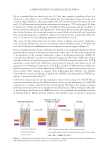
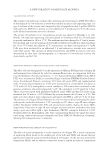
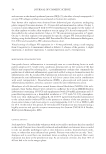
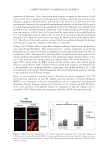
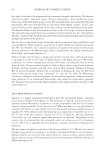
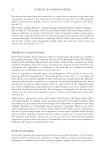
JOURNAL OF COSMETIC SCIENCE 28 agent’s effectiveness, this irregular nature should be resisted and the aligned state stabi- lized, in a form more closely resembling Step 4. In this study, the effect of GG during the procedure outlined in Figure 4 would thus appear to increase the stability of the align- ment from the wet state to the dry state and to greatly reduce the incidence of irregularly shaped hair visibly “breaking away” from the bundle. To model this behavior, stress re- laxation measurements on single hair fi bers under high humidity conditions were used. Using the upper limit of 0.5% strain, the relaxation characteristics of untreated, control treatment–treated, and GG-treated hair fi bers were studied. Figure 5 shows a stress- transient plot of the averaged relaxation data (N = 10) collected for curly damaged Japa- nese hair fi bers at high ( 95%) relative humidity and normalized against the initial values of stress. The greater relaxation after treatment with the control treatment and, Figure 4. Typical grooming procedure in which the application of a GG treatment might be used. Figure 3. Force meter (A) used to evaluate load per fi ber when hair is gently pulled into alignment (B).

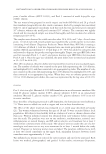
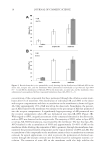
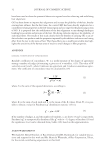
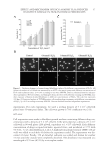
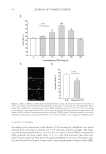
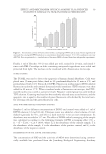
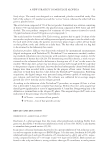
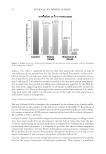
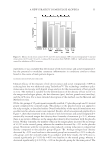
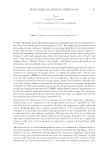
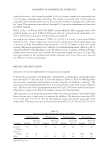
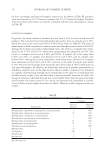
ALIGNMENT CONTROL AND SOFTNESS CREATION IN HAIR 29 more so, after the GG treatment is evident. So, as described by Zuidema et al. (7), this would indicate the higher setting ability of these two technologies. If the relaxation rate is constant at strains of 1%, as described by Feughelman et al. (9), then the effect of the control treatment and the GG treatment on the initial relaxation, from T = 0 to T = 2 min, is also apparent. In the case of the control treatment, the most likely explanation for this effect is due to the breakage of ionic bonds in hair caused by the low pH value of 3.7 of the formulation. Although the GG treatment also has a pH of 3.7, clearly the presence of GG further increases the effi cacy of this formulation. The further signifi cance of the result for GG is that the increased relaxation rate means less time is needed for it to be effective and thus this fi ts within a realistic timeframe for a typical grooming procedure. Combined with the increased relaxation brought about by GG overall, the effectiveness of this agent in setting the hair is evident. EVALUATION OF INITIAL ELASTIC MODULUS Consumers typically determine the softness of their hair under ambient conditions, as well as during the treatment phase when the hair is damp, and the pliability of the hair fi ber itself was also identifi ed as important to the perception of softness, from the panel- ists responses previously described. With regard to the typical grooming procedure out- lined in Figure 4, it was thus considered whether GG could also affect the pliability of individual hair fi bers in addition to its effect on alignment. Stress–strain measurements over the initial 0.25% (the initial strain was reduced from 0.5% to overcome the effect of the shift in the stress–strain relationship for hair on moving from high to low humidity) were performed under 20% humidity conditions and the change in modulus before and after treatment was used as an indicator of the pliability change of each fi ber. Figure 6 shows the change in modulus over this low strain region for untreated control, control treatment–treated, and GG-treated hair fi bers, expressed as a relative modulus value. Although the moduli of the untreated and control fi bers did not change with treatment, those fi bers treated with GG showed a 20% decrease in modulus, indicating the increased pliability of these fi bers at 20% relative humidity. Figure 5. Normalized stress-transient plots under high humidity for curly damaged Japanese hair after various treatments. Solid line, untreated hair dashed line, hair treated with control treatment dotted line, GG-treated hair. Each plot is the average of the data of 10 fi bers.
Purchased for the exclusive use of nofirst nolast (unknown)
From: SCC Media Library & Resource Center (library.scconline.org)