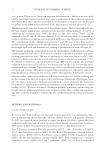
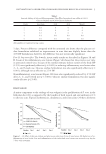
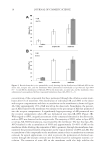
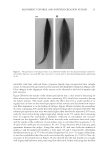
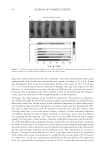
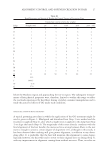
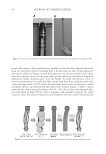
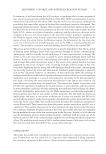
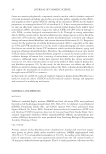
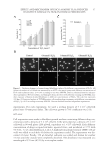
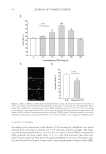
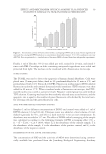
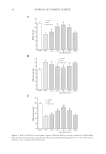
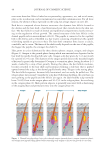
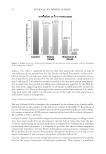
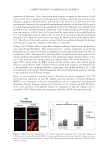
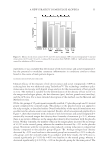
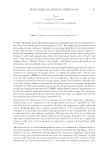
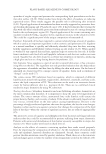
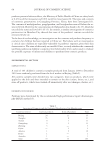
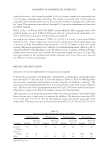
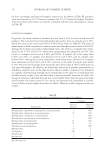
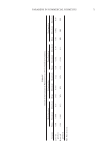
JOURNAL OF COSMETIC SCIENCE 30 NANOINDENTATION AND FORCE MAPPING BY AFM After treatment with GG, the changes in physical property of hair indicated that some modifi cation of the hair components had taken place. To investigate this further, and at- tempt to elucidate which subcomponent(s) of hair may be affected by GG, AFM force measurements were used. In Figure 7A, a force map of an untreated hair section, taken from the root, shows the cortex CMC as dark lines among the lighter cortex cells. This contrast between the CMC and cortex cells is lost, however, in images of the highly dam- aged tip region of curly damaged hair (Figure 7B). After treatment with GG, similar regions of the hair again show strong contrast between the CMC region and the cortex cells (Figure 7C). The control treatment did not show any signifi cant effect (data not shown). Nanoindentation measurements performed on the cortex CMC confi rmed that the modulus of the cortex CMC was higher in the damaged tip but had recovered and was indeed softer than that of the undamaged root, as shown in Figure 7D. Figure 7. Young’s modulus maps of hair cross sections after various treatments, (A–C), and comparison of Young’s modulus for the cortex CMC region of each cross section (D). Figure 6. Relative initial modulus results for curly damaged Japanese hair after various treatments, under dry (20%) relative humidity conditions (N = 5).

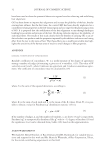
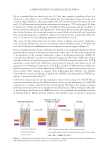
ALIGNMENT CONTROL AND SOFTNESS CREATION IN HAIR 31 In summary, it has been shown that GG can have a signifi cant effect on the properties of hair, improving alignment and the fl exibility of the fi ber. AFM nanoindentation measure- ments have indicated that the cortex CMC may be involved in this process, although the possibility that some other region of the hair also contributes cannot be discounted. Two important physical property changes after treatment with GG were shown in this article the fi rst was an increase in stress relaxation in the very low strain region under the very high ( 95%, almost wet) relative humidity condition, and the other was a decrease in the modulus in the very low strain region in the dry (20% relative humidity) condition. In the Hookean region, stress mainly comes from stretching of hydrogen bonds but in the region of very low strain, before the Hookean region, the deformation by the strain may occur not in keratin but in amorphous parts, such as the CMC or intermacrofi brillar ma- terials. This would be consistent with our fi ndings that GG affects the cortex CMC. The precise nature of this action is not known, but it may be hypothesized that GG is capable of forming many hydrogen bonds with hair proteins through its anionic carboxyl group, amino group, and also centrally located amid group. It is our contention that, on drying, GG resides in the same areas previously occupied by water, forming hydrogen bonds with hair proteins. In the case of the anionic carboxyl group, particularly, such bonding may be consid- ered stronger than either hair protein–water or hair protein–hair protein bonds, as has been suggested for the action of organic acids containing multiple carboxyl groups in hair (12). Even under high humidity, the strong and stable hydrogen bonds of an anionic carboxyl group are not easily replaced by water, and then hair-set durability against humidity is improved (12). In wet conditions, however, an abundance of water molecules allows the exchange of hydrogen bonds between the carboxyl group and hair proteins as well as between hair proteins themselves such exchange is a cause of stress relaxation. According to the data presented in this study, concerning the stress relaxation measurement in the almost wet condition, the stress relaxation increases more for treated hair. This means that further interactions exist between the ingredients included in the treated solution, in particular GG, and hair proteins. In water-abundant conditions, the links remaining after hydrogen bond exchange are chemi- cal bonds, hydrophobic interactions, van der Waals interactions, and the hydrogen bonds of protein–protein sites that are inaccessible to water molecules. The GG molecule also has an amide group, and hence, it can interact with proteins. It seems very possible that GG in the test formulation interacts with protein segments in hydrophobic regions protected from water molecules. In the cortex CMC, this would most likely be within the centrally located protein- aceous δ -layer itself. These interactions diminish protein–protein interactions, and GG acts as a plasticizer. This could be the reason of the stress relaxation decrease by GG under the almost wet condition. Similarly, the plasticization of the water inaccessible areas may be responsible for the modulus decrease of the low strain region in the dry state. In total, it is felt that the specifi c distribution of these chemical functionalities, combined with the small size of the molecule, provide GG with a uniquely high capability for modifying the physical properties of hair. The multifunctional nature of GG is another unique feature of this agent such actions have not previously been described for this, or any other, molecule. CONCLUSIONS This study has clarifi ed the contribution of hair fi ber alignment to the perception of soft- ness. Furthermore, the low strain ( 0.5%) region has been identifi ed as being important for consumers awareness of hair softness. Stress relaxation measurements at slight strains
Purchased for the exclusive use of nofirst nolast (unknown)
From: SCC Media Library & Resource Center (library.scconline.org)