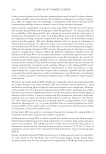
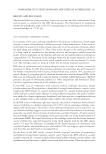
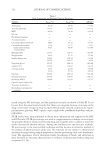
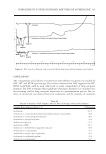
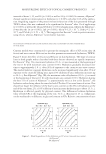
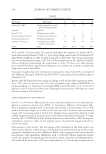
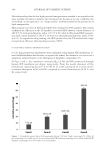
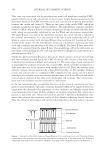
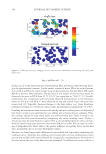
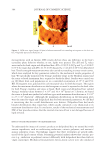
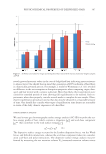
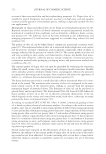
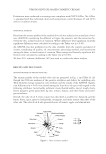
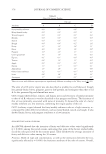
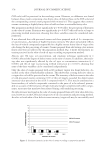
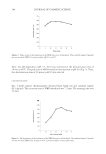
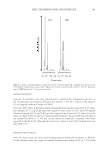
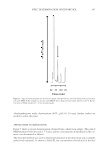
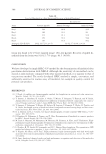
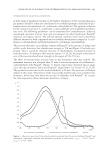
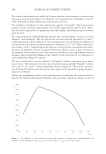
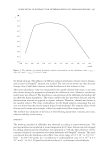
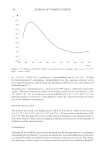
JOURNAL OF COSMETIC SCIENCE 362 F•g = γ•PR•cosθ (1) In this case, F is the interaction force between hair fi ber and water (called wetting force), g is the gravitational constant, γ is the surface tension of water, PR is the wetted perim- eter of solid, and θ is the contact angle between hair and water. For hair fi bers, PR equals πD (D is the hair fi ber diameter). On the basis of our studies of the two hair types, we observed a decrease in DCA from 95.72 ± 6.21° for virgin hair to 79.60 ± 7.12° for deli- pidized hair. For comparison with previously obtained measurements in the literature, values of 103 ± 4° and 98 ± 2° were obtained for dry and soaked virgin caucasian hair, respectively (9). Typically, chemical damage to the hair surface (e.g., from bleaching, permanent waving, etc.) results in contact angle measurements ranging from 70 to 80°. Combing measurements show increases in both dry and wet combing forces of delipidized hair. Such a result is not surprising because adding oils to hair facilitates combing. Thus, the contrary should be true when lipids are removed from hair. Table I contains wet combing data that were obtained by integrating the entire combing curve. Clearly, a distinction may be made between virgin (0.061 g cm) and delipidized (0.325 g cm) hair, with the latter being more than fi ve times more diffi cult to comb. The increase in comb- ing of delipidized wet fi bers refl ects the greater infl uence of capillary forces in this hair type, presumably due to its more hydrophilic surface. Likewise, we found appreciable differences between both hair types when examining dry combing curves. Typically, dry combing curves begin with very low combing forces (root section and middle of the tress) followed by a large peak corresponding to the bottom of the tress where the tips of the fi bers become entangled. To differentiate various effects in Figure 3. FTIR spectroscopic imaging of hair cross sections obtained by monitoring the lipid peak (2850 cm-1).

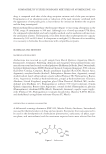
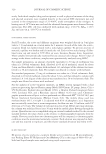
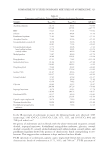
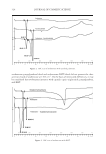
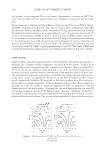
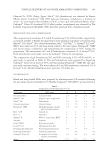
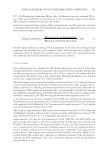
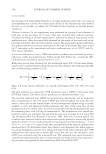
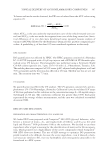
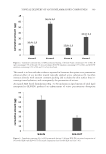
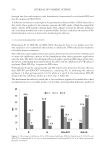
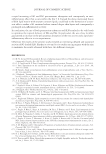
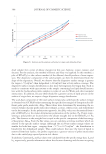
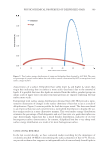
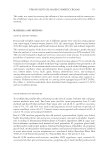
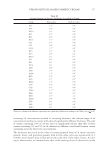
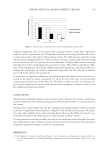
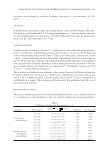
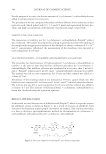
PHYSICOCHEMICAL PROPERTIES OF DELIPIDIZED HAIR 363 the dry combing analysis we examined several regions of the dry combing curves (Table II). In our initial analysis, we compared the maximum peak intensity corresponding to the entanglement peak in which case dry combing of delipidized hair resulted in an in- crease over fi ve times greater than virgin hair. The total combing work is also reported in Table II and represents the integrated values for the entire dry combing curves including the entanglement peak region. We also examined the integrated values of dry combing curves up to, but not including, the entanglement peak. In addition, we also integrated only the entanglement peak region. Overall, all portions of the drying combing curve are more diffi cult to comb in the case of delipidized hair. The smallest difference between the two hair types is in the region up to, but not including, the entanglement peak. Typically, this is the most diffi cult region of the combing curve to differentiate. Please bear in mind that the data reported are statistically signifi cant and represent averages of fi ve hair tresses combed fi ve times for both wet and dry combing analysis. AFM investigations were carried out in contact mode while monitoring topography and lateral forces. A striking feature we found in delipidized hair was the presence of many micropores. Figure 4 provides a representative example on solvent-extracted hair in which a considerable population of micropores can be seen. The average diameter of the pores was determined to be 150 ± 25 nm with their depth estimated to be 8.0 ± 2.5 nm. The pore depth may be greater than the measured value because of limitations of the probe to reach the bottom of the pore. We examined four hair fi bers from each population and obtained 25 images at randomly selected positions along the hair shaft. In virgin hair, we found micropores in only 21% of the sites examined, whereas they were present 70% of the time in delipidized hair. Interestingly, we also observed micropores in 42% of the cases for hair that underwent a standard bleaching procedure. It is likely that the pores are a part of the natural anatomic structure of the hair fi ber and only become revealed when surface lipids are removed (10). HEALTH STATE OF INTERNAL HAIR STRUCTURE Information about the importance that free lipids play in the structural properties of hair was investigated using differential scanning calorimetry (DSC) and tensile strength Table I Wet Combing Work Values for Virgin and Delipidized Hair Hair type Combing work (g cm) Virgin 0.061 ± 0.0071 Delipidized 0.325 ± 0.0450 Table II Dry Combing Work Values for Virgin and Delipidized Hair Hair type Peak max (g) Combing work (g cm)—total Combing work (g cm)—up to but not including peak Combing work (g cm)—peak Virgin 106.24 ± 11.52 0.028 ± 0.0027 0.017 ± 0.0018 0.011 ± 0.0010 Delipidized 559.48 ± 95.02 0.065 ± 0.0066 0.0276 ± 0.0025 0.038 ± 0.0050
Purchased for the exclusive use of nofirst nolast (unknown)
From: SCC Media Library & Resource Center (library.scconline.org)