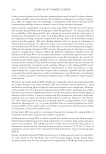
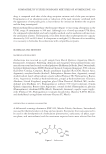
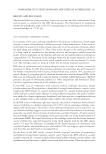
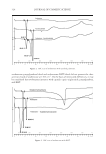
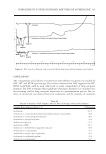
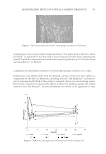
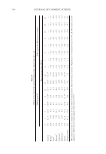
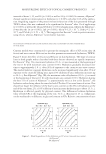
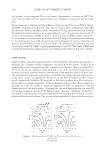
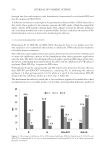
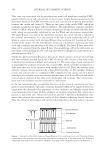
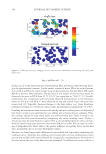
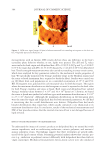
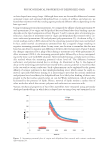
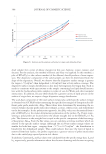
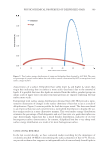
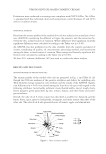
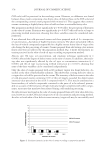
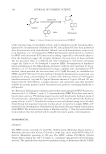
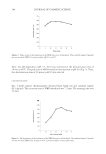
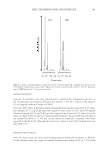
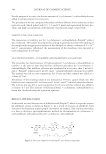
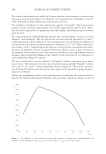
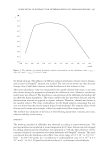
JOURNAL OF COSMETIC SCIENCE 324 avobenzone–propylparaben blend and avobenzone–BHT blend did not present the char- acteristic band of avobenzone at 1305 cm−1. On the basis of mentioned differences, it may be considered that avobenzone interacts with caprylic capric triglyceride, propylparaben, and BHT. Figure 3. DSC scan of avobenzone with BHT. Figure 2. DSC scan of avobenzone with ascorbyl palmitate.

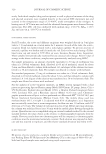
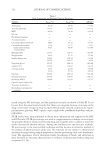
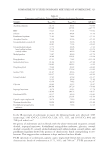
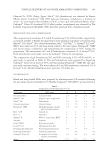
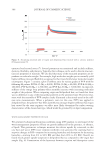
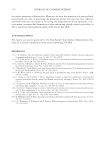
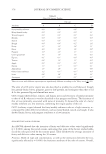
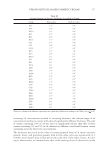
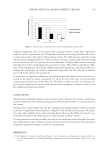
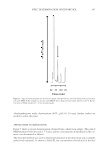
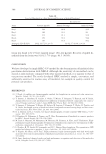
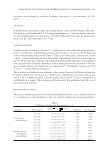
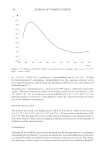
COMPATIBILITY STUDIES IN BINARY MIXTURES OF AVOBENZONE 325 Figure 4. DSC scan of avobenzone with cetearyl alcohol/sodium lauryl sulfate/sodium cetearyl sulfate. Table III Results of Analysis of IST Samples After 15 Days of Storage at Stressed Conditions Samples Ratio drug–excipient (1:1) % Remaining Avobenzone 101.5 Avobenzone + cetearyl alcohol/sodium lauryl sulfate/sodium cetearyl sulfate 98.8 Avobenzone + cetearyl alcohol/ceteareth 20 98.7 Avobenzone + isopropyl myristate 95.6 Avobenzone + glycerin 91.3 Avobenzone + BHT 103.3 Avobenzone + diethylhexyl syringylidene malonate 98.0 Avobenzone + cetearyl alcohol 97.7 Avobenzone + caprylic capric triglyceride 92.1 Avobenzone + paraffi num liquidum 93.4 Avobenzone + propylparaben 94.7 CONCLUSIONS The compatibility and stability of avobenzone with different excipients was studied by DSC, IST, and FT-IR spectroscopy. The results confi rmed that DSC supported by IST/ HPLC and FT-IR could be used collectively to study compatibility of drug–excipient mixtures. The DSC technique offers signifi cant advantages, therefore it is considered as a fast screening tool for drug–excipient interaction in a preformulation process. No evi- dence of interaction was observed between avobenzone and the majority of excipients
Purchased for the exclusive use of nofirst nolast (unknown)
From: SCC Media Library & Resource Center (library.scconline.org)