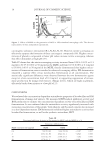
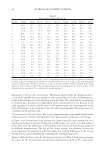
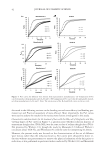
JOURNAL OF COSMETIC SCIENCE 46 extensional sets (y = 0.787x + 18.20, r =0.974). Notably, after 5 min of reduction, the bend- ing set value for the B–N lotion was greater than that of the B–S lotion, while it was less than that of the B–S lotion after 16 min of reduction. This reversal is similar to the results obtained for the Pa/t curves for B–S and B–N lotions, as shown in Figure 5(A), and suggests that the mechanism of deformation is the same for both bending and extensional treatments. Furthermore, these results demonstrate that the bending set behavior can be accurately predicted by the extensional set behavior, which is in disagreement with Wortmann’s claim regarding the weak correlation between the extensional and bending sets. Larger bending sets than extensional sets. One problem associated with the results given in Figure 8(A) is that the bending sets are larger than those obtained after extensional treatment, because the straight line shown in the fi gure does not pass through the origin. The issue of larger bending sets compared to the corresponding extensional sets has been discussed by Wortmann (10) and Feughelman Table III Bending and Extensional Setting Tests Using the Same Hair Exp. No Wave lotion Time (min)a Pa(%) Sℓ(ext)(%)b Sℓ(bend)(%)c 1 A–S 9.5 80.3 84.3 7.9.0 2 A–S 11.1 80.8 86.3 84.3 3 A–S 15.0 84.8 89.4 82.6 4 A–N 10.0 52.9 49.5 58.8 5 A–N 9.2 48.4 51.9 51.8 6 A–N 15.4 67.5 65.1 66.1 7 A–N 15.1 64.3 67.1 71.5 8 A–N 15 62.3 60.4 61.0 9 B–S 16 56.3 87.4 80.0 10 B–N 16.3 69.1 78.3 73.0 11 B–S 5.0 87.4 56.3 56.8 12 B–N 5.0 78.3 69.1 68.0 13 C–S 3.4 20.4 21.1 34.5 14 C–S 4.7 27.6 27.6 41.3 15 C–S 10.0 36.4 35.4 46.7 16 C–S 10.6 43.4 42.2 52.7 17 C–S 9.3 68 70 70.0 18 C–S 14.2 72.5 74.6 83.3 19 C–S 11.9 72.9 76.8 77.5 20 C–S 10.1 40 39.6 47.3 21 C–S 5.0 26.7 24.7 37.9 22 C–S 15 51.8 53.8 53.0 23 C–S 9.1 63.2 64.1 65.8 aReduction time. bExtensional set [equation (1)]. cBending set [equation (3)].

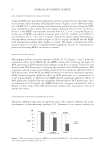
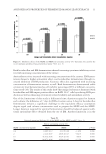
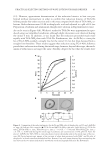
PRACTICAL SELECTING METHOD OF WAVE LOTION FOR HAIR DRESSER 47 (17) on the basis of their respective theories. However, from a macroscopic view point, the simplest explanation is that during bending treatment, the exterior surface of the fi ber is extended, while the interior surface of the fi ber, which is in contact with the cylinder, is compressed consequently, diffusion of the reducing agent on the exterior surface occurs more rapidly than on the interior surface. Thus, to verify the effect of extension and compression on the rate of diffusion and reduc- tion on the exterior and interior surfaces, the following experiment was conducted. A single hair fi ber fi xed in the device shown in Figure 3 was reduced for 5 min using the C–S wave lotion, rinsed with water, and then soaked in 0.1 M HgCl2 for 10 min (18). The distribution of the Hg formed as S–Hg–S bonds was then determined using the method described in Determination of the distribution of Hg (in Formed S–Hg–S Bonds) in hair of the Experimental section. Figure 8(B) shows the relationship between the Hg L-line count and the 44 measurement locations. The integrated Hg count at the outside edge of the fi ber was much larger than that at the inside edge, and the extent of Hg diffusion at the outside edge was greater than that at the inside edge. These results indicate that the effect of diffusion at the out- side edge was greater than that at the inside edge, and thus a greater effect is expected for the bending treatment than the extensional treatment. PRACTICAL ASSESSMENT OF WAVE EFFICACY The practical wave effi cacy assessment results provided by the professional hairdresser are presented in Figure 9(A) (copyright provided to us by H. Takahara). In the hairdresser’s report, it was emphasized that the wave effi cacy of the B–N wave lotion was greater than that of the B–S lotion, even though –S wave lotions usually have greater strength than –N lotions. This comment provides significant validation of the proposed approach. The practical assessment that the wave effi cacy of the B–N lotion was greater than that of the B–S lotion corresponds with the difference in the Pa values taken from the respective Pa/t curves for the B–S and B–N lotions at 5 min. In addition, a comparison of the reducing condition used for the extensional and practical treatments revealed that the volume of the reducing agent relative to the volume of hair was practically infi nite for the exten- sional treatments, but on the order of 1–2 for the practical treatments. Therefore, reduc- tion for 15 min during the extensional treatment is clearly too severe, and the values for Sℓ (ext) on the Pa/t curves at a reduction time of 5 min should correlate well with the wave effi cacy expected during practical applications. Figure 9(B) shows the average practical assessment values for the wave effi cacy plotted against the Sl(ext) values taken from the Pa/t curves in Figure 9(C) (prepared using the data in Table II) at 5 min for each wave lotion listed in Table I. These results suggest that the wave effi cacy can be predicted using the Sl(ext) value. Accuracy of wave effi cacy prediction. Although there is a correlation between the wave effi - cacy results and the extensional set values, it is lower than that between the wave effi cacy and the bending set values (wave effi cacy vs. Sℓ: y = 0.263X + 42.491, r = 0.911). In addi- tion, the order of the values for each wave effi cacy did not exactly coincide with that of the Sl(ext) values, as can be seen in Table IV. Therefore, it is necessary to increase the number of wave effi cacy tests and analyze them statistically to achieve more accurate predictions.
Purchased for the exclusive use of nofirst nolast (unknown)
From: SCC Media Library & Resource Center (library.scconline.org)