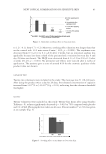
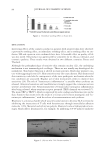
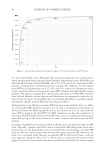
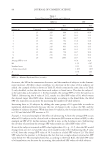
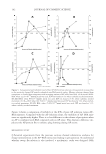
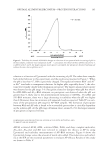
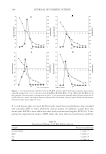
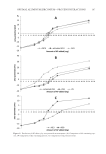
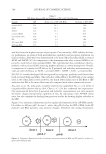
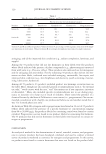
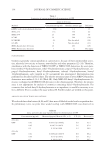
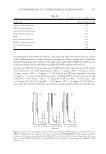
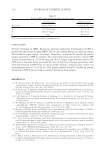
CHOOSING AN EXPECTED SPF VALUE 89 the number of subjects. The label SPF is the largest whole number after subtracting A from the average SPF. Thus, the average SPF from the clinical trial must be suffi ciently large to still meet the target label SPF after the A value has been subtracted. Historical data of A values have been used to evaluate the chances at 70%, 80%, 90%, and 100% of passing a target label SPF of 15, 20, 30, or 50. Using the results of the analysis herein, one can choose an expected SPF that has a known chance of passing the target label SPF. MATERIALS AND METHODS The methods used to determine these percentage increases involved studying clinical trial data (not shown). With the information provided from those trials, sample SDs were es- timated and collaborated to give sample data, which could be used in the calculation of the percentage increase. With that data, sample A values were calculated. A is calculated by multiplying the SD by the critical value on the t-distribution chart at an α level of 0.05, and dividing by the square root of the number of subjects. The 10 calculated A values were examined and the minimum, maximum, and mean were used for further calculations. Using these values, different percent increases were applied to the SPF val- ues to determine what percentage of the clinical trials would pass the intended label SPF value. To determine the actual percent increases, the percent passing was applied to the formula. For example, for SPF 15, the A value to provide 70% passing was 1.32. There- fore, to obtain a label SPF value of 15, the expected SPF value must be at least 16.32, so the subtraction of the A value still results in an SPF of 15. A percentage increase of 8.8% yields this result. This method was continued to fi nd all necessary percentage increases. RESULTS AND DISCUSSION A VALUE AFFECTS THE LABEL SPF Unlike other methods, the FDA-FM (5) method and the more recently published FDA Proposed Amendment (6) and FDA Final Rule methods (7) subtract an A value from the mean SPF to calculate the label SPF value. The A value is composed of the product of the upper 5% point of the one-tailed t-value and the SD divided by n, where n equals the number of subjects. This subtraction decreases the average SPF determined by the FDA-FM and FDA Final Rule methods to the label SPF value, which is the largest integer after subtraction. While product briefs frequently seek an SPF with a 5 or 0 at the end, (e.g., 15, 20, 30, etc.) delivering a formulation with the requested label SPF can be diffi cult due to the variable experimental value of A. There are two examples that exhibit this variability. Example 1. An example of the effect of subtracting A from the average SPF is shown in Table I, where the target label SPF was 50. In this example, the average SPF obtained from the 10 subjects is 52.8. However, subtracting the A value of 4.04 results in a label SPF value of 48, below the target label SPF value of 50. The A value is dependent on three numbers, one-tailed t-value, SD, and number of subjects. As SPF data from more subjects are added, the one-tailed t-value in the numerator

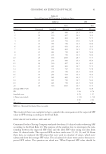
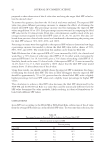
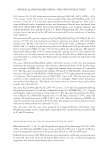
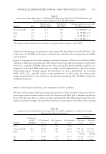
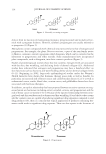
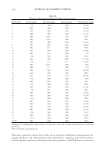
JOURNAL OF COSMETIC SCIENCE 90 Table I Typical Data from SPF Testing on 10 Subjects MED (s) SPF Test Test Subject no. Untreated Standard Material Standard Material 1 15 245 990 16.3 66.0 2 19 310 827 16.3 43.5 3 15 281 863 18.7 57.5 4 15 225 792 15.0 52.8 5 15 245 750 16.3 50.0 6 15 245 653 16.3 43.5 7 15 245 863 16.3 57.5 8 15 281 750 18.7 50.0 9 15 245 750 16.3 50.0 10 19 356 1093 18.7 57.5 Average SPF (n=10) 16.9 52.8 SD 1.32 6.97 Standard error 0.42 2.20 t-Value (one-tailed) 1.833 1.833 A 0.76 4.04 SPF value 16 48 MED (s) - Minimal Erythemal Dose (seconds). decreases, the SD in the numerator decreases, and the number of subjects in the denomi- nator increases. All three values contribute to a decrease in the value of A as subjects are added. An example of this is shown in Table II, which contains the same data as in Table I, only doubled, so that the data from each subject is listed twice. The data for subject 1 is the same data as for subject 11. In this example, the average SPF is 52.8, the same as in Table I. Subtracting the A value of 2.62, results in a label SPF value of 50, which meets the desired target label SPF value. Interestingly, according to the Final Rule, the label SPF of a sunscreen can increase by increasing the number of valid subjects. Increasing data to 30 subjects by adding the same group of 10 again fails to result in signifi cant additional benefi t because the rate of change in the t-value, the SD, and the number of subjects decreases. With data from 30 subjects, the A value reduced from 2.62 to 2.09 and the label SPF remains at 50. Example 2. A second example of the effect of subtracting A from the average SPF occurs when all 10 subjects in the clinical trial to determine SPF return an identical SPF, in this example an SPF of 30. In this instance the SD is zero, so the A value is zero. Subtracting the A value of zero from the average SPF value results in a label SPF value of 30. If one of the subjects returned an SPF value higher than 30, e.g., 34.5, then the SD would change from zero to 1.42 and the value of A would become 0.82. Subtracting the A value of 0.82 from the average SPF value of 30.5 results in a label SPF value of 29. The label SPF value for the product is 29 despite the fact that not a single subject returned an SPF value below 30. This example shows that, according to the Final Rule, the label SPF value of a formulation can decrease by increasing the individual SPF values of valid subjects.
Purchased for the exclusive use of nofirst nolast (unknown)
From: SCC Media Library & Resource Center (library.scconline.org)