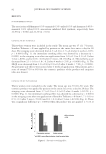
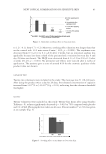
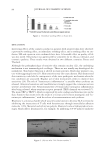
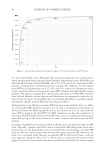
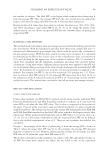
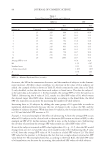
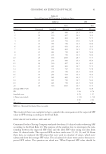
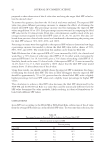
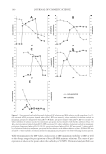
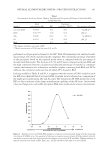
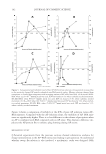
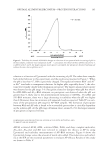
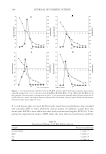
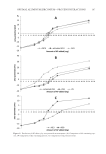
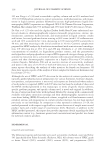
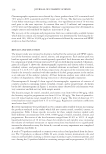
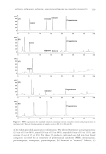
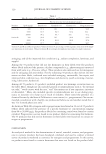
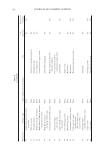
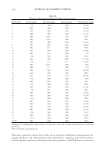
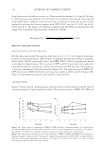
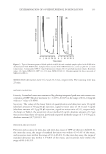
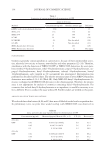
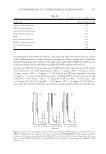
OPTIMAL ALUMINUM/ZIRCONIUM—PROTEIN INTERACTIONS 105 solution as a function of ζ-potential with the increasing of pH. The other three samples had similar behavior in this experiment, and the results are presented in Figure 7. When the pH is less than 4.7, BSA is positively charged. The repulsion between BSA+ and Al3+ or Zn4+ ions leads to transparent solutions. At higher pHs, especially above 5, the solu- tions were visually cloudy with voluminous precipitate. The largest amount of precipitate was observed at the pH range 5–6. Precipitate started to dissipate when pH was over 8. In ACH–BSA and Al13–BSA solutions, no precipitate was observed when the pH was greater than 9, likely due to the aforementioned formation of Al(OH)4-. For ZAG and ZG–BSA mixtures, there was a large decreasing in turbidity when the pH was higher than 8. However, these two mixtures still appeared cloudy as expected. Table IV is a sum- mary of the precipitation pH range for AP–BSA samples. The formation of precipitate between BSA and AP salts is found to be a reversible process that is critically dependent on the solution pH. At the pH range of human sweat, around 6, (36) the largest amount of precipitate is expected to form. COMPARISON AND PREDICTION OF AP EFFICACY BY ZETA POTENTIAL AND TURBIDITY MEASUREMENTS ASCH, activated ACH, ACH, activated ZAG, ZAG, and three complex molecules, Al13-mer, Al30-mer and ZG were selected to compare the effi cacy as AP by using ζ-potential and turbidity measurements of AP–BSA mixtures. Figure 8 shows the ζ-potential change versus the amount of metal salts added. The molar ratio and turbid- ity at the IEP are two essential parameters to evaluate AP effi cacy. Results of this study are shown in Table V. Figure 6. Turbidity of activated ACH-BSA changes as a function of zeta potential with increasing of pH. In all four samples, solutions were transparent at pH = 3, precipitate was observed when pH was raised over 4, at pH between 5 and 6, the largest amount of precipitate was formed, the precipitate dissolved and mixture solution became clear as pH was over 7.

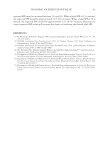
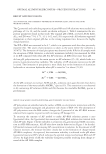
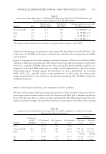
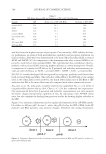
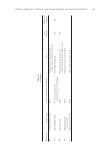
JOURNAL OF COSMETIC SCIENCE 106 Figure 7. Zeta potential and turbidity trend of AP-BSA mixtures which had largest amount of precipitate with pH change from 3 to 12. (A) Activated ACH-BSA, (B) ZAG-BSA, (C) Al13-BSA, (D) ZG-BSA. In all four samples, solutions were all transparent at pH = 3, precipitate was observed when pH was raised over 4, at pH between 5 and 6, the largest amount of precipitate was formed, the precipitate dissolved and mixture solution became clear as pH was over 7. It is well known that activated ACH provides much better performance than standard non-activated ACH in sweat inhibition clinical studies. In addition, studies have also shown that ASCH is more effi cacious than both activated and regular ACH (35). Com- paring the experimental results, ASCH shows the most effective neutralizing capability Table IV Precipitation pH Range of AP–BSA Mixture Solutions Samples Precipitation pH range activated ACH 5 pH 7 ZAG 5 pH 7 Al13 4 pH 6 ZG 5 pH 6
Purchased for the exclusive use of nofirst nolast (unknown)
From: SCC Media Library & Resource Center (library.scconline.org)