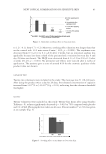
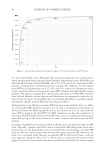
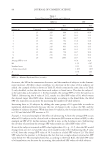
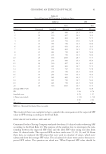
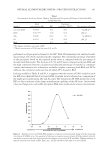
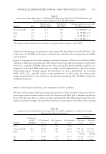
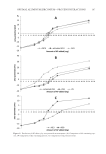
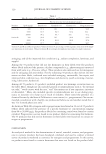
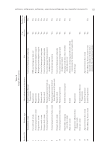
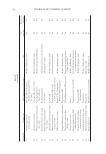
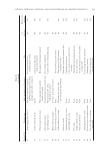
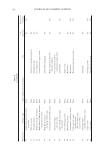
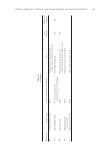
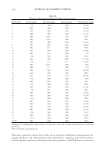
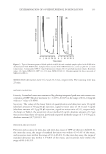
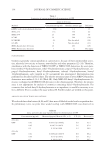
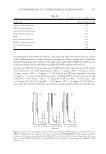
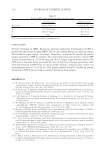
OPTIMAL ALUMINUM/ZIRCONIUM—PROTEIN INTERACTIONS 101 performed on all precipitates formed at the IEP. Table III summarizes the analyzed results of percentage of C, H, N, and metal in the complexes. The calculated percentage of metal(s) in the precipitate based on the reported molar ratios is compared with the percentage of metal(s) from EA results. The decrease of C, H, and N ratios compared with pure BSA and the high correlation between calculated and obtained percentage of metal(s) in complexes confi rm the formation of a substantive insoluble complex containing both BSA and AP. In addition, the correlation indicates that all added AP is bound to BSA. Looking carefully at Tables II and III, it is apparent that the amount of ZAG needed to reach the IEP is less than half that of activated ACH. A similar trend is observed in a comparison of the single species polycations, ZG and Al13-mer. The variation in AP–BSA molar ratio at the IEP is a direct indicator of the charge-neutralization capability of the AP active. Actives with a low size/charge ratio, such as ZG, precipitate BSA more readily and at a lower concentration. Table I Concentration, Isoelectric Points, Highest Turbidity and Precipitate pH Range of Individual BSA and AP Solutions Samples Metal concentration (M) IEP Optimum turbidity* (NTU) Precipitation pH range activated ACH 0.0094 9.21 89.5 b b 5 pH 9 ZAG 0.0071** 9.48 62.5 p pH 7 Al13 0.0090 10.02 71.7 b b10 7 pH ZG 0.0032 7.01 89.6 p pH 6 BSA - 4.72 21.9 - *The highest turbidity was found at IEP. **Metal concentration of ZAG was the sum of Al and Zr. Figure 2. Turbidity of activated ACH–BSA changes as a function of zeta potential change with the increasing of activated ACH/BSA ratio. Zeta potential of solutions increased as more activated ACH was added turbidity was fi rstly increased, and then decreased with the addition of activated ACH into BSA. Highest turbidity of mixture solutions were found at IEPs. ZAG, Al13, and ZG all behaved the same as activated ACH.

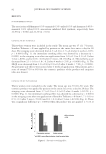
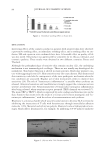
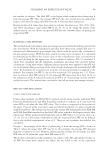
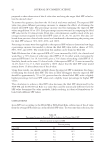
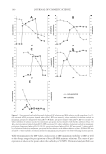
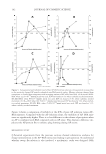
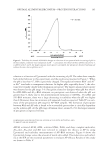
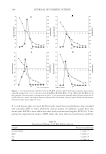
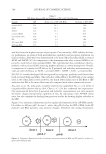
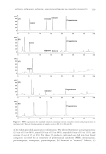
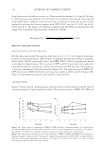
JOURNAL OF COSMETIC SCIENCE 102 Figure 4 shows a comparison of turbidity at the IEPs of pure AP solutions versus AP– BSA mixtures. Compared with the AP solutions alone, the turbidity of AP–BSA mix- tures are signifi cantly higher. There is a clear difference in the volume of precipitate when an AP is combined with BSA compared with an AP alone. This dramatic difference im- plicates the AP/protein fl oc to enhance plug forming during AP action. MECHANISTIC STUDY ζ-Potential experiments from the previous sections showed substantive evidence for charge neutralization in the AP–BSA interaction leading to precipitation. To understand whether sweep fl occulation is also involved, a mechanistic study was designed: BSA Figure 3. Zeta potential and turbidity trend of four AP-BSA mixture solutions. Zeta potential increased due to the positively charged AP particles adsorbed onto BSA particle surface. Mixture solutions changed from transparent to cloudy then transparent with increasing amount of AP added into BSA. (A) Activated ACH- BSA: when 4 122.4 10 mmole × metal was used, IEP was found at 5.65, where turbidity reached maximum. (B) ZAG-BSA: when 4 85 10 mmole × metal was used, IEP was found at 5.60, where turbidity reached maximum. (C) Al13-BSA: when 4 162.79 10 mmole × metal was used, IEP was found at 5.62, where turbid- ity reached maximum. (D) ZG–BSA: when 4 25.95 10 mmol × metal was used, IEP was found at 5.15, where turbidity reached maximum.
Purchased for the exclusive use of nofirst nolast (unknown)
From: SCC Media Library & Resource Center (library.scconline.org)