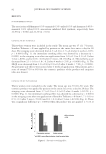
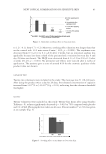
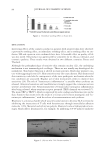
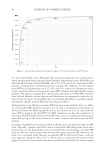
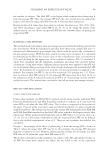
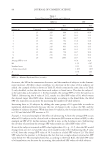
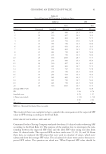
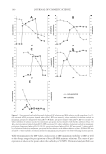
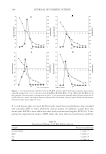
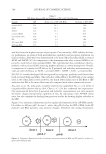
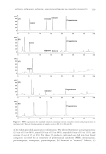
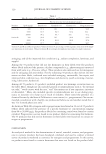
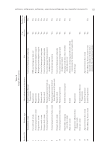
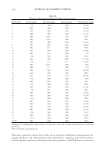
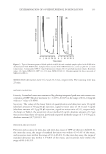
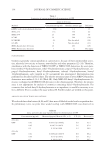
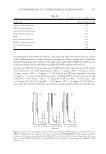
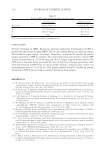
DETERMINATION OF O-PHENYLPHENOL IN SKIN LOTION 135 chromatograms of the three skin lotions, indicating that these skin lotions did not contain butyl 4-hydroxybenzoate or other interfering contaminants. Figure 4 shows typical chromato- grams obtained from three samples of the skin lotions. The peak of NBD-CO-OPP was de- tected in A and B. On the other hand, no NBD-CO-OPP peak was observed in C. As shown in Table IV, the concentrations of OPP in the three skin lotions (A, B, and C) were found to be 1.07±0.06 mg/g (mean ± SD, n = 5, range, 0.996–1.14 mg/g,), 18.8 ± 1.3 μg/g (mean ± SD, n = 5, range, 17.5–20.2 μg/g), and ND (not detectable, less than 5.0 μg/g, n = 5), respectively. Recovery values of spiked OPP from the lotions A, B, and C were 88.7±5.4% (mean ± SD, n = 5, range, 81.2–94.3%). 88.2 ± 4.2% (mean ± SD, n = 5, range, 83.6–92.6%), and 88.9 ± 3.5% (mean ± SD, n = 5, range, 85.0–93.8%), re- spectively. The results of addition–recovery tests in the present system were satisfactory. Figure 4. Typical chromatogram of diluted skin lotion samples (A, B, and C) after derivatization with NBD-COCl.Skin lotion was diluted with water as described in EXPERIMENTAL, and mixtures of diluted samples and IS solution were reacted with NBD-COCl for 2 min at pH 8.5 at room temperature. Retention times: 16.2 min, NBD-CO-OPP (1) 22.2 min, NBD-CO-IS (2). Sample (C) showed no peak of NBD-CO-OPP derivative (1). Table III Relative retention times of paraben derivatives tested for interference with NBD-CO-OPP and NBD-CO-IS Compounds Relative retention time Methyl 4-hydroxybenzoate 0.34 Ethyl 4-hydroxybenzoate 0.47 Isopropyl 4-hydroxybenzoate 0.64 Propyl 4-hydroxybenzoate 0.67 OPP 0.73 Benzyl 4-hydroxybenzoate 0.93 Isobutyl 4-hydroxybenzoate 0.94 Butyl 4-hydroxybenzoate 0.99 IS 1.00

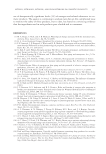
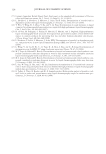
JOURNAL OF COSMETIC SCIENCE 136 CONCLUSION We have developed an HPLC–fl uorescence detection analysis for determination of OPP in paraben-free skin lotions by using NBD-COCl as a pre-column fl uorescence labeling reagent. This method is rapid, simple, convenient, inexpensive, and should be suitable for routine quality assessment of OPP in cosmetics. Two tested skin lotions were found to contain OPP at mean concentrations of 1.07±0.06 mg/g and 18.8±1.3 μg/g using the present system. The OPP level in the other lotion was below the limit of detection. Previous reports have dealt with determination of OPP levels in various sample matrixes, including fruits, serum, and environmental water (6,7,9,10,19–21). Our present method should be suitable for routine assessment of OPP levels, not only in cosmetics but also in those samples. REFERENCES (1) M. Davoren and A. M. Fogarty, In vitro cytotoxicity assessment of the biocidal agents sodium o-phenylphenol, sodium o-benzyl-p-chlorophenol, and sodium p-tertiary amylphenol using established fi sh cell lines, Toxicol In Vitro., 20, 1190–1201 (2006). (2) N. Kolbe and J.T. Andersson, Simple and sensitive determination of o-phenylphenol in citrus fruits us- ing gas chromatography with atomic emission or mass spectrometric detection, J. Agric. Food Chem., 54, 5736–5741 (2006). (3) E. M. Bomhard, S. Y. Brendler-Schwaab, A. Freyberger, B. A. Herbold, K. H. Leser, and M. Richter, o-Phenylphenol and its sodium and potassium salts: A toxicological assessment, Crit. Rev. Toxicol., 32, 551–626 (2002). (4) M. Takahashi, H. Sato, K. Toyoda, F. Furukawa, K. Imaida, R. Hasegawa, and Y. Hayashi, Sodium o-phenylphenate (OPP-Na) promotes skin carcinogenesis in CD-1 female mice initiated with 7,12-dimethylbenz[a]anthracene, Carcinogenesis, 10, 1163–1167 (1989). (5) Ministry of Health, Labour and Welfare. http://www.mhlw.go.jp/fi le/06-Seisakujouhou-11120000- Iyakushokuhinkyoku/keshouhin-standard.pdf. (2000), pp. 1–11. (6) R. D. Thompson, Determination of phenolic disinfectant agents in commercial formulation by liquid chromatography, J. AOAC Int., 84, 815–822 (2001). (7) L. Yang, A. Kotani, H. Hakamata, and F. Kusu, Determination of ortho-phenylphenol residues in lemon rind by high-performance liquid chromatography with electrochemical detection using a microbore column, Anal. Sci., 20, 199–203 (2004). (8) World Health Organization. Guidelines for drinking-water quality incorporating fi rst addendum. Recommen- dations, 3rd Ed. (World Health Organization, 2006), Vol. 1, pp. 427–428. (9) Y. Higashi and Y. Fujii, Determination of three phenylphenols in grapefruit juice by HPLC after pre-column derivatization with 4-fl uoro-7-nitro-2,1,3-benzoxadiazole, J. Anal. Chem. (2014) In press. (10) C. Blasco, Y. Picó, J. Mañes, and G. Font, Determination of fungicide residues in fruits and vegetables by liquid chromatography-atmospheric pressure chemical ionization mass spectrometry, J. Chromatogr. A, 947, 227–235 (2002). Table IV Levels of OPP in skin lotions and relative recovery values Skin lotion Concentration Relative recovecy (mean ± S.D., n=5) (%,mean ± S.D., n=5) A 1.07 ± 0.06 mg/g 87.0 ± 3.6 B 18.8 ± 1.3 μg/g 88.7 ± 5.4 C N.D. 88.9 ± 3.5 N.D., not determined (below the lower limit of quantifi cation).
Purchased for the exclusive use of nofirst nolast (unknown)
From: SCC Media Library & Resource Center (library.scconline.org)