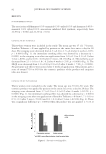
NEW TOPICAL COMBINATION ON SENSITIVE SKIN 85 DNA base damage (27). Xylitol is also moisturizing and inhibits SLS-induced irritation (28). Our results suggest that the association of rhamnose, mannitol, and xylitol inhibits the TNF-α-induced production of IL-8. Among infl ammatory cytokines that are released by keratinocytes, IL-8 is prominent and is especially involved in irritant dermatitis (29). Our results suggest that it is probably involved in the pathogeny of sensitive skins. REFERENCES (1) E. Berardesca, J. W. Fluhr, and H. I. Maibach, Sensitive Skin Syndrome (Taylor & Francis, New York, 2006), p. 281. (2) L. Misery, How skin reacts to environmental fa ctors. J. Eur. Acad. Dermatol. Venereol., 21(Suppl 2), 5–8 (2007). (3) M. A. Farage and H. I. Maibach, “Sensitive Ski n: New Findings Yield New Insights,” in Textbook of Cosmetic Dermatology, R. Baran and H. I. Maibach. Eds. (Informa Healthcare, London, 2010), p. 558. (4) D. Slodownik, J. Williams, A. Lee, B. Tate, an d R. Nixon, Controversies regarding the sensitive skin syndrome, Expert. Rev. Dermatol., 2, 579–584 (2007). (5) L. Misery, Sensitive skin and rosacea: Nosolog ic framework. Ann.Dermatol. Venereol., 138(Suppl 3), S207–S210 (2011). (6) M. A. Farage, A Katsarou, and H. I. Maibach, S ensory, clinical and physiological factors in sensitive skin: A review, Contact Derm., 55(1), 1–14 (2006). (7) L. Misery, Sensitive skin, Expert. Rev. Dermat ol., 8, 631–7 (2013). (8) C. Crawford and M. J. Zirwas, Laundry detergen ts and skin irritancy: A comprehensive review, Skin Med., 12, 23–31 (2014). (9) L. Misery, E. Myon, N. Martin, F. Verriere, T. Nocera, and C. Taieb, Sensitive skin in France: An epide- miological approach, Ann.Dermatol. Venereol., 132(5), 425–429 (2005). (10) L. Misery, S. Boussetta, T. Nocera, N. Perez- Cullell, and C. Taieb, Sensitive skin in Europe, J. Eur. Acad. Dermatol. Venereol., 23(4), 376–381 (2009). (11) L. Misery, V. Sibaud, C. Merial-Kieny, and C. Taieb, Sensitive skin in the American population: Preva- lence, clinical data, and role of the dermatologist, Int. J. Dermatol., 50(8), 961–967 (2011). (12) R. Kamide, L. Misery, N. Perez-Cullell, V. Si baud, and C. Taieb, Sensitive skin evaluation in the Japa- nese population, J. Dermatol.,40(3), 177–181 (2013). (13) M. A. Farage and H. I. Maibach. Sensitive ski n: Closing in a physiological cause, Contact Derm., 62, 137–149 (2010). (14) R. Jourdain, O. de Lacharrière, P. Bastien, a nd H. Maibach, Ethnic variations in self-perceived sensitive skin: Epidemiological survey. Contact Derm.,46, 162–169 (2002). (15) C. M. Willis, S. Shaw, O. de Lacharrière, M. B averel, L. Reiche, R. Jourdain, et al. Sensitive skin: An epidemiological study. Br. J. Dermatol., 145, 258–263 (2001). (16) M. W. Foster and R. R. Sharp, Race, ethnicity a nd genomics: Social classifi cations as proxies of biologi- cal heterogeneity. Genome Res., 12, 844–850 (2002). (17) J. W. Fluhr, R. Darlenski, and E. Berardesca, E thnic groups and sensitive skin: Two examples of special populations in dermatology. Drugs Discov. Today Dis. Mechanisms, 5, e249–e263 (2008). (18) C. Guinot, D. Malvy, E. Mauger, K. Ezzedine, J. Latreille, L. Ambroisine, et al., Self-reported skin sensitivity in a general adult population in France: Data of the SU.VI.MAX cohort, J. Eur. Acad. Der- matol. Venereol., 20(4), 380–390 (2006). (19) P. J. Frosch and A. M. Kligman, A method of app raising the stinging capacity of topically applied substances. J. Soc. Cosmet. Chem., 28, 197–209 (1977). (20) A. Y. Finlay and G. K. Khan, Dermatology Life Q uality Index (DLQI)—A simple practical measure for routine clinical use. Clin. Exp. Dermatol., 19, 210–216 (1994). (21) Y. Hongbo, C. L. Thomas, M. A. Harrison, M. S. Salek, and A. Y. Finlay, Translating the science of quality of life into practice: What do dermatology life quality index scores mean? J. Invest. Dermatol., 125(4), 659–664 (2005). (22) S. Stander, S. W. Schneider, C. Weishaupt, T. A . Luger, and L. Misery, Putative neuronal mechanisms of sensitive skin, Exp. Dermatol., 18(5), 417–423 (2009). (23) N. Branco, I. Lee, H. Zhai, and H. I. Maibach, Long-term repetitive sodium lauryl sulfate-induced ir- ritation of the skin: An in vivo study. Contact Derm. 53(5), 278–284 (2005).

JOURNAL OF COSMETIC SCIENCE 86 (24) A. Kligman, Human models for characterizing “se nsitive skin,” Cosmet. Dermatol., 14, 15–19 (2001). (25) G. Pauly, P. Moussou, L. L. Contet-Andonneau, L . Danoux, O. Freis, M. Sabadotto, et al., New peptidic active ingredient to reduce discomfort and painful sensations in sensitive skin. IFSCC Mag., 12, 25–30 (2009). (26) S. Palacio, J. Viac, A. Vinche, J. C. Huband, H . Gatto, and D. Schmitt, Suppressive effect of monosac- charides on ICAM-1/CD54 expression in human keratinocytes, Arch. Dermatol. Res., 289, 234–237 (1997). (27) E. Pelle, X. Huang, T. Mammone, K. Marenus, D. Maes, and K. Frenkel, Ultraviolet-B-induced oxida- tive DNA base damage in primary normal human epidermal keratinocytes and inhibition by a hydroxyl radical scavenger, J. Invest. Dermatol., 121, 177–183 (2003). (28) C. Korponyai, R. K. Kovács, G. Erös, S. Dikstei n, and L. Kemény. Antiirritant properties of polyols and amino acids, Dermatitis, 22, 141–146 (2011). (29) E. Corsini and C. L. Galli, Cytokines and irritant contact dermatitis, Toxicol. Lett., 102–103, 277–82 (1998).
Purchased for the exclusive use of nofirst nolast (unknown)
From: SCC Media Library & Resource Center (library.scconline.org)