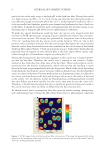
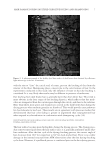
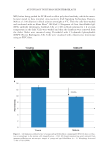
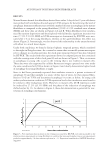
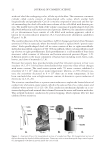
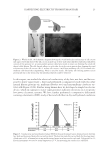
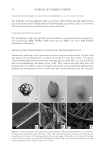
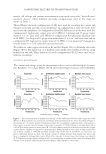
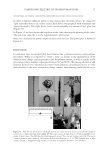
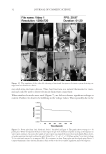
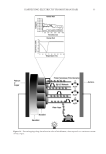
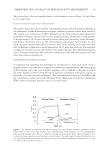
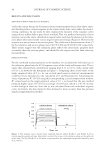
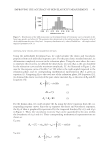
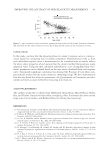
IMPROVING THE ACCURACY OF SKIN ELASTICITY MEASUREMENT 41 DEFINING NEW VISCOELASTIC PARAMETERS OF SKIN Using the individually determined tIPs, we could calculate the elastic and viscoelastic properties from each individual response curve. For the pure elastic standard material, its deformation completely recovers in the relaxation phase. Using the areas above the curve to represent this recovery, we defi ned the ideal elastic recovery (ER) as the area bordered by the relaxation curve and the maximum amplitude, Uf. As illustrated in Figure 2, the area for the response curve of Ecofl ex 5 at 500 mbar is the right-angled trapezoid in the relaxation phase, and its corresponding mathematical representation (RE) is given in equation (1). Comparing RE to the total area of the relaxation phase, R0 [equation (2)], we obtained the elastic recovery of the pure elastic material, ER, as the ratio of RE and R0 [equation (3)]. ( )dt 0 ( ) b E f R U e t = - (1) f R0 U b = (2) / 0 R E E R R = (3) For the human skin, we could calculate the ER using the above equations from the cor- responding response curves. Since the tIP separates the elastic and viscoelastic responses, the ER of skin is graphically represented by the trapezoid bordered by e(ta) and e(tIP) in Figure 1. Then, the viscoelastic recovery (VR) can be quantifi ed by the area within the boundaries of e(tIP) and e(t). Their corresponding mathematical representations are shown as: ER area: 0 ( ) ( ( ) ) dt tIP E f IP IP f R U e t b t U e t (4) VR area: ( ) ( ) dt b V IP tIP R e t e t (5) Figure 3. Distribution of the infl ection points (tIP) determined from 4234 response curves of people of dif- ferent age, gender, and ethnicity. The parameter was determined in the relaxation phase of response curves of cheek and forearm skin sites. Grey bars = frequency distribution of tIP values Dashed line = the single-valued empirical parameter of 0.1 s.

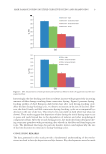
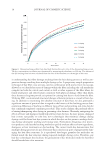
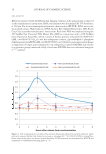
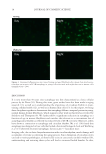
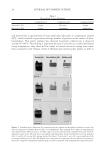
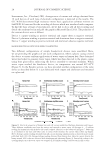
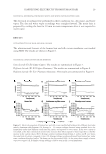
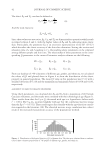
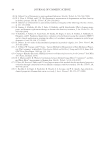
JOURNAL OF COSMETIC SCIENCE 42 The skin’s ER and VR can then be defi ned as: , 0 R R RV RE E V R R0 = = (6) And the total elasticity: R R TR E V = + (7) Since these values are area ratios, ER, VR, and TR are dimensionless quantities which result in values between 0 and 1, with the higher values of ER and TR indicating more elastic skin. Particularly, the parameter ER is an area-ratio representation of the R7 (Ur/Uf ) which describes the elastic recovery of the skin after distortion. Setting the suction and relaxation time of a and b equaling to 2 s, the resulting elastic parameters can be compared among different people and skin sites. The relationship of those parameters to the corre- sponding Q-parameters in the current Cutometer analysis software are the following: R0 = Q0, RE = QE, RV = QR, TR = Q1, ER = Q2, VR = Q3. From our database of 746 volunteers of different age, gender, and ethnicity, we calculated the values of Q2 and plotted them in Figure 4 to show the distribution of this elastic property in general population. The mean Q2 value in this population was 0.511 with a standard deviation of 0.146 and the maximum and minimum values of 0.858 and 0.186, respectively. AGE EFFECT ON SKIN VISCOELASTIC PROPERTIES Using the Q-parameters, we calculated skin ER and VR from a population of 463 female Caucasian volunteers, and the results were correlated with their chronological age (Figure 5). These results show that the ER or Q2 decreased with age in a logarithmic fashion with r2 = 0.664. The VR, Q3, increased slightly with age but the correlation was less strong than the ER (r2 = 0.5352). These results agree directionally with the age-elasticity correla- tion reported in the literature (18). The observed increase in age correlation was a direct result of the increased measurement accuracy of the Q-parameter method. Figure 4. Distribution of biological elasticity (Q2) of human skin. The data were obtained from a combina- tion of three volunteer populations of 746 people of different age, gender, and ethnicity.
Purchased for the exclusive use of nofirst nolast (unknown)
From: SCC Media Library & Resource Center (library.scconline.org)