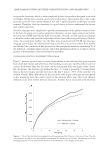
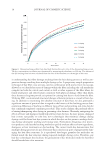
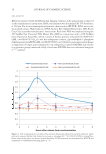
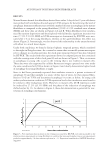
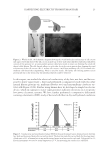
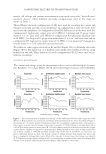
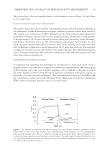
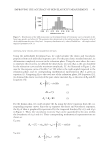
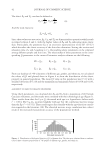
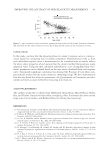
IMPROVING THE ACCURACY OF SKIN ELASTICITY MEASUREMENT 43 CONCLUSION In this study, we show that the relaxation phase of a mode 1 response curve is a more ac- curate region for calculating skin viscoelastic properties. Determination of the tIP from each individual response curve is demonstrated to be a method more accurately refl ects the skin’s elastic properties of each person than the current method that assumes a single empirical value. Using the thus calculated individual tIP, a set of simplifi ed skin visco- elastic parameters can be defi ned based on the area ratios calculated from each response curve. Statistically signifi cant correlation was obtained (by Pearson’s R test) when com- pared the Q2 results with the study volunteers’ chronological age. We have demonstrated that the area-based skin elasticity parameters, the Q-parameters in Cutometer, provide a simple and more accurate method for measuring skin elasticity. ACKNOWLEDGMENTS The authors would like to thank Greg Hillebrand, Rong Kong, Matt DePauw, Robin Ray, and Chithra Ganesan for their effort in helping collect Cutometer data from several large-scale clinical studies, and Barbara Olson for editing the manuscript. REFERENCES (1) V. Couturaud, J. Coutable, and A. Khaiat, Skin biomechanical properties: in vivo evaluation of infl uence of age and body site by a non-invasive method. Skin Res. Technol., 1, 68–73 (1995). (2) P. Elsner, D. Wilhelm, and H. Maibach, Mechanical properties of human forearm and vulvar skin. Br J. Dermatol., 122, 607–614 (1990). (3) A. Cua, K. Wilhelm, and H. Maibach, Elastic properties of human skin: relation to age, sex, and ana- tomical region. Arch Dermatol. Res., 282, 283–288 (1990). (4) G. E. Pierard, F. Henry, D. Castelli, and G. Ries, Ageing and rheological properties of facial skin in woman. Gerontology, 44, 159–161 (1998). (5) N. Krueger, S. Luebberding, M. Oltmer, M. Streker, and M. Kerscher, Age-related changes in skin mechanical properties: a quantitative evaluation of 120 female subjects. Skin Res. Technol., 17, 141–148 (2011). (6) H. S. Ryu, Y. H. Joo, S. O. Kim, K. C. Park, and S. W. Youn, Infl uence of age and regional differences on skin elasticity as measured by the Cutometer. Skin Res. Technol., 14, 354–358 (2008). (7) B. C. Murray and R. R. Wickett, Sensitivity of Cutometer data to stratum corneum hydration level. Skin Res. Technol., 2, 167–172 (1996). Figure 5. Age correlation of skin viscoelastic parameters from a panel of 463 female Caucasian volunteers. The solid dots are the values of elastic recovery (ER) of skin and the crosses are the viscoelastic recovery.

JOURNAL OF COSMETIC SCIENCE 44 (8) H. Dobrev, Use of Cutometer to assess epidermal hydration. Skin Res. Technol., 6, 239–244 (2000). (9) H. S. Yoon, S. H. Baik, and C. H. Oh, Quantitative measurement of desquamation and skin elasticity in diabetic patients. Skin Res. Technol., 8, 250–254 (2002). (10) H. Dobrev, Use of Cutometer to assess dermal oedema in erysipelas of the lower legs. Skin Res. Technol., 4, 155–159 (1998). (11) H. Sumino, S. Ichikawa, M. Abe, Y. Endo, O. Ishikawa, and M. Kurabayashi, Effects of aging, meno- pause, and hormone replacement therapy on forearm skin elasticity in women. J. Am. Geriatr. Soc., 52, 945–949 (2004). (12) T. Kawakita, Y. Takano, N. Asano-Kato, M. Tanaka, M. Dogru, E. Goto, K. Tsubota, S. Takahashi, K. Fukagawa, and H. Fujishima, Quantitative evaluation of eyelid elasticity using the cutometer SEM575 and its clinical application in assessing the effi cacy of tacrolimus ointment treatment in eyelid atopic dermatitis. Cornea, 23, 468–471 (2004). (13) H. Dobrev, In vivo study of skin mechanical properties in psoriasis vulgaris. Acta. Derm. Venereol., 80, 263–266 (2000). (14) A. O. Barel, W. Courage, and P. Clarys, “Suction Method for Measurement of Skin Mechanical Proper- ties: The Cutometer” in Handbook of Non-Invasive Methods and the Skin, J. Serup and G. B. E. Jemec, Eds. (CRC Press, Boca Raton, 1995) pp. 335–340. (15) Courage + Khazaka Electronic GmbH, Information and Operating Instructions for the Cutometer® dual MPA 580. (Koln, Germany, 2014). (16) B. C. Murray and R. R. Wickett, Correlations between Dermal Torque Meter®, Cutometer®, and Der- mal Phase Meter® measurements of human skin. Skin Res. Technol., 3, 101–106 (1997). (17) P. Neto, M. Ferreira, F. Bahia, and P. Costa, Improvement of the methods for skin mechanical properties evaluation through correlation between different techniques and factor analysis. Skin Res. Technol., 19, 405–416 (2013). (18) C. Escoffi er, J. de Rigal, A. Rochefort, R. Vasselet, J. L. Leveque, and P. G. Agache, Age-related me- chanical properties of human skin: an in vivo study. J. Invest. Dermatol., 93, 353–357 (1989).
Purchased for the exclusive use of nofirst nolast (unknown)
From: SCC Media Library & Resource Center (library.scconline.org)