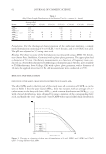
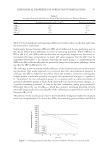
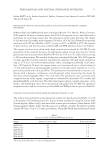
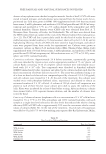
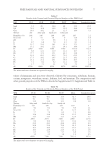
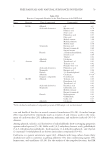
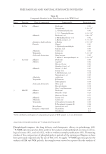
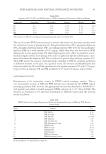
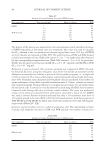
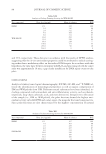
FREE RADICALS AND NATURAL SUBSTANCES IN PELOIDS 73 Seifert MZIV q/2q, Seifert Analytical, Berlin, Germany) and chemical analysis (ICP-MS, Thermo X Series II). PREPARATION OF POLAR AND NONPOLAR FRACTIONS OF DM AND WM PELOIDS: GENERAL PROCEDURE WM and black mud (BM) peloids were centrifuged (Rotofi x 32A, Hettich, Berlin, Germany 6000 rpm for 20 min) to remove water, dried (48 h of exposure to air), and subjected to trituration in a porcelain mortar. For the preparation of the polar fractions, the sample (5.0 g) was treated in soxhlet with n-heptane (100 ml) at 40°C for 24 h, followed by sequential extraction with 200 ml of EtOAc at 60°C, acetone at 80°C, or MeOH at 80°C (the amount of polar extracts and the extraction yield for DM and WM peloids are given in Table I). The organic fractions were dried under high vacuum and analyzed by GC-MS. For the preparation of the nonpolar fractions, the appropriate sample (5.0 g) was placed in 250-ml glass beaker and macerated with MeOH (100 ml) for 24 h at 25°C under orbital stirring at 200 revolutions/min. The residual sludge was centrifuged (Rotofi x 32A 6000 rpm for 15 min), and the recovered solid was suspended in n-heptane (200 ml) under orbital stir- ring at 25°C for 14 h (200 revolutions/min). After centrifugation (Rotofi x 32A Centri- fuge, 6000 rpm for 20 min), the organic phase was concentrated (up to a fi nal volume of 1.5 ml) and loaded on a chromatography column (25 cm high with a diameter of 1.5 cm), previously packed with silica gel (SiO2). The purifi cation was performed in isocratic con- ditions with n-heptane, cyclohexane, and diisopropyl ether, monitoring the eluate by thin-layer chromatography (TLC). For each eluent the purifi cation was continued until complete elution of the organic compounds as evaluated by ultraviolet (UV)-visible and phosphomolybdic acid detection. The three fi nal organic phases, namely n-heptane, cyclo- hexane, and diisopropyl ether, were concentrated and analyzed by GC-MS (the amount of nonpolar extracts and the extraction yield for DM and WM peloids are given in Table II). ANALYSIS OF POLAR AND NONPOLAR DM AND WM FRACTIONS BY GC-MS The analyses were performed on the appropriate sample (10 mg) dissolved in EtOAc (1.0 ml) in the presence of 6-methoxy purine (0.1 mg) as internal standard, by using GC Varian 3900 (Varian-Agilent, Milan, Italy), associated with a mass-spectra analyzer Varian Saturn 2000 (Varian-Agilent, Milan, Italy). Specifi cations are as follows: column: FactorFour capillary column VF-5ms 30 m × 0.25 mm and software: Varian MS Work-Station-System-Control Table I Extraction Yield of DM and WM Polar Fractionsa Sample Amount of extract (mg) Extraction yield (%) DM-EtOAc 160 3.2 DM-Acetone 80 1.6 DM-MeOH 60 1.2 WM-EtOAc 38 0.8 WM-MeOH 50 1.0 WM-MeOH 40 0.8 a The extraction yield refers to 5.0 g of starting material.

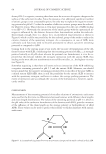
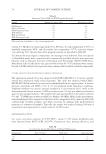
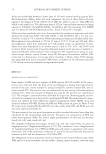
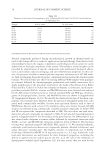
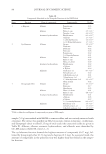
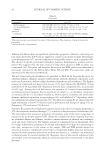
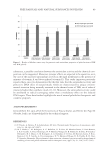
JOURNAL OF COSMETIC SCIENCE 74 version 6.9. Method: (a) mass range from 50 to 800 m/z, (b) trap temperature 150°C, (c) manifold temperature 80°C, and (d) transfer line temperature 247°C injection volume 1 μl, splitting 10%. Specifi c data of the program analysis are provided in Table III. To identify the main organic components, two strategies were followed. First, the spectra of identifi able peaks were compared with commercially available electron mass spectrum libraries such as National Institute of Standards and Technology (NIST) (NIST-Fison, Manchester, UK). In this latter case, spectra with at least 93–97% similarity were chosen. Second, GC-MS analysis was repeated using commercially available standard compounds. 31 P-NMR ANALYSIS OF PHOSPHOLIPIDS: GENERAL PROCEDURE The appropriate peloid (20 g) was extracted with CHCl3/MeOH (2:1 v/v ratio), and the solvent was evaporated under reduced pressure. The crude was extracted with CHCl3/ MeOH/KCl (Folch method) to concentrate phospholipids in the organic phase. A solvent mixture of pyridine and CDCl3 (1.6:1.0 v/v) was prepared under anhydrous conditions. Triphenyl methane was used as internal standard at a concentration of 0.1 mol/l in the aforementioned solvent mixture. Cr(III) acetylacetonate (15 mg) was added as relaxation agent to this standard solution. The sample (100 mg) was dissolved in the solvent solution (0.5 ml). 31 P-NMR spectra were recorded on a Bruker (400 MHz, Milan, Italy) spectrometer, and phospholipids were assigned on the basis of the comparison of the chemical shift with commercially available samples, and when necessary by spiking with predetermined quantities of commercial samples. Typically, the sample was analyzed during 180 min of acquisition time (equivalent to a mean value of 10,000 scans). ANTIOXIDANT ACTIVITY Test systems and culture conditions. L5178Y TK+/− clone (3.7.2C) mouse lymphoma cells were obtained from ATCC (CRL-9518™). Generation time, plating effi ciency, and Table II Extraction Yield of DM and WM Nonpolar Fractionsa Sample Amount of extract (mg) Extraction yield (%) DM-Heptane 20 0.4 DM-Cyclohenane 55 1.1 DM-Diisopropyl ether 50 1.0 WM-Heptane 33 0.7 WM-Cyclohenane 35 0.7 WM-Diisopropyl ether 30 0.6 a The extraction yield refers to 5.0 g of starting material. Table III Set of Data for the GC-MS analysis of DM and WM fractions Temperature Rate (°C/min) Hold (min) Total time (min) 50 – 3 3 280 10 5 31
Purchased for the exclusive use of nofirst nolast (unknown)
From: SCC Media Library & Resource Center (library.scconline.org)