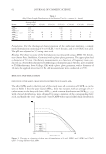
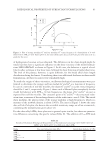
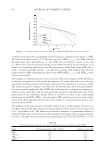
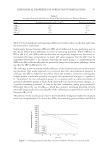
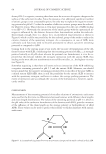
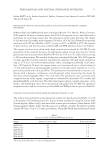
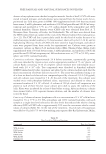
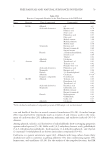
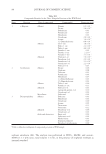
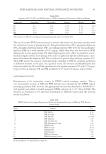
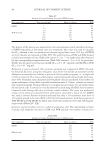
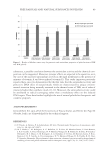
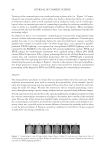
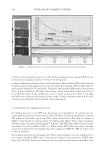
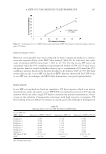
RHEOLOGICAL PROPERTIES OF SURFACTANT FORMULATIONS 63 Figure 3. Plot of storage modulus G′ and loss modulus G″ versus frequency of a formulation of 9 wt% SLES/3 wt% APB12/2 wt% NaCl (pH 5.5) the inset shows same data as Cole–Cole plot (the semicircle is a guide for the eyes). of hydrogenated coconut oil was obtained. The differences in the chain length might be small, but they have a signifi cant infl uence on the shear viscosity of the model formula- tions SLES/APB/NaCl as shown in Figure 2. In all cases, the behavior is typical of rod- like micelles: a plateau at low shear rates, followed by shear thinning at higher shear rates. The level of the plateau, however, is quite different, for the broad alkyl chain length distribution being the lowest. Considering there is no additional thickener in these model formulations, all their viscosities were remarkably high. To study the origin of these viscosities, oscillatory rheological measurements were per- formed to determine the storage and loss moduli G′ and G″ as a function of frequency. In case of a network of rod-like micelles, the slopes G′ and G″ in a plot versus frequency should be 2 and 1, respectively. Figure 3 shows such a Maxwell plot exemplarily for the model formulation with APB12. At low frequencies, the slopes of G′ and G″ are just as expected for rod-like micelles. The crossover point of G′ and G″—aka structural relax- ation time, a measure of the exchange kinetics of the surfactants—was 0.5 Hz. The initial shear modulus, the plateau value of the storage modulus at high frequencies, which is a measure of the network density, is about 190 Pa. The inset in Figure 3 shows the same data as Cole–Cole plot the data in the accessible sensitivity range are all on a semicircle, confi rming the interpretation given above (2). For the other alkyl APBs, these plots are in general quite similar, but there are quantita- tive differences concerning the specifi c values (Table II). The addition of C14-APB leads Table II Results of Oscillatory Rheological Measurements of Formulations Containing 9 wt% SLES/3 wt% of APB/2 wt% NaCl (pH 5.5) for Different Alkyl APBs Name Structural relaxation time (Hz) Initial shear modulus G′ (Pa) APB12 0.50 190 APB12/14 0.35 220 APB8/10 + 12/18 0.72 145 APBcoco 0.50 160

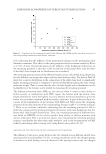
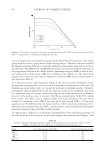
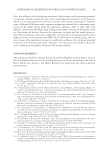
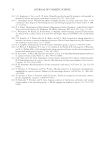
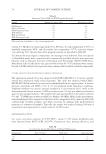
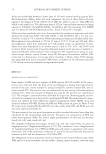
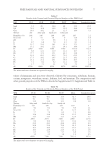
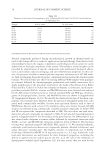
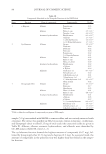
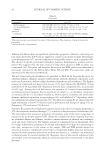
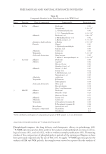
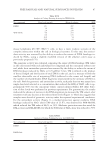
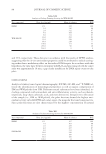
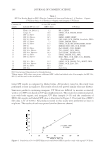
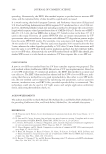
JOURNAL OF COSMETIC SCIENCE 64 Table III Streaming Potential and Isoelectric Point of Micellar Solutions of Different Alkyl APBs Name Streaming potential at pH 5.5 (mV) Isoelectric point (pH) APB12 129 6.57 APB12/14 400 6.78 APB8/10 + 12/18 62 6.08 APBcoco 232 6.25 to slower exchange kinetics and higher initial modulus as compared to the pure C12-APB. The fastest relaxation time of 0.72 Hz was found for APB8/10 + 12/18 , the APB with the broadest alkyl chain distribution, i.e., the APB with the highest content of C8- and C10-APB this is also the material leading to the lowest low-shear viscosity (Figure 2). It seems to be reasonable that this is caused by the presence of the short-chain APB, since a chain—as well as rod-like micelle—can only be as strong as the weakest link. Accord- ingly, both the APBs containing the short-chain APB (APB8/10 + 12/18 and APBcoco) have lower initial moduli. The changes in exchange kinetics, however, are not suffi cient to explain all the differences in rheological properties of the model formulations. To study their root cause, we mea- sured the streaming potential of micellar solutions of the betaines as a function of pH. The results are given in Figure 4 and Table III. All four betaines show the typical behav- ior of zwitterionic surfactants like CAPB the surfactants have a negative streaming po- tential at basic pH values and become positively charged at low pH values due to the protonation of the carboxylate group. There is, however, an effect of the chain length distribution on the IEPs: APB12/14 has the highest IEP, and the two betaines with a rather broad alkyl chain distribution have the lowest tendency to become protonated as indi- cated by the low IEPs. The infl uence of the chain length on the pKa of fatty acids is already known. Kanicky et al. (18) have reported that pKa increases as chain length increases, from 6.4 for octanoic acid to 8.7 for palmitic acid. The behavior for betaines, however, is signifi cantly shifted to lower pH values due to the presence of the quaternized nitrogen and its strong inductive (−I) effect. The pKa of the natural betaine trimethylglycine (CH3)3N+CH2COO− is 2.351 Figure 4. Streaming potential of micellar solutions of different alkyl APBs as a function of pH.
Purchased for the exclusive use of nofirst nolast (unknown)
From: SCC Media Library & Resource Center (library.scconline.org)