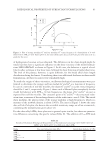
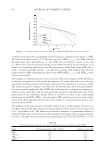
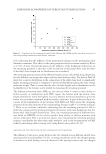
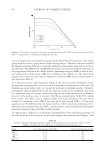
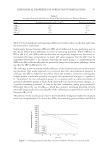
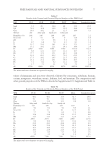
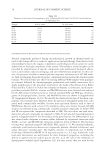
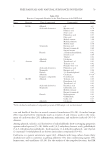
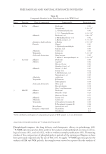
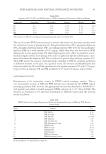
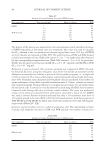
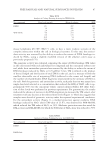
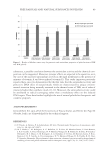
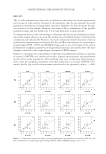
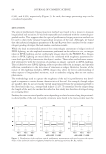
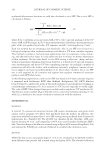
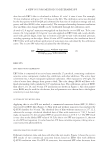
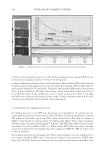
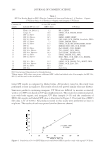
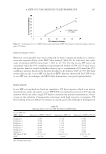
LONGITUDINAL STRIATIONS OF THE NAIL 97 RESULTS The 33 nails evaluated were selectively included into the analysis to evenly represent the entire range of ridge severity. Because of this sampling, they do not represent the usual population distribution of longitudinal striations therefore, we did not report descrip- tive statistics on this sample. However, the range of Ra is informative of the possible population range and was found to be 2.0–10 μm from least to most extreme. A comparison between the cosmetologist evaluations and the optical profi lometry meth- ods on this sample allows us to verify the validity of each method. Figure 2 illustrates the correlations and indicates the Pearson’s r for each comparison between measures of optical profi lometry measurements of striations (Ra, Rq, and Rz) and measures of cosmetologist- graded ridges (PPOL, XPOL, and PRIMOS images and in vivo). Ultimately, of the optical profi lometry roughness parameters of longitudinal striations, Ra and Rq were the most strongly correlated to the cosmetologist assessment of PPOL images. Further, to determine the repeatability of this optical profi lometry method, an analysis of variance (ANOVA) was conducted on three separate measurement trials performed on the entire study population. The resulting data sets, comprising three measure- ment trials per roughness parameter, were then subjected to a one-way ANOVA. Ulti- mately, the Ra, Rq, and Rz measurements were found to be repeatable, with p = 0.960, Figure 2. Comparison between measures of optical profi lometry measurements of striations (Ra, Rq, and Rz) and measures of cosmetologist-graded ridges (PPOL, XPOL, PRIMOS images, and in vivo).

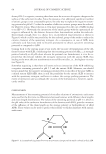
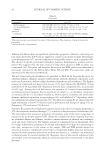
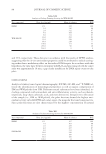
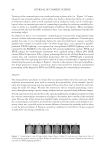
JOURNAL OF COSMETIC SCIENCE 98 0.963, and 0.956, respectively (Figure 3). As such, the image processing step can be considered repeatable. DISCUSSION The optical profi lometry fringe projection method was found to be a means to measure longitudinal nail striations. It was both repeatable and correlated with the cosmetologist- graded results. This suggests that the optical profi lometry fringe projection method can be used to objectively measure longitudinal striations of the nail. Although, we found that the industrial roughness parameters of Ra and Rq were best correlated to the cosme- tologist grading of ridges, Rz had similar correlation results. While the fi nal recommended protocol for cosmetologist assessment of ridges involved PPOL lighting, we also explored assessments performed on the subject in vivo, on images taken in XPOL lighting, and on visible-light images taken by the PRIMOS Pico. Images taken in PPOL lighting are most likely to be correlated with roughness parameters be- cause both specifi cally characterize the object’s surface. These other methods were reason- able alternatives with the exception of grading on images captured in XPOL lighting. This is likely because XPOL lighting reduces specular refl ection in images, and specular refl ection contributes to the detection of striations or ridges. However, because of the nature of this lighting modality, XPOL images may allow for better understanding of other aspects of longitudinal striations, such as underface ridging that are not surface phenomena. The methodology used to capture the roughness of the nail via profi lometry was devel- oped in response to certain known characteristics of the nail. For example, though ridges are parallel, they do not necessarily extend uninterrupted from the proximal nail fold to the distal nail edge (e.g., sausage-link ridges) (2,4,5). To normalize for the ridges along the length of the nail, the method described in this study was therefore developed using an averaging fi lter. Further, the cross-sectional profi le varies depending on their location along the proximal- to-distal profi le of the nail. Generally, striations were found to be more evident near the Figure 3. Distribution of the triplicate optical profi lometry measurement trials used to assess the repeat- ability of the industrial surface roughness parameters for measuring striations Ra, Rq, and Rz.
Purchased for the exclusive use of nofirst nolast (unknown)
From: SCC Media Library & Resource Center (library.scconline.org)