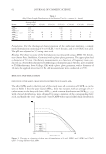
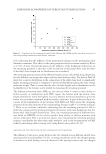
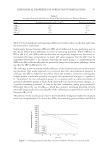
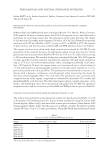
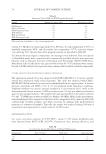
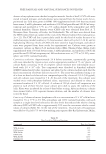
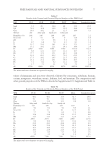
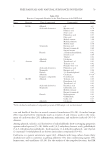
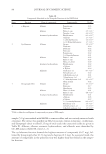
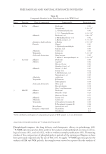
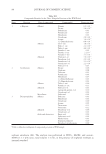
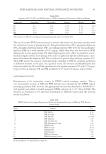
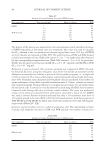
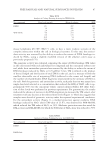
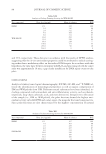
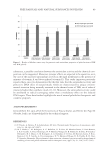
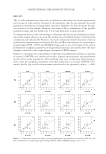
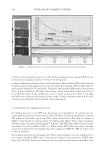
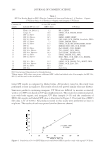
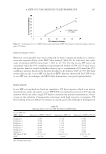
RHEOLOGICAL PROPERTIES OF SURFACTANT FORMULATIONS 67 Table V Streaming Potential and Isoelectric Point of Micellar Solutions of Different Betaines Name Streaming potential at pH 5.5 (mV) Isoelectric point (pH) APBcoco 232 6.25 AEBcoco -887 3.5 APB12/14 400 6.78 AB12/14 510 9 Figure 7. Streaming potential of micellar solutions of different betaines as a function of pH. Table V reveal signifi cant and surprising differences between these on the fi rst sight sim- ilar zwitterionic surfactants. Surprisingly, the two betaines APB and AEB, which differ only by one methylene unit in the spacer, behave quite differently in terms of streaming potential. While APB has its IEP at pH 6.25, the AEB yields micelles that are negatively charged over the entire in- vestigated pH range extrapolation to lower pH values suggests that the IEP must be somewhere below pH 3.5. In contrast, removing the amide group, i.e., transforming the APB to an AB, yields micelles that are positively charged over the entire pH range, mean- ing that the IEP of AB must be 9. The challenge is now to understand this infl uence of the chemical structure on the stream- ing potential. One useful approach is to envision how this electrochemical property is achieved. The IEP is defi ned as the pH at which the numbers of positive and negative charges within a molecular assembly are equal each quaternized nitrogen is “equalized” or “neutralized” by one carboxylate group. In a situation with an identical number of quat and carboxylate groups to begin with, there will be an excess of cationic charges, i.e., a positive streaming potential, as soon as the fi rst carboxylate group gets protonated. Obviously, this is the case for AB12/14, which has a positive streaming potential over the entire pH range studied, because the pKa of the carboxylate is reported to be as low as 1.8 [for pure AB12 (19)]. The presence of the amide group close to the hydrophilic headgroup makes the situation much less straightforward. In case of the APBs, the streaming potential above the IEP at

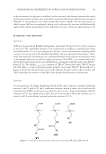
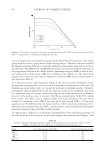
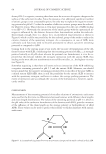
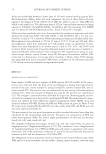
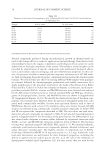
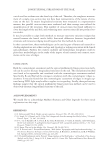
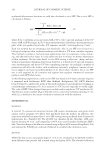
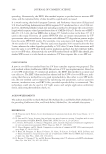
JOURNAL OF COSMETIC SCIENCE 68 about pH 6.5 is negative, meaning that there must be an excess of negative charges at the surface of the surfactant micelles. Since the presence of an additional signifi cant number of anionic groups is not a reasonable option, the only way to explain the negative stream- ing potential at pH of 7 is that the number of effective cationic groups must be reduced, for whatever reason. This reduction is even more pronounced in the case of AEB, leading to an IEP 3.5. Obviously, the interaction of the amide group with the quaternized ni- trogen is infl uenced by the distance between these functionalities within the molecule. Interestingly enough, there is a chance for a six-membered ring formation as shown in Figure 8, which could be one possibility for the carbonyl group of the amide to reduce the cationic character of the quaternary nitrogen. As a consequence, in case of AEB, more carboxylic acid functions need to become protonated to obtain a positive streaming potential as compared to APB. Coming back to the starting point of our study, the viscosity of formulations of the dif- ferent betaines with SLES, considering that the streaming potential of AB12/14 is strongly positive basically at all pH values relevant for personal care formulations, it is to be ex- pected that this betaine exhibits the strongest interaction with the anionic SLES, thus leading to the most effi cient transformation to rod-like micelles, i.e., the highest viscosity (see Figure 6). Somewhat surprising is that there still seems to be an interaction of the AEB exhibiting a negative streaming potential at pH 5.5 and the anionic SLES. However, one should keep in mind that the negative streaming potential refers to micelles of the pure AEB in a mixed system SLES/AEB, there is still the possibility for the anionic SLES to interact with the quaternary nitrogen, and hence to reduce the average packing parameter. The extent of interaction and accordingly the viscosity of the formulation is, however, signifi - cantly smaller. CONCLUSION Measurements of the streaming potential of micellar solutions of zwitterionic surfactants were used for the fi rst time to differentiate between betaines with different chain lengths and chain length distributions. The values of the streaming potential at pH 5.5, which is the pH value of the surfactant formulations of the betaines with SLES, provide a measure of the infl uence of the chain length on the average polarity or hydrophilicity of alkyl APBs. These values can be used to predict their ability to thicken mixtures with anionic surfactants. Figure 8. A six-membered ring formed between the quaternary nitrogen and the amide carbonyl in alkyl AEB.
Purchased for the exclusive use of nofirst nolast (unknown)
From: SCC Media Library & Resource Center (library.scconline.org)