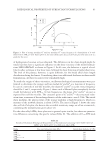
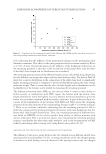
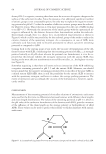
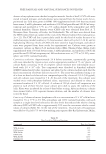
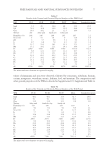
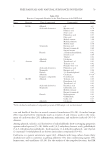
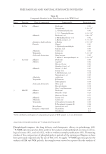
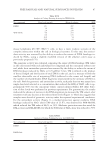
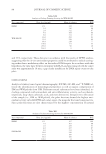
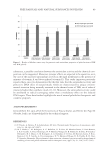
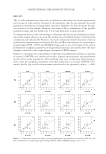
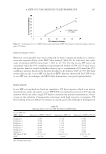
RHEOLOGICAL PROPERTIES OF SURFACTANT FORMULATIONS 65 Figure 5. Correlation of the streaming potential of the different alkyl APBs and the zero shear viscosities of the corresponding formulations with anionic surfactant. (19), indicating that the infl uence of the quaternized nitrogen on the protonation equi- librium is immense. This effect of the quat group has also been shown earlier by Weers et al. (20). A more detailed discussion on the infl uence of the headgroup architecture on the streaming potential is the topic of the second part of this paper here, only the effect of the alkyl chain length and its distribution are considered. The streaming potential values of the different betaines are not only shifted along the pH axis but also different concerning their slopes and thus their absolute values. The data in Table III show that a narrow distribution in the composition of the alkyl chain leads to signifi cantly higher streaming potentials as compared to the broad distribution having the same average molecular weight. Thus, it seems that the effect of chain length and its distribution on the hydrophilicity of the betaines can be probed by measuring the streaming potential. The differences between these APBs are also obvious when it comes to their ability to build viscosity in combination with SLES. Again, the betaine with the narrow chain length distribution yields the highest viscosity, whereas the broad distribution gives the lowest viscosity when combined with the anionic surfactant. A plot of the zero shear vis- cosities of the formulations of the betaines with SLES and NaCl versus the streaming potential of micellar solutions of the corresponding betaines at pH 5.5 is shown in Figure 5. There is an excellent correlation, indicating that the streaming potential is able to probe the average polarity/packing parameter of betaines with same headgroups but dif- ferent alkyl chain length distributions. Thus, the streaming potential of different beta- ines based on DMAPA can be used to predict their ability to thicken mixtures with anionic surfactants. This is an attractive option, since measuring the streaming potential requires considerably less effort than other methods, such as the determination of CMC either by measuring surface tension or by using fl uorescence probes (21,22). INFLUENCE OF THE STRUCTURE OF THE HEADGROUP OF THE BETAINES The infl uence of the spacer group between the two charged sites in ABs has already been investigated by several authors (23–25). A strong interaction of the two charged groups in betaines via back folding was only observed if the spacing between the two charged

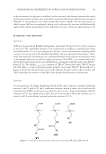
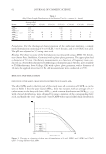
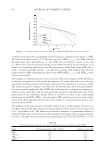
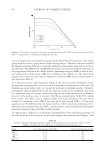
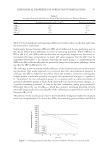
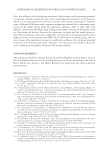
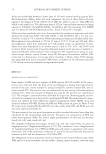
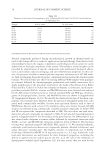
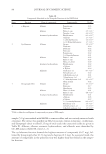
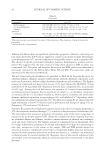
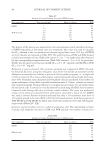
JOURNAL OF COSMETIC SCIENCE 66 sites was longer than 10 methylene groups (20,26). However, the interaction of an amide group with the cationic group has not been investigated yet. Therefore, we have modifi ed the headgroups of the betaines to study the infl uence of the amide group and its position. In addition to the APBs based on DMAPA discussed so far, betaines with an ethyl instead of a propyl spacer between the amide and the quaternary nitrogen (AEB) as well as beta- ines without the amide group (AB) were synthesized (see Figure 1). The alkyl chain lengths were chosen to allow direct comparisons with the APBs used in the fi rst part of this study (see Table I). As it becomes obvious when looking at Figure 6, the structure of the hydrophilic head- group has an enormous effect on the viscosity of formulations with anionic surfactant. All formulations again behave like it is typical for networks of rod-like micelles. However, reducing the spacer length between the two nitrogen atoms by one methylene unit leads to a signifi cant drop in viscosity, whereas leaving out the amide group leads to dramatic increase in the plateau value of viscosity. Oscillatory measurements (Table IV) confi rm these results. The AB12/14 has a slightly higher structural relaxation time and initial modulus as compared to the APB of the same alkyl chain length APB12/14. Even more signifi cant are the differences for the betaine with an ethyl instead of a propyl spacer be- tween the two nitrogen atoms the AEBcoco has the lowest initial modulus and the highest structural relaxation time of all the betaines studied. To explain these differences in rheology, measurements of the streaming potential of micellar solutions of the betaines were performed again the results shown in Figure 7 and Table IV Results of Oscillatory Rheological Measurements of Formulations Containing 9 wt% SLES, 3 wt% of APB/2 wt% NaCl (pH 5.5) for Betaines with Different Headgroup Structures Name Structural relaxation time (Hz) Initial shear modulus G′ (Pa) APBcoco 0.50 160 AEBcoco 1.15 110 APB12/14 0.35 220 AB12/14 0.46 245 Figure 6. Viscosity as a function of shear rate of formulations of 9 wt% SLES/3 wt% betaine/2 wt% NaCl (pH 5.5) using betaines with different headgroup structures.
Purchased for the exclusive use of nofirst nolast (unknown)
From: SCC Media Library & Resource Center (library.scconline.org)