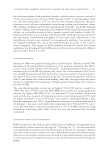
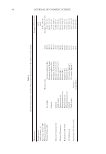
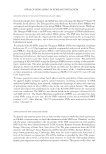
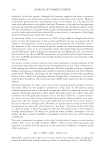
PHARMACEUTICALLY OPTIMIZED TOPICAL NANOGEL FORMULATION 57 appeared when the pH of mixture was adjusted to 5.4–5.95. This was because when the pH was below 4.7, which is the isoelectric point of BSA (28), there was electrostatic re- pulsion between positively charged BSA and well-protonated CS, preventing the aggre- gation of denatured BSA. When the pH was adjusted within the range of 5.0–5.6, negatively charged BSA combined with the protonated CS. With the pH continuing to increase, the positive charge of CS decreased and the negative charge of BSA increased so that electrostatic attraction occurred between CS and BSA and the chain of CS clustered, leading to the formation of NPs. Taking into particle size distribution, the PI, and scat- tering light intensity into consideration, the optimal pH for the formation of NPs was between 5 and 6. The pH measurement results of the formulations without vitamin C active substance loading are shown in Table IV. Figure 3. Flow curves of the formulations at 25°C.

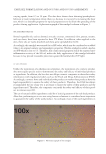
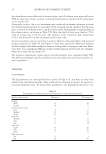
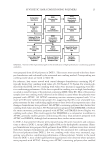
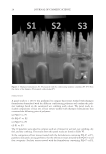
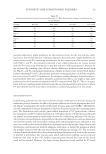
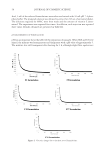
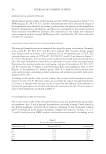
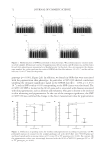
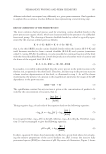
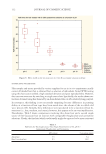
JOURNAL OF COSMETIC SCIENCE 58 MORPHOLOGICAL ANALYSIS WITH AFM Morphological imaging studies of the formulations with AFM are presented in Figure 1. For AFM imaging, F1, F9, F19, F27, and F31 formulations were used. 2D and 3D images of the formulations were obtained. According to these results, the particles in the formulation showed a homogeneous distribution, and their size corresponds to the results obtained when measured with Malvern Zetasizer. The consistency of the results was confi rmed when compared with the nanogel AFM images of Lee and Akiyoshi (29). The results thus proved to be consistent. VARIATION OF SHEAR RATE DUE TO OPTIMUM FORMULATIONS The nanogel formulations were examined rheologically using a rheometer. Formula- tions coded F1, F9, F19, F27, and F31 were studied. The viscosity change graphs were drawn based on the fl ow curve and shear rate of the formulations at 25°C. The viscosity-shear rate values of 25°C for F1, F9, F19, F27, and F31 are shown in Figure 2. As seen in the graphs, the viscosity of all conditions decreased with increasing shear rate. Gel-type formulations must have an optimum viscosity value and appropriate fl ow properties during production, packaging, and use. Formulations F9, F19, F27, and F31 were found to exhibit a non-Newtonian fl ow of pseudoplastic fl ow at 25°C (Figure 3). Formulation F1 showed plastic fl ow. It is found in the literature that semi-solid systems containing polymer solutions and polymers generally show pseu- doplastic fl ow (30). Ac cording to the results of the viscosity studies, the viscosity of the formulation was be- tween 6.53 and 14.0 cP. These low values are acceptable for topical nanogel formulations (31), but it is thought that viscosity can be increased by the addition of the polymer to increase the permanence on the skin and hence the retention time (32). Th e viscosity re- sults of the formulations are shown in Table V. IN VITRO RELEASE STUDIES OF NANOGELS The in v itro release study of the selected formulations was fi rst performed using the dialy- sis membrane. And, 2 mL of nanogel formulations containing vitamin C were placed in the dialysis membrane, and 100 mL of solution containing 10 mL of ampoule solution (pH 7.4) was placed in the dialysis membrane. Samples were taken at 30 min, 1, 2, 3, 4, 5, and 6 h and given for HPLC analysis, and results were obtained. According to the Table V Viscosity Results of Formulations Formulation code Temperature (°C) Viscosity (cP) F1 23.2 6.53 F9 23.1 12.3 F19 23.1 10.2 F27 23.0 11.6 F31 23.3 14.0
Purchased for the exclusive use of nofirst nolast (unknown)
From: SCC Media Library & Resource Center (library.scconline.org)