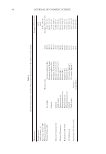
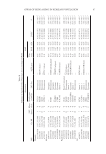
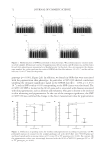
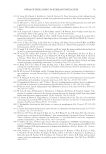
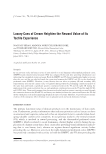
JOURNAL OF COSMETIC SCIENCE 76 characteristics, and many previous studies have reported melanin-related genes and gene mutations. In addition, differences and correlations between genes involved in pigmenta- tion have been reported (17). In the present study, we identifi ed new candidate loci, TSN1, RUFY4, NCLN, and CDC42BPA, as well as the previously reported OCA2 gene, which is associated with various skin pigment-related diseases, such as albinism (13) and melanoma (50). In particular, an amino acid substitution (His615Arg) found in Asian populations has been reported to present at a high prevalence in cases of skin whitening and pigment changes (13). According to our results, rs74653330 is a missense (Ala481Thr) SNP that is re-associated with pigmentation in the East Asian population (31,32). Although the other genes are not functionally related to genes that directly affect melanin or skin tone, TSN1 encodes collagen-associated intercellular adhesion proteins (51), and RUFY4 causes skin infl ammatory responses (52). NCLN and CDC42BPA are not reported to be associated with pigmentation of the skin. However, our single-tissue eQTLs show differences in genotype expression in skin tissue. This suggests that our analysis and results are reproducible com- pared with previous studies, which indicates accuracy of our correlation model with skin measurements and suggests that we used effective analytical methods. OIL CONTENT Oil forms a protective fi lm on the skin to prevent various problems, such as water evapo- ration and infection. However, when various factors result in abnormal control of oil content, problems such as infl ammation, acne, and sebaceous gland hypersecretion may occur (53). In general, the amount of oil in the skin decreases with aging, which causes the skin to lose elasticity, moisture content, and dryness (54). In addition, recent studies have reported that skin diseases can be caused by excessive oil and that air pollutants may be absorbed by skin oil that can adversely affect skin health. As such, oil acts as a source of protection for the skin and prevents skin aging, in addition to preserving the moisture content (55). Therefore, rs308971, rs9577919, rs8107564, and rs6490805, which are associated with skin oil, may cause skin changes. The most signifi cant SNP in our analy- sis was rs908971, which is located at intron 1 of the SYN2 gene. Traditionally, SYN2 is associated with neurotransmitters (56). Recently, the association between the lipid me- tabolism and the SYN2 gene has been reported (57). Based on this, SYN2 is involved in the synthesis of synaptic vesicles and is associated with the formation of lipids and apoli- poproteins (58), which may affect the formation of lipids in the body. There have also been reports of associations of SNPs with triglycerides (57), which may lead to associa- tions in the lipid metabolism and further suggests that it is a process that can have a measurable effect on the skin. Furthermore, rs9577919 is located in intron 1 of GAS6, which mediates the infl ammatory response and affects the development of psoriasis (59). In addition, rs8107564 is located downstream of the INSR gene. Insulin receptors en- coded by INSR are involved in various mechanisms, including the regulation of infl am- mation (60), cancer development (61), and keratinocyte proliferation (62). Although rs6490805 shows a correlation with skin oil content, there are no relevant research re- ports or reported functional correlations. However, because single-tissue eQTLs show differences in expression levels in skin tissue according to genotype, potential oil abnor- malities can be inferred from observed skin changes. rs7334780, the SNP with the stron- gest signifi cance in sensitivity of the skin, is located in the intergenic region, and there is no gene present nearby therefore, further studies are needed to determine its function.

GWAS OF SKIN AGING IN KOREAN POPULATION 77 ACKNOWLEDGMENTS This research was fi nancially supported by the Ministry of Trade, Industry and Energy (MOTIE), and the Korea Institute for Advancement of Technology (KIAT) through the National Innovation Cluster R&D program (Development of the Fundamental Technology for Customized Cosmetics Industry Utilizing Big Data: P0006712). R EFERENCES ( 1) T. Hakozaki, C. L. Swanson, and D. L. Bissett. “Hyperpigmentation in aging skin,” in Textbook of Aging Skin, M. Farage, K. Miller, and H. Maibach. Eds. (Springer, Berlin, Heidelberg, 2015), pp. 1–10. ( 2) S. Akazaki, H. Nakagawa, H. Kazama, O. Osanai, M. Kawai, Y. Takema, G. Imokawa. Age-related changes in skin wrinkles assessed by a novel three-dimensional morphometric analysis. Br J Dermatol 147 689–695 (2002). ( 3) C. Endo, T.A. Johnson, R. Morino, K. Nakazono, S. Kamitsuji, M. Akita, M. Kawajiri, T. Yamasaki, A. Kami, Y. Hoshi, A. Tada, K. Ishikawa, M. Hine, M. Kobayashi, N. Kurume, Y. Tsunemi, N. Kamatani, M. Kawashima. Genome-wide association study in Japanese females identifi es fi fteen novel skin-related trait associations. Sci Rep 8 8974 (2018). ( 4) J. Axelsson, T. Sundelin, M. Ingre, E.J.W. Van Someren, A. Olsson, M. Lekander. Beauty sleep: Ex- perimental study on the perceived health and attractiveness of sleep deprived people. BMJ 341 1–5 (2010). ( 5 ) A.K. Dąbrowska, C. Adlhart, F. Spano, G.-M. Rotaru, S. Derler, L. Zhai, N.D. Spencer, R.M. Rossi. In vivo confi rmation of hydration-induced changes in human-skin thickness, roughness and interaction with the environment. Biointerphases 11 031015 (2016). (6 ) S.I. Jang, M. Lee, J. Han, J. Kim, E. Kim, A.R. Kim, J. Soo, A. Jin, O.P. Beom, J. Kim. A study of skin characteristics with long - term sleep restriction in Korean women in their 40s. 1–7 (2019) doi:10.1111/ srt.12797. (7) J . Krutmann, A. Bouloc, G. Sore, B. A. Bernard, and T. Passeron, The skin aging exposome, J. Dermatol. Sci., 85, 152–161 (2017). (8) M. Li, A. Vierkötter, T. Schikowski, A. Hüls, A. Ding, M.S. Matsui, B. Deng, C. Ma, A. Ren, J. Zhang, J. Tan, Y. Yang, L. Jin, J. Krutmann, Z. Li, S. Wang. Epidemiological evidence that indoor air pollution from cooking with solid fuels accelerates skin aging in Chinese women. J Dermatol Sci 79 148–154 (2014). (9) C . Marionnet, C. Tricaud, and F. Bernerd, Exposure to non-extreme solar UV daylight: spectral charac- terization, effects on skin and photoprotection, Int. J. Mol. Sci., 16, 68–90 (2015). (10) K. Pezdirc, M. Hutchesson, R. Whitehead, G. Ozakinci, D. Perrett, C.E. Collins. Can dietary in- take infl uence perception of and measured appearance? A Systematic Review. Nutr Res 35 175–197 (2015). (11) T. Sundelin, M. Lekander, G. Kecklund, E.J.W. Van Someren, A. Olsson, J. Axelsson. Cues of Fatigue: Effects of Sleep Deprivation on Facial Appearance. Sleep 36 1355–1360 (2013). (12) P. Sulem, D.F. Gudbjartsson, S.N. Stacey, A. Helgason, T. Rafnar, M. Jakobsdottir, S. Steinberg, S.A. Gudjonsson, A. Palsson, G. Thorleifsson, S. Pálsson, B. Sigurgeirsson, K. Thorisdottir, R. Ragnarsson, K.R. Benediktsdottir, K.K. Aben, S.H. Vermeulen, A.M. Goldstein, M.A. Tucker, L. A. Kiemeney, J.H. Olafsson, J. Gulcher, A. Kong, U. Thorsteinsdottir, K. Stefansson. Two newly identifi ed genetic determinants of pigmentation in Europeans. Nat Genet 40 835–837 (2008). (13) P. Sulem, D.F. Gudbjartsson, S.N. Stacey, A. Helgason, T. Rafnar, K.P. Magnusson, A. Manolescu, A. Karason, A. Palsson, G. Thorleifsson, M. Jakobsdottir, S. Steinberg, S. Pálsson, F. Jonasson, B. Sigurgeirsson, K. Thorisdottir, R. Ragnarsson, K.R. Benediktsdottir, K.K. Aben, L.A. Kiemeney, J.H. Olafsson, J. Gulcher, A. Kong, U. Thorsteinsdottir, K. Stefansson. Genetic determinants of hair, eye and skin pigmentation in Europeans. Nat Genet 39 1443–1452 (2007). (14) Y. Liu, W. Gao, C. Koellmann, S. Le Clerc, A. Hüls, B. Li, Q. Peng, S. Wu, A. Ding, Y. Yang, L. Jin, J. Krutmann, T. Schikowski, J.-F. Zagury, S. Wang. Genome-wide scan identifi ed genetic variants associ- ated with skin aging in a Chinese female population. J Dermatol Sci 96 42–49 (2019). (15) M.R. Choi, J.M. Shin, Y.A. Shin, Y.H. Chang, M.Y. Chang, C.A. Lim, K.C. Sohn, Y.J. Seo, C.D. Kim, J.H. Lee, Y. Lee. Possible role of single stranded DNA binding protein 3 on skin hydration by regulat- ing epidermal differentiation. Ann Dermatol 30 432–440 (2018).
Purchased for the exclusive use of nofirst nolast (unknown)
From: SCC Media Library & Resource Center (library.scconline.org)