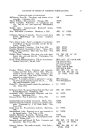
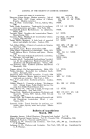
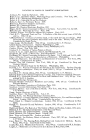
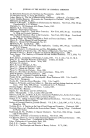
34 JOURNAL OF THE SOCIETY OF COSMETIC CHEMISTS useful in exploring glyceride behavior, specifically x-ray diffraction, are eminently suited for these non-glyceride materials. BIBLIOGRAPHY (1) N. D. Fulton, E. S. Lutton, and R. L. Wille, y. alm. Oil Chem. $oc. al, 98 (1954). (2) A. E. Bailey and E. A. Kraemer, Ibid. 21,251 (1944). (3) (a) R. W. Crowe and C. P. Smyth, 2 t. aim. Chem. $oc. 72, 4427 (1950). (b) R.W. Crowe and C. P. Smyth, lbid. 72, 5281 (1950). (c) R. W. Crowe and C. P. Smyth, Ibid. 7:t, 2040 (1950). (4) O.T. Quimby, 2 t. aim. Chem. $oc. 72, 5064 (1950). (5) A. E. Bailey, "Melting and Solidification of Fats," Interscience Publishers, Inc., New York (1950). (6) E. S. Lutton, 2 t. aim. Oil Chem. $oc. 27, 276 (1950). (7) (a) T. Malkin in "Progress in the Chemistry of Fats and Other Lipiris," Vol. I, Academic Press, Inc., New York (1952). (b) T. Malkin, Ibid., Vol. II (1954). (8) E. S. Lutton and F. L. Jackson, •t. aim. Chem. $oc. 72, 3254 (1950). (9) R. J. Howe and T. Malkin, 7. Chem. $oc. 7:t, 2663 (1951). (10) J. B. Martin, Ibid., 75, 5483 (1954). (11) E. S. Lutton, Ibid., 7:t, 5595 (1951). THE SEQUENCE OF EVENTS IN THE DEVELOPMENT OF AN ECZEMATOUS SENSITIZATION* By ADOLPH ROSTENB.SX % Jz., M.D. University of Illinois, Chicago, Ill. THE TYPE OF sensitization that ordinarily develops to ingredients used in cosmetics is the eczematous variety of the delayed type of allergic sensitization. The usual kind of substance which causes this type of sensitization to come into being is commonly referred to as a "simple chemical." To the immunochemist, this seemingly vague designation has a reasonably precise connotation. It denotes a compound whose structural configuration is known in contradistinction to a substance such as a pro- tein, for which the exact structural formula could not, at present, be determined. Now, if simple chemicals are the usual substances which en- gender this type of allergic sensitization, it is obvious that not any simple chemical will do otherwise, practically everything that is encountered would cause a sensitization. As is well known, there are many simple chemicals, e.g., water, salt, iron, etc., to which allergic eczematous sensitiza- tions never develop. In other words, the simple chemical must have a certain attribute. This is the ability to enter into some sort of union with a protein molecule (?) without too markedly disturbing its structure. The type of union which has been most thoroughly studied is the one in which a * Presented at the October 12, 1954, Meeting, Chicago, Ill.

DEVELOPMENT OF AN ECZEMATOUS SENSITIZATION 35 protein conjugate is formed such as by 2:4 dinitrochlorobenzene. Land- steiner and Jacobs (1) studied compounds of this type and came to the following conclusions: "In the case of a series of substituted benzenes (C1, NO•.) a connection between sensitizing capacity and lability of the C1 or NO2 groups has been shown, indicating the formation of conjugated antigens in the animal." This type of union is, of course, not the ony kind that might develop be- tween the simple chemical and the protein molecule. Gell, et aL (2), dis- cuss the various possibilities: "Many chemical compounds which act as sensitizers have one general feature in common: they are capable of reacting with a group or groups in the molecule of a protein to form a conjugate. A second type of sensitizer is not able itself to combine with protein, but may be metabol- ized in the body to a derivative possessing such powers of combination. There may be a third category of sensitizers which do not react chemi- cally but form strong adsorption complexes with protein. In any case the conjugate or adsorption complex so formed will become antigenically distinct from the parent protein, and if the sensitizer gains access to the tissues of an animal the proteins of the latter may be rendered antigenic." It is important to emphasize the point previously made that the union between the simple chemical and the protein molecule must not too seri- ously derange the structure of the latter. For example, sulfuric acid enters into a rather violent union with protein yet, no one has ever become allergically sensitized to sulfuric acid, and I would doubt that such is bio- logically possible because the reaction between the sulfuric acid and the protein so modifies the protein that it can no longer function as an antigenic entity. These remarks probably pertain equally to all strong acids and alkalies and possibly also apply to a wide variety of substances labeled as "primary irritants." On reflection, it is then seen that the eczematous variety of the delayed allergic sensitization differs from all other allergic sensitizations in at least one fundamental particular, namely, that in this one the full antigen is made in vivo and a constituent of the body partici- pates as a part of the antigenic complex. So far as I know, this is not true for any other form of allergic sensitization. These facts probably have important effects on the subsequent immunologic events and on the nature and location of the pathologic alterations. The exact site at which the protein conjugate is made is not known, but there are reasons to believe that it is ordinarily the epidermis. First, the usual mode of contact with eczematous sensitizers is by application to the skin consequently their method of entry is percutaneous. From a con- sideration of the points previously made as to their chemical reactivity, it is not reasonable to believe that these compounds could get very far into the system without entering into some sort of union with various con-
Purchased for the exclusive use of nofirst nolast (unknown)
From: SCC Media Library & Resource Center (library.scconline.org)