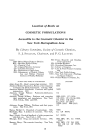
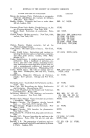
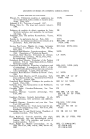
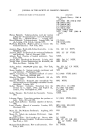
PHYSIOLOGY AND HISTOCHEMISTRY OF HAIR GROWTH 9 BIBLIOGRAPHY Lane, C. G., and Blank, I. H., "Cutaneous Detergents," y. Am. Med. Assoc., 118, 804 (1942). Blank, I. H., "Action of Soap on the Skin," Arch. Dermatol. and Syphilol., 39, 811 (1939). Kooyman, D. J., and Snyder, F. H., "Tests for Mildness of Soap," Ibid., 46, 847 (1942). Johnson, S. A.M., Kile, R. L., Kooyman, D. J., Whitehouse, H. S., and Brod, J. S., "Com- parisoh of Effects of Soaps and Synthetic Detergents on Hands of Housewives," Ibid., 68, 643 (1953). Pluss, J., "Uber die Bedentung der Synthetischen Wachschmittel als Eczematogene," Derma- tologica, 106, 186 (1953). Schwartz, L., Tulipan, L., and Peck, S. M., "Occupational Diseases of the Skin," Philadelphia, Lea and Febiger (1947). Rothman, S., "Physiology and Biochemistry of the Skin," Chicago, University of Chicago Press (1954). Johnson, S., Kile, R., Fliegelman, M., and Fix, J. C., "Differences in Skin Surfaces According to Age and in Age Groups by Subjective Methods," Proc. Sci. Sect. Toilet Goods Assoc., No. 16 (1951). Blank, I. H., "Factors Which Influence the Water Content of the Stratum Corneum," •. In- vestigative DermatoL, 18, 433- (1952). Gaul, L. E., and Underwood, G. B., "Relation of Dewpoint and Barometric Pressure to Chapping of Normal Skin," Ibid., 19, 9 (1952). Van Scott, E. J., and Lyon, J. B., "A Chemical Measure of the Effect of Soaps and Detergents on the Skin," Ibid., 21, 199 (1953). Sharlit, H., and Sheer, M., "The Hydrogen Ion Concentration of the Surface on the Healthy Intact Skin," Arch. Dermatol. and Syphilol., 7, 592 (1923). Burckhardt, W., "Neuere Untersuchungen uber die Alkaliempfindlichkeit der Haut," Derma- tologica, 94, 73 (1947). Klauder, J. V., and Gross, B. A., "Actual Causes of Certain Occupational Dermatoses. III. A Further Study with Special Reference to Effect of Alkali on the Skin, Effect of Soaps on pH of Skin, Modern Cutaneous Detergents," Arch. DermatoL and Syphilol., 63, 1 (1951). Haxthausen, H., "Verwandtschaftsreaktion bei Nickel- und Kobalt- Allergie der Haut," Arch. Dermatol. u. Syphilis, 174, 17 (1936). THE PHYSIOLOGY AND HISTOGHEMISTRY OF HAIR GROWTH*, By HEM,N B. Biology Department, Brown University, Providence 12, R. I. ONE FUNCTION of skin is the production of hairs. This keratinized product is produced in a cyclic fashion and is periodically shed. Actually the hair follicle is continuous with the basal layer of the epidermis and may be considered as a specialized portion of it. Likewise, the peripheral cells of the sebaceous gland are part of this continuity of the "germinal epi- thelium." Therefore, it is not surprising that physiological activity in the hair follicle is associated with changes in the epidermis and in the sebaceous glands. In addition, there are changes in the corium or dermis layer and in * Presented at the December 9, 1954, Meeting, New York City. t Work supported by Grant #C592 from the U.S.P.H.S. and by Grant #ENV-3 from the American Cancer Society recommended by the Committee on Growth of the National Research Council.

10 JOURNAL OF THE SOCIETY OF COSMETIC CHEMISTS the adipose or subcurls layer which are associated with phases of the hair growth cycle. The skin is thus a highly integrated and cyclic system and yet there is considerable autonomy, since different areas on the body can be in different physiologic states at any given time. There is a vertical integration but a limit to lateral influences. It is easy to see the value to the organism of such a situation, keeping disturbances localized, so to speak, but what is the mechanism ? Also there is no conclusive answer as yet to the question of what initiates a hair follicle to produce a hair and what, after a certain time, causes the follicle to cease producing a hair. The observations to be reported in this paper on the physiology and histochemistry of hair growth do not answer these basic questions but rather emphasize the im- portance of these two unanswered questions for our eventual understanding of the physiology and pathology of the skin. The basic similarity of all mammalian skin is evident. There are dif- ferences, however, and one of these may be pertinent to the present dis- cussion. For instance, man and the guinea pig differ from the mouse, rat, hamster, and rabbit in not having waves of hair growth. The hairs of man and the guinea pig are not synchronized in their growth, each hair going through its cycle without relation to its immediate neighbors. Tenta- tively it would appear that if follicles are less than one-half or one-third of a millimeter apart, as they are in many mammals, they can "communicate" and thus result in a wave. In any highly integrated system it is meaningless to designate any one component as the "master" component, since they are all necessary for normal function. The term "central component" may be used, perhaps, with more validity. Such a component is the upper external sheath of the hair follicle, the "permanent" portion (2). This upper external sheath is continuous with the basal layer of the adjoining epidermis and is also con- tinuous with the peripheral cells of the sebaceous gland. In the resting phase, telogen, of the hair growth cycle, this upper sheath is the whole follicle. Its lower end, the "germ," is in contact with the resting dermal papilla, which is continuous with the contracted connective tissue sheath around the follicle. The brush-like club end of the hair is anchored in this follicle just above the lower "germ" end and just below the opening of the duct of the sebaceous gland. When this follicle again becomes active, i.e., enters anagen, there is in- creased mitotic activity not only in this sheath but also in the adioining basal layer of the epidermis and peripheral cells of the sebaceous gland (5). Rapidly a lower external sheath is added and the bulb surrounding the dermal papilla is at the end of it. The dermis and especially the adipose layer thicken at this time. Histochemically, the most striking aspects of this early anagen are the tremendous, accumulation of glycogen in the cells of the newly added lower external sheath and the appearance of mucopoly-
Purchased for the exclusive use of nofirst nolast (unknown)
From: SCC Media Library & Resource Center (library.scconline.org)