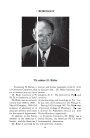
BOOK REVIEWS 65 the background of author Haynes formerly publisher of Chemical In- dustry, a chemical trade journal. It was William Hale who sold Haynes the idea that he should com- plete a task started earlier by the now deceased Charles Herty and Francis Garvin. Haynes' long as- sociation in the chemical industry gave him intimate knowledge of much valuable information. Even so, it would be a long and costly labor. Therefore, help from the in- dustry was sought and obtained. First the late Dr. Willard Dow of- fered to defi'ay a part of the expense. He was followed by Edgar Queeny (St.). Eventually funds came from practically all the industry. Author Haynes points out in his "To the Reader" preface that he realizes that even in the pages taken up in the present volumes, he is unable to do the exhaustive treat- ment that he would like. Volume I gives the background and beginnings of the American chemical industry from 1608 to 1910. Let me recite a few of the "firsts" in the United States. The first glass works in 1608 at Jamestown Cambridge College es- tablished in 1637 and changed to Harvard in 1638 upon receipt of oe 779 and400 volumes Ben Frank- lin and father made soap and candles in 1716 first course in chemistry taught at Kings College 1767 first chemistry book in U.S. was pub- lished in 1770 the first chemical so- ciety (of the world) was founded in Philadelphia in 1792 Colgate starts business 1806 Chevreul made his studies of fats and oils and of saponi- fication in 1811 first peppermint oil distilled 1812 in Connecticut first canned goods made in 1819 and the U.S.P. was first issued in 1820 B&O the first U.S. passenger rail- road in 1828 1829 coconut oil was introduced into soapmaking 1837 P&G, and in 1840 Emery, started to make soap and candles Kohn- stamm started making ultramarine in 1851 American Pharmaceutical Association formed in 1852 New Jersey Zinc Company started in 1854 first liquid soap patented in 1865 William R. Warner started in 1866 Vaseline first made by Chesebrough in 1870, and in 1871 Fritzsche-Schimmel and Company was formed. Lehn and Fink started in 1874 Turkey Red Oil was first made in 1876, the same year Eli Lilly Company started Synfleur Scientific Laboratories in 1889 cam- phor was first synthesized Jn 1896 in 1900 Heyden started to make sal- icylic acid 1901 and 1902 Monsanto started making saccharin and vanil- lin respectively Van Dyk and Com- pany started in 1902, the year the first movie house opened Seydel, J. T. Baker and Naugatuck started in 1904 the Food and Drug Act was passed in 1906 in 1907, du Pont was sued by the government as a monopoly and in 1910 the Ameri- can Oil Chemists Society was formed. These are just a few of the high- lights out of Volume ! which covers a period from 1608 to 1910. Volume II takes in World War I from 1912 to 1922 wherein it is clearly shown how the chemical in- dustry of the United States was to- tally unprepared for war. The great need for any and all chemicals gave many companies the backing needed to guarantee later growth. Volume III continues a discus- sion of the problems of the new in- dustry. It includes a chapter on page 327 on natural and synthetic aromatic materials including the influence of men like Von Isakovics, Van Dyk, Isermann, Dodge, Burton Bush, the Fries brothers, Ittner, Felton, and many others. Volume IV covers the "Merger Era" through 1930. This was in-

66 JOURNAL OF THE SOCIETY OF COSMETIC CHEMISTS deed a well-coined name for those times. The reading is most fas- cinating. Chapter 12 (page 294) reviews the progress in scents and flavors through that period. Volume V reviews the "decade of new products" during the period 1930-1939. Perfumes and cosmet- ics comprise Chapter 19 (page 282). Ruzicka's work on musks is men- tioned. The work of men like Gold- schmidt, Evans and McDonough, Max Factor, Burton T. Bush, Un- gerer, Kleber, to name a few, is dis- cussed in this roundup of the industry. Volume VI is devoted exclusively to the company histories of over two hundred companies. Included is the earliest origin of the company, its affiliations, subsidiaries, mergers, and present officials. From this industry histories of the following companies are factually recorded: Colgate, C. E. Ising Corp., P&G, M. M. & R., Los Angeles Soap Co., van Ameringen-Haebler, Verona, Van Dyk and Co., William R. War- ner and Co., and Sterling Drug Com- pany. This reviewer saw no misspelled words. The data that could be checked seemed correct. Exten- sive appendices and tabulations ap- pear in the first five volumes. Price of chemicals, tariffs for various pe- riods, and hundreds of other useful data are included. Both du Pont and Goodyear in- troduced sorbitol a couple of years before Atlas introduced it in 1936, a fact author Haynes did not record. A number of convictions emerge from reading this monumental ef- fort. First, that this is a land of opportunity, a fact recognized by the nationals of many countries who had a hand in creating its great chemical industry. Second, that many of the businesses were on or nearly "on the rocks" but stub- born sticktoitiveness brought them through. (Some of them are not small names either.) Third, fail- ure once or twice did not stop men from trying again. Fourth, that nowhere more than here is it true that "from acorns, great oaks grow." Fifth, the U.S. chemical industry has often broken a strangle hold on some natural or synthetic material, bringing the price down precipi- tously as in the case of ionones, men- thol and the synthetic musks, for example. Sixth, that obstacles, depressions, government control, fights for survival, always acted as industry stimulants. Seventh, that the future of the industry is brighter than ever. Some may argue that additional companies should have been listed in Volume VI. It is hard to draw a line and yet one must be drawn somewhere or the listing would be practically endless. Historically, this is a must for every chemical library. Individual volumes may be had if one does not want the set although there is a con- siderable saving in buying the set. It is hoped that author Haynes can complete a seventh volume cov- ering the decade or more after 1939. Haynes has succeeded in his goal. The entire chemical industry •s thereby forever beholden to him. It has been greatly enriched by this mammoth history.--M. G. DE- NAVARRE. IoN EXCHANGE RESINS IN MEDI- CINE AND BIOLOGICAL RESEARCH. Volume 57, Art. 3. Annals of the New York Academy of Sciences, New York 21, N.Y. 1953. Pages 61-324, 6 X 9 inches. Price $4.50. This volume comprises the papers presented at the conference on Ion Exchange Resins in Medicine and Biological Research held by the Section of Biology and the Section of Physics and Chemistry of The New York Academy of Sciences,
Purchased for the exclusive use of nofirst nolast (unknown)
From: SCC Media Library & Resource Center (library.scconline.org)