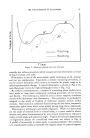
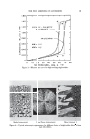
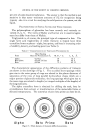
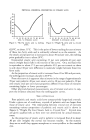
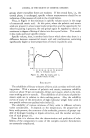
46 JOURNAL OF THE SOCIETY OF COSMETIC CHEMISTS groups where crystalline forces are weakest. If the crystal forln, i.e., the crystal .phase, is unchanged, specific volume measurements should be an •ndication of the presence of voids in the crystal lattice. Thus, in Figure 11 the minimum in specific volume occurs in the range of commercial stearic acid. At this point, where the palmitic and stearic acids are present in about equal molar proportion and the opportunity for selective pairing is greatest, the end groups again fit together so there is a maximum in degree of fitting of chains into the crystal lattice. This results in less voids and lower specific volume. Specific volume, then, is another basic factor which shows that there is a difference between commercial stearic acid and combinations containing significantly higher or lower proportions of stearic in palmitic acid. 1.04 1.02 1.00 0.98 • i • • I I I I • , 0 10 20 30 40 50 60 70 80 90100 MOL % STEARIC ACID Figure 11. Mol % stearic acid rs. specific volume of solid. SOLUBILITY The solubilities of binary mixtures of fatty acids correlate well with melt- ing points. With a mixture of palmitic and stearic, maximum solubility occurs at about 70 per cent palmitic-30 per cent stearic, which is the mini- mum melting point or eutectic. The solubilities of all mixtures of palmitic- stearic acids are in relation to their melting points. Also, the solubility curves of many of the derivatives of high molecular weight fatty acids in any specific solvent are qualitatively similar (2). The solubility of various mixtures of fatty acids in different solvents varies considerably. It depends on the temperature, the proportions of fatty acids present, the structure of the molecules, presence of groups cap- able of hydrogen bonding or dipole attraction, and the number and posi- tion of such groups (1). From this it is obvious that the determination and prediction of solu- bilities of the components in some of the complex cosmetic formulations are extremely complicated.

PHYSICAL CHEMICAL PROPERTIES OF STEARIC ACID 47 Further understanding of crystallization behavior of mixtures of fatty acids is obtained from x-ray diffraction studies. X-RAY DIFFRACTION PATTERNS X-ray diffraction patterns provide the only positive means of identifica- tion of crystal form, i.e., the phase, of a solid material. Since most of the physical properties of substances vary in accordance with their crystal form, x-ray studies are of fundamental importance. Investigations have shown that each mixture of fatty acids gives a single long spacing value and the sharpness of the lines is comparable to those observed for pure acids. Thus, for any composition a definite spacing is obtained which is characteristic for that particular mixture (2). This is considered to be good evidence that a single solid solution is formed in such mixtures. Long spacing measurements can be used to determine if a par- ticular combination is a mechanical mixture of dissimilar crystals, a solid solution, or both (1). Although a single crystalline form is obtained from melt (no solvent present), study of solvent crystallized fatty acids and their mixtures reveals the possibility of several polymorphic modifications, only one of which, that obtained from melt, is stable. Fatty acids exist in at least three poly- morphic forms each of which has different long crystal spacing and, there- fore, fundamentally different crystal cells. For identification purposes, the different forms are C, B, and A and all three are known for palmitic and stearic acids, but C is the only truly stable form. The particular modifications in a given system depend upon the composition, the previous treatment, and the environment present at time of examination. The C or stable form of palmitic or stearic acids is obtained from melt or by slow crystallization from some solvents, acetic acid for example. The B form is obtained by crystallization from benzene at intermediate temperature (80øF. for stearic and 60øF. for palmitic). Higher temperatures are apt to give C, lower temperatures A and C. Storage of metastable forms near the melting points effects transformation to C. Commercial stearic acid does not show the polymorphism exhibited by its components. For example, from melt, acetic acid and benzene, triple pressed stearic acid crystallizes in a single diflqcultly identifiable form prob- ably of C type. This again illustrates the basic difference in behavior of commerical stearic acid as compared to combinations containing other ratios of palmitic to stearic. Knowledge of the crystal behavior of commercial stearic acid and other combinations of palmitic and stearic acid alone and in various cosmetic formulations has a practical significance to cosmetic chemists. From this type of information, basic facts about specific formulations can be learned. For example, variations in product appearance, consistency, etc., can be
Purchased for the exclusive use of nofirst nolast (unknown)
From: SCC Media Library & Resource Center (library.scconline.org)