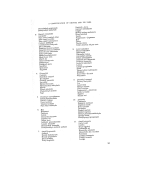
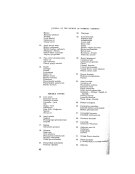
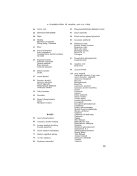
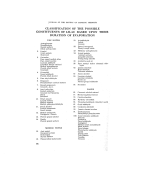
A CLASSIFICATION OF ODOURS AND ITS USES (80) Hydroxy Citronellal (88) Ethyl Methyl Phenyl Glycidate (89) Cyclamen Aidehyde (90) Orris and Opoponax Resins (91) Undecalac- tone (94) Angelica Root and (100) Amyl Cinnamic Aidehyde, Coumarin, Decyl Aidehyde, Isoeugenol, Labdanum Resin, Artificial Musks, Oakmoss Resin, Patchouli, Phenyl Acetic Aidehyde, Santal, Undecyl Aidehyde, Vanillin and Vetivert. My paper contains a complete list, which I will give to your president for publication. A question that arises from this classification is as to whether the con- stituents of one group may function temporarily in another if they are used in a dominating percentage in the finished compound. In this connection it is interesting to. compare the vital constituents of lilac with those of hyacinth, because there is a similarity between them, but with two substitu- tions and one notable omission. The following are common to both in this ratio: 5 times as much benzyl acetate in the hyacinth 6 times as much phenyl ethyl alcohol in the lilac the same percentage of heliotropin and of isoeugenol in each but the hyacinth requires 3 times as much cinnamic alcohol, and 100 times as much phenyl acetic aidehyde. It will be observed that the almost equivalent change-over in the quantity of the two top-note constitutents is required by the difference in bouquet of the flowers, and is further modified of necessity by replacing the terpineol in the lilac with a similar quantity of linalol in the hyacinth the middle note of anisic aidehyde in the former is replaced by ionone in the latter and while hydroxy citronellal is an essential constituent of the lilac, it can be omitted entirely from the hyacinth, which, however, is dominated by the vast increase in the powerful aidehyde. It would seem, therefore, that longer-lasting aromatics might be used in such quantity as to raise them temporarily into a higher grouping, as further instanced by the middle note of ylang in a lilac fantasy, where it might be used in such quantity as to dominate its fragrance or the basic notes of such aliphatic aldehydes as C 10 or 11 or 12 in an intense flowery bouquet, where they might be raised to middle- or even top-notes in accordance with the percentage employed. But in my view this cannot ultimately alter the original coefficients in this classification. On the other hand, it seems certain that the relative quantities of aroma- tics in a complex mixture do in fact influence the duration of evaporation of the whole: first, depending upon the ratio of the combined basic substances to the middle and top note constituents and second, to the changes that may take place on maturing, or even to interactions of an obscure nature between the various constituents. But it is not easy to prove the latter point, and an examination of the former may even lead to speculation. For, if we take a simple compound of two substances, such as bergamot and patchouli, or lavender and coumarin, and mix them in the proportions of 85

JOURNAL OF THE SOCIETY OF COSMETIC CHEMISTS 0 to 1, we shall find that although the odour of the major portion will be modified by that of the minor, the latter will last long after the former has evaporated. Furthermore, if we take an already blended perfume containing patchouli and coumarin, and substantially increase their percentages, •ve may find an overall increase in the lasting properties of the fragrance, but there would also be a shading of the note of the bouquet which might well spoil its lift and balance. This brings me to the vexed question of fixation, to which I shall refer only briefly as it is incidental to the main theme of this paper. The problem of tenacity is as old as scents themselves, and was mentioned by Theophrastus as long ago as 370 B.c. when, after classifying them as light, heavy, weak and strong, he concluded by saying of such things as myrrh and spikenard' "owing to their strength and substantial character they do not easily evapor- ate and are not easily made to disperse, and a lasting perfume is what women require." I think we may safely assume that this ancient philosopher was the first to realise the implications of vapour pressure without knowing anything about it. Moreover, his womenfolk correctly assessed one of the most important qualities of a. fragrance, which has not changed with the passing of the centuries. In the first place, what is understood by fixation ? Is it the retarding of the rate of evaporation of the more volatile substances in an already blended mixture of aromatics, by the addition of odourless, or nearly odourless, substances of high boiling-point ß or is it the skilful blending of aromatics of low volatility, which not only largely contribute to the note of the perfume, but also inhibit the loss of the less tenacious middle and top note constituents? I think the tyro would accept the first premise, and the expert the second mainly on the grounds that low vapour pressure solvents, such as diethyl phthalate and benzyl benzoate, have a distinct tendency to flatten the lift of a fragrance, and especially so if they are added in sufficient quantity of function as real fixatives. You may, of course, regard this opinion as mere speculation, based upon long years of perhaps unconscious observation. So, with the sole object o[. proving or of disproving this belief, I made the following experiments. first object was to discover which of the so-called "fixatives" delayed evapora -' .. tion for the longest period, and for this purpose I chose benzyl alcohol/i B.?. 68 C at 3 min. ß diethyl phthalate, B.?. 143 C at 3 ram. ß and benzyl•ii.i benzoate, B.?. 147 C at 3 mm. pressure all of which are cheap and readily?i available. I would say, in passing, that I included benzyl alcohol becaus?• it is not an uncommon constituent of floral compounds. But these by no means exhaust the list of usable substances, many of which I enuraer•:-!• ated on page 86 in Volume II of the sixth edition of my works. I selecte/i::ii two top-note aromatics owing to their greater volatility: acetophenone,':• ii essential oil of relatively compleX' straight synthetic, and bergamot, an ::.•
Purchased for the exclusive use of nofirst nolast (unknown)
From: SCC Media Library & Resource Center (library.scconline.org)