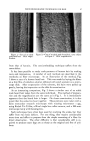
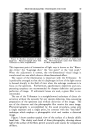
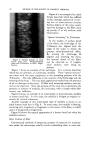
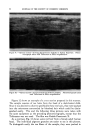
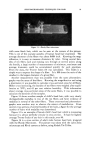
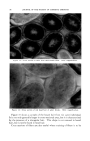
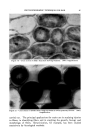
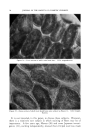
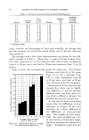
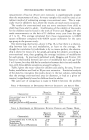
METHODS OF INCREASING SKIN PIGMENTATION 83 specimen removed after 14 days. Silver nitrate stain revealed almost no new pigment formation. SPECIMENS FROM THE RIGHT THIGH The horny layer was thickened and a specimen removed after 14 days of ultraviolet irradiation showed the formation of a stratum lucidum. This is a homogenous pink staining layer lying at the lowest level of the stratum comeurn. Normally this is present only in the skin of the palms and soles. The cells of the epidermis were swollen and there was inter- cellular edema. The perivascular infiltrate in the upper cutis was more prominent than that seen in specimens from the left thigh. Silver nitrate stain of the specimen removed after 14 days of irradiation revealed new pigment formation in the melanocytes. The amount of melanin, however, was not very great. No pigment was present in the horny layer. In order to determine the effect of 8-MOP over a longer period of time, a biopsy specimen was removed from the back of a patient who had been using 8-MOP and ultraviolet light for the treatment of vitiligo for two months. His skin was darker than his usual tan. This specimen had a very prominent stratum lucidum. In spite of this individual's dark tan the histologic sections did not reveal abnormally active pigment formation. Most of the pigment was contained in cells in the basal cell layer (prob- ably the cell bodies of melanocytes). A few dendrites contained pigment granules and there were irregularly scattered pigment granules in the horny layer. Although a controlled experiment was not performed on this patient, the amount of pigment retained by the melanocytes was much greater than one would expect in this individual (light complected, blue eyed Scandinavian). INTERPRETATION The initial effect 'of 8-MOP plus ultraviolet radiation occurs in the upper layers of the epidermis. This is as far as the high energy, erythema- producing ultraviolet radiation penetrates. The metabolism of the cells is altered in such a way that a stratum lucidurn is formed. This struc- ture explains the increased tolerance to ultraviolet light (increase in ery- thema dose) which occurs before there is any appreciable pigment forma- tion. Taking 8-MOP, increased pigment formation. There was also an in- crease in the inflammatory reaction and pigmentation did not precede the inflammation. These findings appear to rule out a direct effect of 8-MOP alone or 8-MOP and high energy ultraviolet radiation on the pigment form- ing system. We cannot be certain about the effect of low energy, pene- trating ultraviolet. It is fairly certain that long wave ultraviolet and

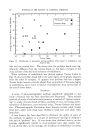
84 JOURNAL OF THE SOCIETY OF COSMETIC CHEMISTS visible light pass through the altered stratum corneum and reach the level of the melanocytes. Lerner (3) has shown that after a concentrated solu- tion of 8-MOP is irradiated with ultraviolet light a yellow solution is produced. This yellow solution showed absorption in the 4000-6000 Ang- strom range. Pigmentation could be brought about in part by altered 8-MOP and low energy radiation. The dark tanning of the patient who had been using 8-MOP for vitiligo appears to be due to an increased retention of melanin by the pigment- forming cells. Very little is known about the mechanisms controlling the storage or release of pigment after it has been formed by the melano- cyte. Stimulation of the skin by various types of irradiation causes the pigment forming cells to enlarge and probably to multiply. We cannot tell whether enlargement of the melanocytes, a metabolic change causing retention of pigment, or both effects are responsible for the pigment re- tention produced by 8-MOP. INCREASING PIGMENTATION OF NOV, MAt, SKIN Although heat, friction and many types of irradiation will produce pig- mentation, exposure to ultraviolet radiation is the most practical method in use today. When one desires pigmentation of the normal skin, the total melanin content rather than the rate of production is the critical factor. Preliminary evidence indicates that 8-MOP causes an increased retention of pigment by the melanocytes. Lerner stated at the Academy of Dermatology in 1956 that he believed 5-methoxypsoralen produced greater pigmentation with less erythema than did 8-MOP. Bergapten (5-methoxypsoralen) is the photosensitizing principle in oil of bergamot. When this material produces a photodermatitis after application on the skin, there is active pigment formation. The reaction, unfortunately, is so great that it destroys the melanocytes resulting in the deposition of melanin in the cutis. The destruction of the melanocytes is the limiting factor in photosensitization. We cannot say at this time whether or not the pigment retaining effect of the psoralens depends upon photosensitivity. It may be possible to find a chemical in the psoralen group which will produce little photosensi- tivity but relatively great pigment retention. Melanin may be retained in the stratum comeurn after it has left the melanocyte. Many people experience the loss of their suntan as soon as they start to peel. The altered stratum comeurn produced by 8-MOP is very adherent and it does not peel. Therefore 8-MOP produces reten- tion of melanin both in the melanocytes and in the horny layer. Any procedure such as the application of a mild acid which hardens the horny layer and makes it adherent will prolong a suntan.
Purchased for the exclusive use of nofirst nolast (unknown)
From: SCC Media Library & Resource Center (library.scconline.org)