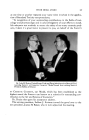
JOHN H. DRAIZE, THE MAN AND THE SCIENTIST By G. RoB.R'r IT IS WITH THE greatest pleasure that I appear here tonight to participate in this award to Dr. Draize. The SOCIETY could not have selected a more worthy recipient from the standpoint of scientific ability. Neither could they have found a man whose qualifications as a person are greater. It will be my happy task to tell you something of the life and experiences of your Medalist. John Henry Draize was born in Brussels, Wis., May 21, 1900, on a farm homesteaded by his father. He attended public elementary and high schools in Wisconsin. He entered the University of Wisconsin in 1918, and received a Bachelor of Science degree in Chemistry in 1922. He almost became a cosmetic chemist on the spot. He was offered a position with a cosmetic firm in Detroit. He chose, however, to remain in Wisconsin, and went to work in the laboratories of the Lindsay-Mc- Millan Oil Company in Milwaukee. He remained in this position until 1927, when he decided that his primary interests lay in biology and bio- chemistry. His acquaintance with Dr. A. F. Loevenhart was in part responsible for his decision to enter the Graduate School of the University of Wiscon- sin with the idea of studying pharmacology. Dr. Loevenhart died one year later, and Dr. Draize continued his work with Dr. A. L. Tatum. Our Medalist received the degree of Doctor of Philosophy in Pharma- cology in June, 1931. His thesis was published under the title "Experi- mental Thyrotoxicosis." Dr. Draize did not, however, devote all of his time to the pursuit of knowledge. In 1928 he and Miss Ira Dekeyser, also of Brussels, were married. Their first child, William, was born in 1931. As soon as the ink on the diploma was dry, the Draizes set out for Lara- mie, Wyo., where Dr. Draize had accepted a position on the faculty of the College of Agriculture of the University of Wyoming. The duties of this position were pharmacological and toxicological studies of plants known 120

JOHN H. DRAIZE, MAN AND SCIENTIST 121 or suspected to be toxic to livestock on the ranges. There was, and still is, heavy loss to stockmen from the death of range animals which feed on certain wild plants. Work on these projects led to publication of papers on "Poisonous Vetches, .... Arrow Grass" and "Death Comas," as well as some general bulletins about plants poisonous to animals. Another disease of animals is known as alkali disease. The acute form of the disease is known as "Blind Staggers" from the behavior of affected animals. The disease is due to consumption of plants grown in areas where the concentration of selenium in the soil is high, specifically in the areas in which outcrops of cretaceous shales occur. The publications by Doctors Draize and O. A. Beath on the pathology of this disease are the authoritative works on the subject. The investigations led to some experiences well outside the ivory tower in which scientists are so often pictured. No pharmacologist could be happy, or successful, without autopsy ma- terial. The University did not provide him with any of it. They did, however, equip the department with a deer rifle and a road map. With this equipment Dr. Draize set out for a ranch at Woods Landing to collect his first specimens. The rancher and the pharmacologist engaged in a dialogue something like this: Rancher: "Son, you aren't from these parts, are you ?" Pharm.: "No sir, I've just come from Wisconsin." Rancher: "Wisconsin, eh? Well now, that's east of Omaha, ain't it?" Pharm.: "Yes, it sure is." Rancher: "Heck, Son, then you're just an Eastern Dude. We'll have to give you a hand! Now, the way you do it is this, you draw an imaginary line from the bottom of one ear to the opposite eye of the critter. Then you do the same thing from the other side. Where those lines cross, you let him have it !" So, our new Doctor of Philosophy drew his lines, then drew his bead and let them have it. Autopsy material was available. One investigation involved emergency treatments. The investigators found that if the animals could be aroused from their lethargic condition, they could frequently be saved. The treatment devised was that of in- jecting a solution of strychnine and picrotoxin. On one occasion, Dr. Draize, with a chemist assistant, set out to treat a large but seriously ill prize bull. When the treatment took effect, the bull leaped to his feet, and promptly charged the chemist. The chemist escaped with his life but not his dignity. Dr. Draize chose to remain a pharmacologist, possibly because he concluded that chemists are more likely to be chased around than are pharmacologists. In 1935 the Draize family left Wyoming for Maryland, where Dr.
Purchased for the exclusive use of nofirst nolast (unknown)
From: SCC Media Library & Resource Center (library.scconline.org)