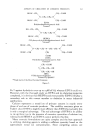
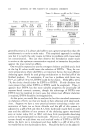
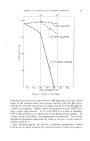
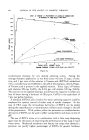
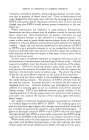
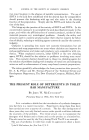
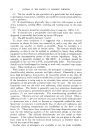
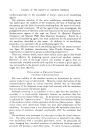
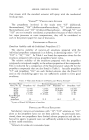
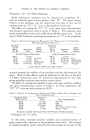
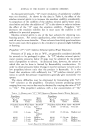
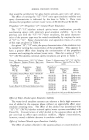
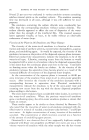
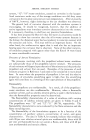
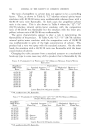
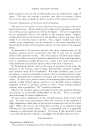
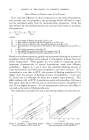
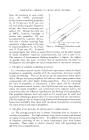
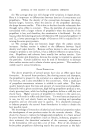
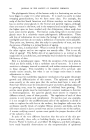
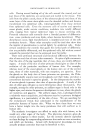
294 JOURNAL OF THE SOCIETY OF COSMETIC CHEMISTS How Muc• or PROPELLENT CAN FL^S•? If we omit the influence of other components in the aerosol formulation, and consider only the propellent, the percentage which will flash to vapor can be calculated easily from its thermodynamic properties. From the heat balance for the adiabatic process (at constant heat content), we obtain the equations: y_ ha-- hS0orY= C(t•-tø) (hs,)0 (hsg) 0 where Y = percentage of flashing propellent in B.t.u./lb. hfi = heat content of liquid at the initial pressure pi in B.t.u./lb. hs0 = heat content of liquid at the surrounding pressure P0 in B.t.u./lb. (hsg)0---- the latent heat of evaporation of the liquid at the surrounding pressure p0 in B.t.u./ lb. t• -- the initial temperature of liquid in øF. to = the equilibrium temperature of liquid at P0 pressure in øF. c = the average sr•ecific heat between t• and to in B.t.u./lb. øF. Based on the above equations, graphs were prepared showing the amount of propellent which will flash when exposed to atmospheric pressure from any initial temperature. These graphs are very useful in comparing certain important characteristics of aerosol formulations made with different propellents. Figures 4, 5 and 6 show the calculated flashing amount of some hydrocarbon and halocarbon propellents, and their mixtures. It is interesting to note that at 80øF., the amount of flashing propellent 114 is higher than the amount of flashing mixture of propellents: 75 per cent 11-25 per cent 12, although the latter has a higher vapor pressure. This effect explains why at 80øF., formulations made with propellent 114 have a finer spray than those with the above mentioned mixture of propellent 11 and 12 at a higher pressure. At low temperatures, however, this effect is reversed as the curve of flashing indicates. Our experience in production and in pre-testing of glass aerosols also con- Figure 4.--Flashing of halocarbon propel- lents (P) mixtures of P-11 and P-12. Figure 5.•Flashing of halocarbon propel- lents (P)mixtures of P-12 and P_114.

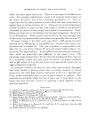
FORMULATING AEROSOIJS TO OBTAIN SPRAY PATTERNS 295 firms the existence of such condi- tions. At - 10øF., accidentally broken bottles containing propellent 1l, 12 (75 per cent 11-25 per cent 12) were projecting glass fragments further than those containing pro- pellent 114. During the drop test at 100øF., however, breakage of bottles with propellent 114 was accompanied by a greater detona- tion and a farther reaching frag- mentation of glass than in the cases of mixed propellents 11, 12 (75 per cent 11-25 per cent 12). It should LIqIJID ?I•lPtI•?IIRS 'F Figure 6.- Flashing of hydrocarbon propel- lents. be stressed again that when an aerosol bottle breaks, not the whole amount of liquid propellent vaporizes instantaneously, but only a part of it. The amount of instantaneous flashing propellent is higher, the higher its specific heat, the lower its latent heat of vaporization, the lower its boiling point and the higher the initial temperature of the aerosol contents. 4. The e•ect of solubility on flashing of aerosols In a two-phase aerosol system (liquid and vapor phase) where the liquid propellent is completely miscible with the concentrate, the latter usually retards the flashing. This can be proven by the experiment which shows that a 100 per cent pure propellent will deliver a finer spray pattern than compounded with other higher boiling ingredients. Also, by increasing the ratio of propellent to concentrate, a finer spray will be obtained. In a three-phase aerosol system, (two liquid phases and one vapor phase), where the liquid propellent and concentrate form separate layers, the concentrate does not influence significantly the flashing of the propellent. The propellent behaves here very much as if it would exist by itself, and its amount of flashing is greater than if it were mixed with the concentrate. This fact explains why at drop testing, bottles with three-phase formulation broke more forcefully than those with two-phase formulations, containing the same amount and type of propellent. 5. The e•ect of (a) viscosity, (b) density and (c) surface tension (a) The average particle size is always increasing with an increase in viscosity of a product. Too high viscosity may cause a streamy jet instead of a spray or may even clog the valve. It is difficult to predict the viscosity of solutions consisting of two or more constituents even with known viscosities. There exists a critical viscosity limit still permitting the delivery of an acceptable spray.
Purchased for the exclusive use of nofirst nolast (unknown)
From: SCC Media Library & Resource Center (library.scconline.org)