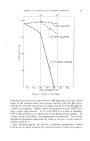
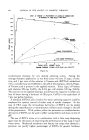
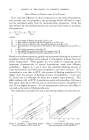
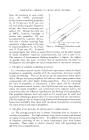
296 JOURNAL OF THE SOCIETY OF COSMETIC CHEMISTS (b) The average drop size will change with variations in liquid density. Here it is important to differentiate between density of concentrates and propellents. When the density of the concentrate decreases, the drops become larger however, when the density of the propellent decreases, the drops become smaller. This is due to the fact that the volumetric flow through valve orifice is constant. Thus, the particles of concentrate are surrounded with a larger volume of propellent when the density of the propellent is low, and therefore, the atomization is facilitated. For this reason,when formulating aerosols with Genetron 101 instead ofpropellent 11 and 12, a lower percentage by weight of Genetron 101 is required for ob- taining the same spray pattern. (c) The average drop size becomes larger when the surface tension increases. Surface tension is related to the difference between liquid density and vapor density. Because surface tension is also a measure of energy to produce a new surface, it has a definite influence on spray forma- tion. Propellents and solvents have usually low surface tension. Low surface tension aids dispersion, because less energy is required to separate the particles. Certain additives may be used in formulation to decrease their surface tension and to obtain a better spray pattern. This method is widely used in aerosol emulsions. Fo^M FORM^TtON The above properties of aerosol sprays have also an effect upon foam formation. In aerosol foam products, like shaving creams and shampoos, the propellent is present in the container as a separate layer on the top or the bottom, and is also emulsified in the concentrate. Only a small part of propellent-concentrate mixture is soluble in each other. The foam quality depends upon the type and amount of concentrate and propellent. Generally with a given concentrate, high boiling propellents produce a wet, slowly growing foam, while low boiling propellents deliver a stiff, dry and elastic foam. Higher amounts of propellent in relation to the same con- centrate will result in stiffer and drier foams. Too wet foams are impractical in use, too dry and elastic foams are lacking in wetting and spreading properties and are obviously poor in quality. It is absolutely necessary to balance properly the aerosol foam formulation in order to obtain the best possible result. The knowledge of interaction of physical and chemical properties makes the development of new products easier for the cosmetic chemist. Thus, should he choose to replace the halogenated propellents in a foam aerosol by pure hydrocarbon propellents (such as butane, isobutane, propane or their mixtures) the theoretical evaluation of the necessary adjustments in the formulation will save him a lot of time. First of all, mixture of hydrocarbon propellents delivering nearly the same pressure as the halo-

FORMULATING AEROSOLS TO OBTAIN SPRAY PATTERNS 297 carbons should be used. Then, knowing that the density of the hydro- carbon propellents is lower than that ofhalocarbon propellents, the amount of the required volume of hydrocarbons per aerosol container can be cal- culated. Further, since the flashing determines mainly the amount of instantaneous evaporation, and therefore the basic foam formation, the evaluation of the flashing curves should be taken into consideration. If the flashing curve of the hydrocarbon mixture has a flatter slope than that of the corresponding halocarbon mixture, an increased volume of hydro- carbon propellent might compensate in foam formation. Finally, since the new product would have somewhat different properties, small correc- tions in the formulation may be required to adjust surface tension, density, viscosity, and solubility of the propellent concentrate mixture. CONCLUSION The cosmetic chemist who intends to formulate a product in aerosol form should evaluate all the factors affecting spray or foam characteristics. Important factors are valve design, vapor pressure, thermodynamic values and the physical and chemical properties of propellent and product. Special emphasis should be given to the phenomenon of "flashing." Graphs were prepared to compare the relative flashing rate of halocarbons and hydrocarbons. REFERENCES (1) "A Tentative Method for Determination of the Particle Size Distribution of Aerosols," Chem. Specialties Moers. Assoc. Proc. 43rd Ann. Meeting, Dec., 1956. (2) Marshall, W. R., Jr., "Atomization and Spray Drying," Chemical Engineering Progress Monograph Series, 50, No. 2 (1954). (3) York, J. Louis, y., $oc. Cosmetic Chemists 7, 204 (1956). (4) Kinetic Chemicals, Inc., "Thermodynamics Properties of Freon 11, Freon 12, Freon 114." (5) Goodhue, Lyle D., and Franz, H., "Hydrocarbon Propellents for Aerosols," Phillips Petroleum Co., Research Division, Report 1751-$7R.
Purchased for the exclusive use of nofirst nolast (unknown)
From: SCC Media Library & Resource Center (library.scconline.org)