300 JOURNAL OF THE SOCIETY OF COSMETIC CHEMISTS years old, yet already has sired a large scientific family. I myself am a kind of bastard son of his, the product of a few chance encounters. His enthusiasm is so contagious that he is a real menace to me. A few minutes with him and I am ready to give up medicine and join his staff to work in the thrilling environment he creates. Phenobarbital constitutes my only defense against following such an impulse. It is said that nothing succeeds like success looking at Montagna, one is prompted to say that nothing succeeds like excess. He has by mortal stand- ards excess energy. Sleeping he abhors. He has excess drive, he can't wait to get on with the next project. He has excess curiosity to him the highest sin is not to know. He has excess brilliance and imagination. The modern scientific world is divided into a thousand kingdoms the barriers between the specialities are getting harder to break down. We are all living in our own little province, talking our own private jargon which is unintelligible to our neighbors. One of Dr. Montagna's greatest achievements has been the inauguration of the Brown Skin Symposia in 1951 where dermatologists and biologists annually congregate to discuss interdisciplinary matters. These conferences are a real joy of 'free speech.' Medicine after all is only a sub-division of biology. Despite the fact that Dr. Montagna was born in Italy and couldn't speak a word of English until he was fourteen, he is one of the most ar- ticulate of the English-speaking scientists. His writings are masterful. They are also numerous and diverse, reflecting the width of his interests. For a while he taught ornithology at Cornell and even illustrated a text- book on birds. He is an artist in his own right. His book "The Structure and Function of Skin" is a classic. Soon he will add another monument, a book on comparative anatomy. He has become so popular as a speaker and writer that the continuance of his career is threatened. His present distinction may be the direct cause of his extinction as a creative worker. He gave anatomy lectures at the University of London in 1953. Again in 1955 he went to London to participate in a Symposium on the Ageing of Transient Tissues. In 1957 he organized a symposium in London on the biology of hair growth, the proceedings of which are now in galleyproof. His rise has been meteoric. It was only in 1944 that he got his Ph.D. at Cornell. Eight years later he had already become a full professor in the biology department of Brown University where he now holds court. Truly great men are rarely narrow. Their talents are many. He plays the French horn so well that he almost became a professional musi- cian. He is a gardener, writer and artist. His main loves are normal skin, the arts, literature and his family. His aversions are fake and humbuggery, disorder, sloppy thinking, poetry, peddlers of cliches, and smooth talkers. The fact that he himself is a smooth talker shows only that we cannot stand our own faults in others.

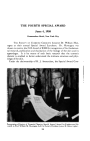
FOURTH SPECIAL AWARD 301 The SOCIETY is to be congratulated in rewarding a man of such out- standing worth. I can assure you the man in the ivory tower can use not only honor, which he has usually been able to get in abundance, but a little hard cash which has been exceedingly scarce." President .lames H. Baker in presenting the scroll and check said, "William Montagna, the SOCIETY o•' COSMETIC CHEMISTS recognizes your outstanding fundamental research on the biology of the skin and its appendages, which elucidates many of their intricate processes and gives the cosmetic scientist an understanding whereby he can advance in his specialized field. Because of this basic research, together with your publication of it, I present to you, on behalf of the members of the SO- CIETY, this scroll and check with the hope it will serve as stimulation for additional skin research." Dr. Montagna's acceptance of the Award follows.
Purchased for the exclusive use of nofirst nolast (unknown)
From: SCC Media Library & Resource Center (library.scconline.org)