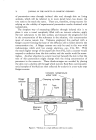
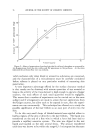
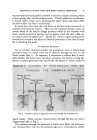
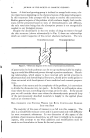
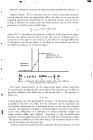
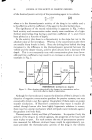
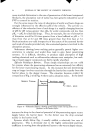
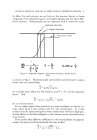
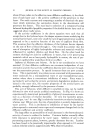
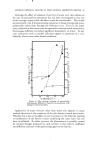
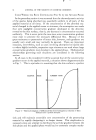
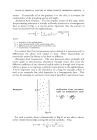
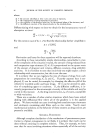
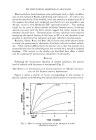
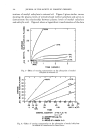
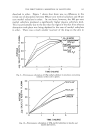
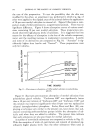
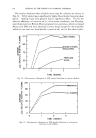
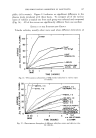
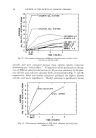
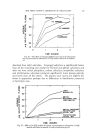
METHODS FOR MEASURING PERCUTANEOUS ABSORPTION 73 One of the big advantages of using isolated skin is that several experi- ments can be carried out on skin from the same animal and even from the same region if the pieces of skin used are not too large. The apparatus we employ has, therefore, been designed in the form of a battery of five diffusion cells which are simply holes in a stainless steel plate. The base of each cell is a concave glass slide cemented to the plate. The skin is placed over the cell and held down by a stainless steel cylinder ordinary rubber bands supply tension and these fit over hooks attached to the cylinder and to the plate. Holes leading into each cell are bored entirely through the width of the plate so that a flow of Ringer solution can be maintained through each cell. The dimensions of the cell have been kept to a workable minimum so that a modest flow of Ringer solution adequately flushes the cell without giving very large serial samples of liquid for sub- sequent analysis. The area of skin used, however, must be large enough to accommodate the spreading of the largest drop of test substance likely to be used in our experiments this is about 0.003 ml. The cell area in the apparatus shown is 3.5 cm. • and its depth 0.6 cm., and its volume is, therefore, about 2 ml. The cell contents are stirred magnetically. The maximum flow rate through the cell is about 5 mi./min., and the Ringer solution is collected in sample tubes which are automatically changed at intervals ranging from 10-60 min. The temperature of the cells is kept at 33øC., by a thermostatically controlled water bath of which the cell base plate is an integral part. In nearly all the experiments freely falling drops of test substance have been used. These have been dispensed by a precision microburette delivering volumes down to 2 X 10 -6 ml. The area of skin covered by the drop is determined by placing a dental x-ray film over the skin at the end of the experiment and taking an autoradio- graph of the region. As a general rule a drop of liquid on the skin spreads rapidly outwards for a minute or two and then changes very little in area over a fairly long period. The results are obtained as an unbroken series of recoveries of the test substance which has penetrated the full thickness of the skin during each relatively short sampling time. Summated and plotted with time, the data fall on a curve giving the total amount of the substance penetrating the skin at any given time. Generally, the shape of the curve can be described by a relation of the form d = kp(t-- d+de- where .4 is the total amount penetrating in a time t. k is a constant depending on the size of the drop, p is a permeability constant corre- sponding to the gradient of the later region of the graph which is linear, and d is a delay period which can be obtained from the graph by extrapola- tion of the linear portion to zero recovery.

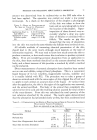
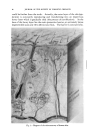
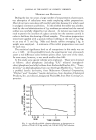
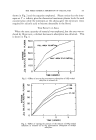
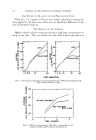
74 JOURNAL OF THE SOCIETY OF COSMETIC CHEMISTS A criticism of this method is that the diffusion must proceed through the full substance of the skin, whereas when the circulation is intact, the penetrating molecules meet the blood at the papillary capillaries and may then be removed from the site. Against this, we know that the penetra- tion of the corium is extremely rapid and its presence may not unduly influence the over-all penetration rate. However, it is possible to examine the effect of the skin circulation directly by perfusing the skin with physio- logical fluid during the course of an experiment. Most regions of the skin obtain their blood supply from a network of cutaneous arteries and veins with numerous anastomoses which connect a particular region to several sources. For perfusion purposes, a self-contained system of capillaries should arise from the branching of a single artery large enough for cannulation, and the venous blood should drain into a single vein. Feldberg and Paton, among others, (4), showed that these conditions are most nearly satisfied in the skin over the roedial aspect of the hind leg in animals. The arterial blood to this region is supplied by branches of the saphenous artery and the venous blood is drained by the accompany- ing veins joining the great saphenous vein. The entire skin flap con- taining this closed circuit can be isolated from the animal and perfused by passing physiological fluid into the cannulated saphenous artery and collecting the perfusate flowing from the great saphenous vein. We have estimated the normal blood flow rate in this region of skin by autoper- fusion. The preparation was taken as far as cannulation of the saphenous vein, leaving the artery intact, and the venous outflow of blood collected over a measured period of time. In the rabbit this flow rate ranged from 0.2-0.4 mi./min. and in pigs weighing approximately 30 kg. the flow rate was about 3 ml./min. Similar rates of flow have been maintained in the experimental perfused skin preparations. The fluid used was Ringer's solution with 20 per cent of horse serum added to prevent oedema. The perfused skin is warmed to 30øC. on a thermosrated plate of perspex which has a central hole through which the cannulated vessels protrude. The arterial cannula is connected to a pressure head of Ringer solution and the effluent from the venous cannula flows directly into a collecting tube. At the start of the perfusion a moderately high pressure of Ringer-- about 80 cm. water---is necessary to clear the residual blood, and light massage of the skin assists this process. When the flow of perfUsate is established, the pressure is reduced to 30-40 cm. water this pressure being adequate to force the less viscous Ringer solution through the skin vascular system. There is no difficulty in identifying the central region of the skin which is being perfused for this becomes very pale immediately after the circulating blood has been washed out. The test substance is applied to this region and sampling of the venous effluent continues until sufficient data has accumulated. The rate of penetration of the skin estimated by
Purchased for the exclusive use of nofirst nolast (unknown)
From: SCC Media Library & Resource Center (library.scconline.org)