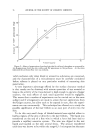
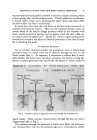
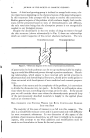
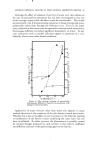
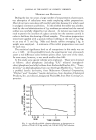
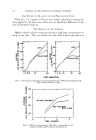
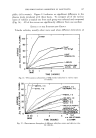
92 JOURNAL OF THE SOCIETY OF COSMETIC CHEMISTS where D here refers to the effective mean diffusion coefficient h, the thick- ness of each layer and 3' the activity coefficient of the penerrant in that layer. For such a system and comparing a number of chemicals the pene- rrant which minimizes the summation shown in the denominator will penetrate the fastest. This may lead to selection of a compound having balanced hydrophilic lipophilic properties if the double bai'rier layer such as suggested above really exists. If the activity coefficients in the above equation were such that all except that in the hydrous layer. the deeper aqueous tissues underlying the normal barrier layer, were very small the rate of agent penetration would be expected to be a sensitive function of the rate of capillary blood flow. This assumes that the effective thickness of the hydrous barrier depends on the rate of flow of blood through it. One would thus predict that the rate of absorption of highly hydrophobic solvents and materials would be influenced by capillary dilation and blood flow. On the other hand for systems showing low activity coefficients in water, that is for penetrating materials which are at least partly hydrophilic in nature, the rate of per- fusion or capillary flow would have little or no effect. ß Influence of Moisture and Solvents. So far in our consideration we have assumed (1) that diffusion coefficients are constants independent of con- centration and (2) that activity coefficients likewise were constant through- out the penetration process. In special instances these are poor assump- tions. This is particularly true where we are concerned with penetration ot water molecules by a transepidermal route or any transepidermal pene- tration where there is concomitant imbibition of water. Since water is particularly well sorbed by protein and protein degradation products con- tained in the outer skin, the transfer properties of the several layers are probably strongly influenced by the presence of water. - This sort of behavior, while difficult to establish in vivo, can be readily followed in vitro with certain artificial membranes. In Fig. 6 is shown an experimentally determined permeability of glyceryl monostearate to mois- ture as a function of relative humidity. At very low humidity perme- ability (gm./cm. 2. hr. min. Hg) is relatively insensitive to relative humidity, whereas near 100 per cent, the rate of penetration is acutely dependent on water activity. This is attributed to imbibition of water by the barrier phase exposed to saturated water vapor and consequent changes both in the diffusion coefficient and activity coefficient. The large effect on permeability of small decreases in the thermodynamic activity of water is evident for leather. Common leather normally offers little resistance to penetration by water vapor. Addition of salt to the penetrating aqueous phase, however, greatly decreases the rate. Leather has been found to be practically impermeable when exposed to 2.5 normal sodium chloride solution (approximately 90% relative humidity).

PHYSICAL CHEMICAL ANALYSIS OF PERCUTANEOUS ABSORPTION PROCESS 93 Although the effect of variation of activity of water over skin surface on the rate of percutaneous absorption has not been investigated as yet, one would strongly suspect that the effect would be considerable. This would be particularly true if the penetrating substance is being transported trans- epidermally rather than through the follicular route. Even in the latter case, hydration of the tissues may be expected to cause physical alteration in the passages sufficient to produce significant dependency on water. In any case, substances such as methyl salicylate appear to penetrate at a con- siderably altered rate under humid conditions. m IC- 1336- • ILl 13•- 4 - 2- 0 0 , /-,,07 ! _ I /_ 18o I-- / •o t- / / 1501• I •40 100 I i I 25 50 75 % HUMIDITY Figure &--Plot showing variation of permeability and apparent diffusivity of glyceryl monostearate with change in relative humidity. Application of many solvents other than water also appears to cause marked alteration in the resistance of the skin barrier toward penetration. Whether this is due to the effect of such treatment on the follicular opening or modification of the barrier tissues underlying the outer layer has not been established. In either instance the phenomenon is possibly caused by marked changes produced by such solvents in the activity coefficient and diffusion constant of the penetrating agent in the barrier.
Purchased for the exclusive use of nofirst nolast (unknown)
From: SCC Media Library & Resource Center (library.scconline.org)