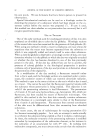
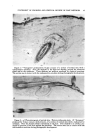
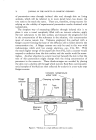
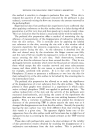
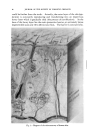
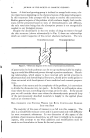
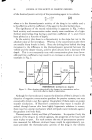
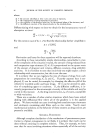
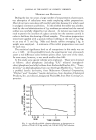
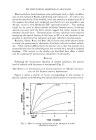
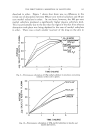
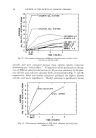
JOURNAL OF THE SOCIETY OF COSMETIC CHEMISTS layers. A third and growing group is inclined to accept both routes, rela- tive importance depending on the chemical nature of the penetrating agent. In this treatment little attempt will be made to resolve this controversy. Rather, general aspects of the problem which embrace largely both mecha- nisms will be presented based on laws of thermodynamics and diffusion, the only restriction being that the absorption process is not energetically coupled to any biological process. Despite the dissimilarity in the two modes of drug movement through the skin structure (shown schematically in Fie. 1) there are relationships which are valid irrespective of the correct absolute mechanism. The rate Transfollicular Transepidermal Figure 1.--Schematic diagram of two routes of percutaneous penetration. of penetration by both pathways can be set ,up mathematically by employ- ing as a model the diffusional process through a passive membrane. Result- ing relationships, which appear to have received only partial attention in pharmaceutical and dermatological literature, should prove useful guides to those entrusted with development of new medicinal and cosmetic prepara- tions. Because of the nature and the complexity of the problem, it is convenient to divide the discussion into two parts. In the first we will analyze situa- tions where the rate-controlling step or steps are in the skin. In the second part we will consider those cases where the thermodynamic potential drop of the percutaneously absorbed materials is largely in the applied phase such as an ointment base. , RELATIONSHIPS FOR S¾S'rEMS WHERE THE RATE CONTROLLING BARRIER Is IN THE SKIN The majority of the cases of interest to us fall into this category. The skin is a wonderfully resistant cover and it is penetrated only with difficulty by most noncaustic substances. In our discussion of this aspect of the problem of percutaneous absorption, we will treat it initially in its simplest aspects, then attempt to see what additions and modifications must be made in our formulation to better fit the real systems.

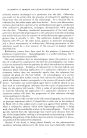
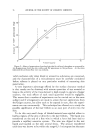
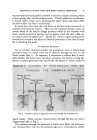
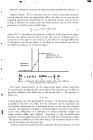
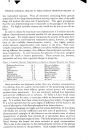
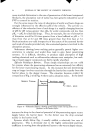
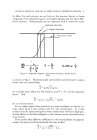
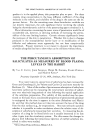
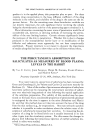
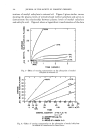
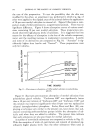
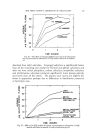
PHYSICAL CHEMICAL ANALYSIS OF PERCUTANEOUS ABSORPTION PROCESS 87 Simplesl Model. If it is assumed that the vehicle containing the pene- trating chemical does not appreciably affect the skin, we can set up the following approximate relationship for an idealized system, such as shown in Fig. 2, between the steady state rate of penetration (dq/dt) and various properties of a fairly water soluble d•ug' dq (P.C.) (Conc. of Drug) dt - L (1) where (P.C.) is the effective distribution coefficient of the penetration agent between the vehicle and the barrier of the skin, (Conc. of Drug), the con- centration of the agent in the vehicle, D, the effective average diffusivity of the agent in the barrier phase, z/, the effective cross section area, and L, the effective thickness of the barrier phase. Penetrant in- Aqueous Vehicle Aqueous Receptor 4'•, : D[PC]A =A-- L •' L Figure 2.--Schematic plot showing simple steady state diffusion across a barrier layer of thickness L. The main characteristics of the penetrating agent which determine its rate of entry through the skin, according to this equation, are its effective partition coefficient and diffusivity in the barrier phase. The product of these two (P.O.) (D) is often spoken of as the permeability constant. If the barrier phase were available in the form of a film, the two constants can be separated and individually determined by a technique known as the lag time method. Actually the important variable in the permeability constant is the (P.C.) factor since diffusivity of a substance of similar molecular weight and shape usually differ only slightly. According to the Stokes-Einstein equation, D varies approximately only as the cube root of molecular weight. The partition coefficient, on the other hand, is an extremely sensitive func- tion of molecular structure and size. Another useful but equivalent form expresses the same equation in terms
Purchased for the exclusive use of nofirst nolast (unknown)
From: SCC Media Library & Resource Center (library.scconline.org)