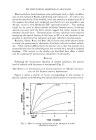
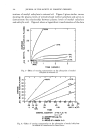
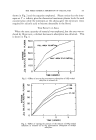
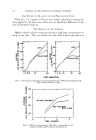
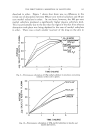
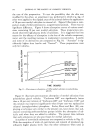
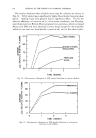
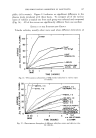
78 JOURNAL OF THE SOCIETY OF COSMETIC CHEMISTS finally the rate became steady. This steady rate of penetration has been used for comparison with those measured by some of the methods described, and the results tabulated. It is seen that in the case of the rabbit, where the comparison is complete, that there is very good agree- ment between the results. With the pig, where total body digestion was not a very practical proposition, the measurements based on diffusion through isolated skin and perfused skin, and on disappearance from the skin agreement between the rates of percutaneous absorption into intact animals and the penetration rates directly measured on perfused skin preparations. The use of isolated skin offers a technique for studying the penetration of human skin by chemical substances, but samples of whole skin are necessary and these are not always readily available. The method is therefore of little value in semiroutine tests, but its use in fundamental studies may throw much light on the mechanism of chemical penetration of the skin. On the other hand, studying the rate of disappearance of a labeled test substance from the skin surface has been shown to provide reliable information on the rate of skin penetration. This is a procedure which can be carried out with complete safety on humans for the quantity applied to the skin can be extremely small. The size of the dose is only limited by the requirement for a radioactivity sufficient to produce a reasonable count in a Geiger-Mtiller tube, and the limitation of manipulating very small quantities of liquid. REFERENCES (1) Treherne, J. E., :7. Physiol.. 133, 171 (1956). (2) Griesemer, R. D., Blank, I. H., and Gould, E., y. Invest. Dermatol., 30, 255 (1958). (3) Blank, I. H., Griesemer, R. D., and Gould, E.,Ibid., 30, 187 (1958). (4) Feldberg, W., Paton, W. P., y. Physiol., 114, 491 (1951).

BIOLOGICAL FACTORS AFFECTING PERCUTANEOUS ABSORPTION By ROBERT D. GRIESEMER* Presented September 23-24, 1959, Seminar, New York City IN THE STUDY of penetration of chemicals into and through the skin, two groups of significant factors emerge. The first concerns the biolog- ical aspects of the skin, the second the physical chemical phenomena arising from the interaction of molecules. That these two groups of fac- tors must of necessity overlap is apparent immediately when one realizes where the decisive field of operations for biological activities exists, namely, at the molecular level (1). Thus in one sense, the gross biological features of the skin, such as his- tological structure, chemical composition, and physiological responses, may be relegated to minor roles in the process of skin penetration. Under normal circumstances, they are not involved in permeation. But in another sense, these features are actually paramount, since they sharply restrict percutaneous absorption to narrow pathways in which molecular interac- tion can become the controlling force. During formation of the skin and under abnormal conditions when the skin is damaged, the small restric- tive channels of penetration in normal skin do not exist, and creation of the entire skin is the central problem. GENERAL BIOLOGY OF THE SKIN From the biological standpoint one may consider not only the physical and chemical structure of mature skin, but also the profound changes which occur during growth and development and which result from stress and disease. Because of its exposed position, the skin is called upon early in life to assume its chief role as guardian of the internal milieu of the body. It is not surprising, therefore, to find that the skin just before birth has attained almost complete maturity, relative to its protective capacity. Throughout adult life and into old age, the skin maintains this capacity with remarkable constancy. It is perhaps because of this dependability that the idea often develops that the skin is a dead envelope. Nothing * Dermatological Research Laboratories, Dept. of Dermatology, Harvard Medical School at the Massachusetts General Hospital, Boston 14, Mass. 79
Purchased for the exclusive use of nofirst nolast (unknown)
From: SCC Media Library & Resource Center (library.scconline.org)