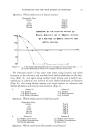
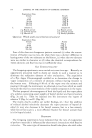
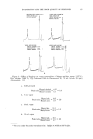
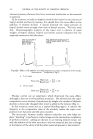
EVAPORATION AND THE ODOR QUALITY OF PERFUMES 179 CONCLUSION As far as the present paper is concerned, this is the end of the experi- mental section. As far as our research program is concerned, it is only the beginning. Each experiment that we carried out immediately sug- gested a number of others to be tried. We have just scratched the sur- face in this field and a great deal of work remains to be done before we shall have a full and quantitative picture of the forces acting between odorant molecules and the molecules surrounding them and before we shall really know the factors governing the evaporation of a perfume. In this early stage in the investigation, I suggest that we accept the fol- lowing points as a working hypothesis: 1. Under the normal conditions of use of perfumes, attraction forces between odorant molecules and the molecules surrounding them in the liquid state have an order of magnitude such that they can distinctly affect the odor of the perfumes. 2. The magnitude of these forces depends on the extent to which the odorant molecule and the surrounding molecules have structural features in common. In any given situation the forces acting on the different odorants in a perfume blend will not be equally large. This selectivity is suflSciently pronounced so that its effects are readily discernible by the human nose as well as by analytical instruments. By changing the situa- tion, the vapor composition and the odor of the perfume is changed. I believe that some day in the not too distant future perfumers will be as familiar with the laws governing evaporation as were the painters of the 16th through the 19th centuries with the laws of anatomy and per- spective. Let us hope that the perfumer of the future will use his laws as skillfully and creatively as did the painter of the past! .dcknow[edfments: I wish to express my gratitude to the management of Polak's Frutal Works, Inc., for the support given to this work and the per- mission to publish it. I am also indebted to Mrs. Thelma J. Bloomfield for her assistance in the preparation of this paper and to Dr. Donald A.M. Mackay for our stimulating discussions. REFERENCES (1) Wells, F. V., Soap, Perfumery & Cosmetics, 30, 925 (1957). (2) Pickthall, J., J. Soc. CosyrEarm CHEmSrS, 5, 182 (1954) Soap, Pe•umery & Cosmetics, $0, 712 (1957). (3) Poucher, W., ztm. Perfumer Essent. Oil. Re,., 66, 17 (1955). (4) Jellinek, J. S., ztm. Perfumer Atromat., 73, 27 (1959).

COSMETIC ADVERTISING UNDER THE FEDERAL TRADE COMMISSION ACT By CHARLES A. SWEENY* Presented November 29, 7960, New York City Ix •s A PLEASURE and somewhat of a challenge to discuss with cosmetic chemists the advertising of the fruits of their efforts. It is en- tirely appropriate that your profession have an understanding of this area of government regulation, and I shall offer my personal views for your consideration on the basis of more than twenty-five years experience in dealing with food and drug matters as a Federal Trade Commission at- torney. I stress the fact that these are my personal views, because, as a staff member, I cannot express or anticipate the official position of the Com- mission. While the Federal Trade Commission Act was approved in 1914, and action to correct false and misleading advertising has represented a sub- stantial effort on a continuing basis ever since, the Act was amended in 1938, in so far as advertising of foods, drugs, devices and cosmetics is concerned. I propose to limit my discussion to our enforcement efforts today, dipping into historical references only when that would seem to promote understanding. In this area, there may be a question as to whether a particular product is a cosmetic or a drug, because of its composition, or the claims made for it. The question is not of practical importance to us, and I shall not burden you with definitions or discussion of the subject, simply because the provisions of the Act applicable to both categories are identical. For this reason, too, I will refer to cases involving drug products where they may clearly illustrate principles discussed. The Commission's authority in the regulation of false and misleading advertising stems basically from Section 5 of the Federal Trade Commission Act, which provides that "Unfair methods of competition in commerce, and unfair or deceptive acts or practices in commerce, are hereby declared unlawful." Section 12 declares specifically that the dissemination of false advertising for a food, drug, device or cosmetic is an unfair or deceptive act or practice in commerce within the meaning of Section 5. In inter- preting commerce, the Act is unique with respect to products in these four * Bureau of Investigation, Federal Trade Commission, Washington, D.C. 180
Purchased for the exclusive use of nofirst nolast (unknown)
From: SCC Media Library & Resource Center (library.scconline.org)