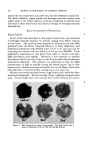
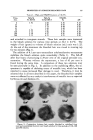
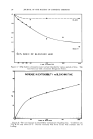
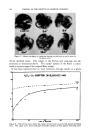
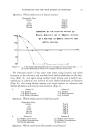
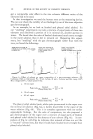
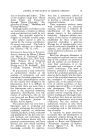
PROPERTIES OF PEROXIDE-BLEACHED HAIR 135 TABLE 1.--HdD2 A•r• NH4OH C•A•OES AT 32.2øC. Time, H,,O• % HdD2 % NH4OH, min. No EDTA 0.1% EDTA % pH 0 5.92 6.08 0.50 9.52 15 .. 5.87 0.45 9.36 30 ... 5.79 0.44 9.38 45 5.68 0.44 9.38 60 •.b• 5.60 0.43 9.38 120 3.12 5.06 0.39 9.38 180 2.58 4.67 0.36 9.38 240 2.15 4.31 0.31 9.38 and attached to two-gram strands. These hair samples were immersed in the bleach solution for various time periods at 32.2 + 0.1øC. The weight of hair (grams) to volume of bleach solution (mi.) ratio was 1:25. At the end of the treatment the bleached hair was rinsed in running tap for two minutes (Fig. 1). The addition of 0.1 per cent tetrasodium ethylenediamine tetraacetate stabilizes the bleach solution quite remarkably (Table 1). The fall-off after four hours of processing is 29 per cent of the original peroxide con- centration. Whereas without the sequestrant, a loss of 63 per cent is found during the same time. A comparison of these two solutions may be seen pictorally in Fig. 2. In addition to the stabilizing effect, the se- questrant is capable of chelating traces of metallic ions, which has been reported to cause increased fiber damage in wool. Therefore, it may be assumed that in all tests described in this paper, the bleached hair samples were not affected by any catalytic interferences of metallic ions as reported by Stoves (4) and Andrews (5). "' '?:•!:'!5'7.'•' ,r.: ....... ...:..: •.?. ::5, ß .' ...... .j:..!( ? ..... ß :.a"-• ....... 4.',- 5:•:•.. :..:7 :.•.: ......... .•: ß -- .•: . . -• ,• ..... •5: .• ',¾. 1:•:, '. : ::.• ß :. •..:' .... :5: • •: _:} .:. •:'.: *'*'::. .:• ':' "• ".5.%.•.•:': :. x } ' .... ,. . ..... :,- -,%• • :..•..,:•:• ..? -%:. Figure 2.Comparison between hair sample bleached in stabilized (top row) and unstabilized (bottom row) bleach solution for time periods of 120, 180 and 240 minutes.

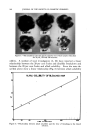
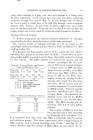
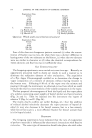
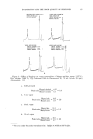
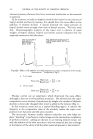
136 JOURNAL OF THE SOCIETY OF COSMETIC CHEMISTS Measurements of Hair Damage The most widely used measure for reporting hair damage is the 20 per cent Index, which is the ratio of work required to stretch the fiber 20 per cent after treatment to the work required before treatment. Twenty per cent Indexes were obtained with a Constant Elongation Tester. The instrument was made by G. F. Bush Associates, Princeton, N.J., to meet the requirements of Evans Research and Development Corporation. After a calibration stretch, in distilled water at room temperature, the 12 human hair bundles were attached to the two-gram strands and treated for various lengths of time. The strands were rinsed for two minutes in tap water, after which the bundles of 12 hairs were carefully removed from the strands and re-stretched in distilled water. The 20 per cent Indexes were calculated from the load-extension curves. The organic solvents, methyl-, ethyl alcohol and ethylene glycol, were previously dried and distilled over calcium hydride. The water content was determined and controlled during the stretch process by means of Karl Fischer titrations. The dry fibers, which had been in a vacuum desiccator for twenty-four hours over anhydrous calcium sulfate, were immersed for seven days in the organic solvents and calibrated in these anhydrous solvents. After the bleach treatment was performed (32.2øC.), the procedure as mentioned above was carried out, the fibers re-stretched, where possible for 20 per cent of their original length, and again the 20 per cent Index calculated from the load-extension curves. However, the results obtained by using only the 20 per cent Index lead to the use of other tests, particularly the extension-at-break, alkali solu- bility and copper-uptake tests. The results of these tests, as well as infor- mation obtained by photomicrographs are described in following sections. In order to understand how these procedures came to be used, it is nec- essary to turn to the tests themselves. T•E TEsTs 20 Per cent Index The 20 per cent Indexes obtained in water on hair bleached for various periods of time are shown in Table 2. A blank run on the fibers treated with the same solution (without the H202) is also shown in Table 2 and Fig. 3. It can be seen that NH4OH, sequestrant and water have a minor effect on the physical properties of the fiber. The table shows a 20.9 per cent drop in the 20 per cent Index during the first two-hour period and a 8.1 per cent drop during the second two-hour period. This change in rate may be caused by a combination of factors, such as the drop in H20= concentration with time, the possible formation of new cross linkages, and the partial breakdown of disulfide bonds.
Purchased for the exclusive use of nofirst nolast (unknown)
From: SCC Media Library & Resource Center (library.scconline.org)