354 JOURNAL OF THE SOCIETY OF COSMETIC CHEMISTS There is also a certain amount of unnecessary duplication. For instance, adjacent monographs describe acetic acid and glacial acetic acid separate monographs describe ethyl alcohol and I.M.S. sodium carbonate anhydrous, monohydrate and decahydrate calcium hydroxide and lime water chalk and calcium carbonate. The monograph on I.M.S. is particularly disappoint- ing and gives a completely erroneous picture of a material the use of which is made complex enough by Excise regulations information on denaturi- sation requirements could usefully have been included. Probably the most important group of modern cosmetic materials are the surface-active agents and their treatment in this volume is very sketchy and inadequate in contrast to the lengthy discussion of some materials of comparatively minor importance. Errors and misleading statements are all too frequent in this volume, making the reviewefts task the more difficult. The formula for D.D.T. (p. 165) is wrong the old numbering for the Arctons (p. 196) is used the Isceons and Ucons are not mentioned and the derivation of the present propellant numbering system is not given the formula for sodium perborate (p. 442) is wrong but the correct formulas for the two "hydrates" are given in the TPF standard on the adjacent page! (its main use as a cold wave neutraliser is not quoted) is propenyl alcoho! a synonym for glycerol (p. 202) ? The monograph on the Carbopols appears on page 113 but the TGA specification follows Polyvinyl alcohols on page 369 with no cross- reference. The monograph on cetyltrimethyl ammonium bromide incor- rectly ascribes this constitution to Cetrimide and Cetavlon the latter are, of course, the mixed alkyl (average C•4) derivative. I cannot agree with the definitive statement (p. 27 referring to aluminium chloride as a deodorant) "... it is the aluminium ion which reacts with and precipitates the skin proteins with consequent obstruction of the sweat pore". Perhaps the most spectacular error however refers to the use of thioglycollic acid in cold waving (p. 502), "... it severs the S-S link in hair and forms an S-H group. An oxidizing agent is then applied to the hair and a sulphenic group is produced R-S-OH, which combines with another amino group in the hair molecula to give the 'set' "• I found particularly irritating the inconsistent and sometimes quite erroneous presentation of references, and the extraordinary number of typographical errors indicate that the proof-reading leaves very much to be desired. The presentation, binding and paper of this new edition are excellent but regrettably I cannot say that this volume is either a worthy successor to the first edition, or a worthy companion to the filth edition of Volume 1. R. P. REEVES.

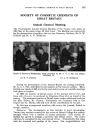
SOCIETY OF COSMETIC CHEMISTS OF GREAT BRITAIN 355 SOCIETY OF COSMETIC CHEMISTS OF GREAT BRITAIN Annual General Meeting THE FOURTEENTH Annual General Meeting of the Society took place on 24th May at the usual venue, 55 Park Lane. The Meeting was noteworthy for the presentation of scrolls to the two new Honorary Members, Dr. H. W. Hibbott and Dr. A. W. Middleton. Scrolls of Honorary Membership being presented by Mr. G. A. C. Pitt, the retiring President, to: Dr. H. W. I-Iibbott Dr. A. W. Middleton During his presentation of the Annual Report the retiring President, Mr. G. A. C. Pitt, underlined recent progress in the Society's affairs. Mem- bership now stands at 392, and in the year under review six scientific meetings took place in London. In 1963 the number of British issues of the Journal will be five, and these will, of course, be produced by Pergamon Press Ltd. on behalf of the Society. The increased number of British issues makes additional work for the Hon. Editor, Mr. Herzka. Fortunately our Symposia help in this respect but Mr. Herzka will still need all the contributions he can get. By this new arrangement members will receive the Journal, British or foreign, monthly. Education. The development in this activity is most encouraging. Twenty-four students entered for the course at Brunel College this session, amongst whom were a number of science graduates. Next session Dr. Skellon has agreed to arrange a part-time day release course. The course will then be completed in one year instead of two. Undoubtedly this raises both the standard and prestige of the course. Our congratulations and
Purchased for the exclusive use of nofirst nolast (unknown)
From: SCC Media Library & Resource Center (library.scconline.org)