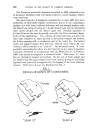
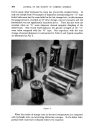
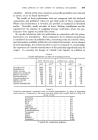
SOME ASPECTS OF THE SAFETY OF AEROSOL CONTAINERS 377 backed by a 25 mm diameter circular rubber shield. Following use, there is some dribbling from the delivery tube but this is not a hazard relevant to carriage or storage. Plastics caps are particularly common. They are most frequently moulded from polyethylene cellulose ester caps are generally more rigid and less deform able under load but some have shown a tendency slowly to embritt!e. Thus, when pressure was applied to a cellulose ester cap of a dispenser that had been stored for two years, the cap instantly shattered. High density polyethylene is also subject to environmental cracking with certain solvents, especially aromatic hydrocarbons. To minimize exposure to the vapour of these solvents, some polyethylene caps are vented, i.e. bearing two or more fine holes, which are (presumably) intended to permit evaporation of solvent spilt into the cup during use. The majority of plastics caps are cylindrical, 31-33 mm internal diameter and usually 20-22 mm high. One series, available in both high density polyethylene and cellulose ester, which is particularly popular in the home- market, has generally been considered unsatisfactory for export unless special features of the inner packaging attenuate direct loading on the caps. The internal height is only 18 mm which for transport and storage purposes may be considered an inadequate clearance (less than 2 mm) above the valve button.* The basic cap design may be improved by a variety of integrally moulded features. Thus, resistance to a vertical load is assisted by fluting the sides and/or the provision of internal ribs, whilst adherence to the rim of the valve cup, normally achieved by an annular thickening of the cylinder wall moulding to form a "gripping ring" below the fluting, is improved by the presence of 3, 4 or 6 flanges. The cylindrical pattern is subject to further modification. Thus, polyethylene caps may be moulded in a conical frustum (half-barrel) shape. One such cap has an internal diameter of 33 mm, tapering to 24 mm, and is further supported by three substantial internal ribs this form achieves a better load resistance, albeit slightly increasing the ease of dislodgement. Another polyethylene example, recently submitted, has less to commend it. It is more flexible, has less taper (i.d's. of 33 and 26 mm) and little significant additional support is given by four slender moulded struts this cap will resist moderate loads when fitted to the (broader) 12 oz dispensers but tends to splay, thereby releasing the valve, when tested with the smaller (narrower) containers. The logical extension of this frustum trend is seen in a tough, hemispherical, cellulose ester cap with an equatorial grip-ring and 6 internal flanges. These caps are not easily dislodged and offer excellent resistance to applied loads. Unfortunately, a deceptively similar cap, made of thin polyethylene, is *This design has since been modified by the manufacturers to give a satisfactory internal clearance.

378 JOURNAL OF THE SOCIETY OF COSMETIC CHEMISTS available which dimples readily under load and the valve button is dis- charged. A number of dispensers have been fitted with an example of the contrary trend in style--a strong, thick, polyethylene, cover in the shape of a "pork-pie" hat this is one of the strongest plastics caps in our experience. A specialized dispensing cap has been fitted to a herbicidal preparation. A 50 mm diameter, 12 mm maximum height, polyethylene, mushroom-shaped cover with six slender ribs, fits over the brass valve stem. From the middle of the top of the cover, a 25 mm extension leads to a fine metal jet, which in turn is protected by a 12 mm plastic stall. It was found that quite gentle vertical pressure on the shoulder of the cover was sufficient violently to force off the stal/-cap and eject the flammable solvent. It has been recommended that for transportation a suitable cover be fitted to the valve and the dispensing caps packed separately. Caps in a larger series, also generally moulded from polyethylene, are designed to fit the full width of standard 50 mm diameter dispensers. A variety of designs have been observed, all comprising flat-ended, smooth-wall cylinders of 48-52 mm internal diameter and heights between 27 and 32 mm. Resistance both to dislodgement and to a vertical load is furnished in three caps by a concentric cylindrical inner skirt of appropriate diameter to fit inside or outside the valve cup (one is described as a "Stack Cap") a fourth design has six rectangular ribs, a fifth includes four vertical pillars of outward- facing T-shaped cross-section which tangentially fit the valve cup rim and, finally, one has a stepped brim reaching down over the shoulder of the dis- penser: this last design has been referred to as a "Top Hat" style. Several types of pilfer-proof cap have been examined. One, of Nor- wegian origin, comprises a tough polyethylene cylinder, 30 mm internal diameter and finely fluted 15 mm sides, attached by 5 integrally moulded tabs to a larger collar (outside diameter 35 mm) this collar fits snugly about the valve cup. When submitted to steady pressures up to 130 psi., the upper, narrower portion of the cap sinks down onto the valve cup rim and under 160 psi. the button is momentarily discharged the tabs, however, are still preserved intact. Neither will abrupt moderate blows with a hammer break them, but if the dispenser is allowed to fall from about 2', cap downwards, on to a hard, wood-block floor, the union is severed. However, the cap is still retained in situ by the severed collar and continues effectively to serve as a satisfactory cover, resisting loading equivalent to 130 psi. Another tamper-proof closure, made in this country, consists of a moulded, ribbed, plastic dome retained by an aluminium foil overseal. This seal has to be cut and removed before the cap can be lifted. A similar overseal has been supplied with a slender, low-density polyethylene, vented cover (22 mm diameter base) designed to fit closely around the actuator button and inside the valve cup. Both these tamper-proof covers adequately resist applied loads of 200 lb.
Purchased for the exclusive use of nofirst nolast (unknown)
From: SCC Media Library & Resource Center (library.scconline.org)