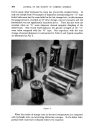
SOME ASPECTS OF THE SAFETY OF AEROSOL CONTAINERS 387 The inside is slotted to take a number of light alloy partitions which restrict possible movement of glass beakers which have been fitted individually to each pressurized dispenser under test. It is important to allow free circula- tiov of hot air within the oven and adequate time for the liquid contents of the dispensers to reach the test temperature. Further details would willingly be supplied if required. MR. E. K. CLARKE: I would recommend the use of gloves and face shield when handling hot aerosol containers, and indeed would take care when handling cool containers that had been heated to 55øC. TI•E LECTURER: In general, these precautions are wise. However, in the specific context of our oven test, the hazard is minimized by leaving the dispensers within the protective metal case for about 30 minutes before removal, either to complete their cooling prior to examination, or if the vapour pressure at elevated temperature (usually 55øC) is to be rechecked, for transfer to a screened water bath. MR. E. K. CLARKE: You quote a test of flammability in a dish as being "more searching than the U.S. modified Tagliabue open cup test" If the flammability is "masked," why is it necessary to consider it, and what reason is there for having a more searching test. T•E LECTURER: In general, apparatus for the determination of flashpoint are designed to estab!ish the lowest temperature at which a flammable vapour is evolved from a product as a whole. The Abel apparatus has a "closed cup" which tends to concentrate the vapour(s) evolved and gives consistently lower flashpoint values than the Tag!iabue "open cup" equip- ment. This is well recognized in, for exampie, the IATA definition of a "flammable liquid" for which the temperatures 73øF in a closed cup tester, and 80øF in an open cup tester are equated. In both these, and related flashpoint methods, the actual apparatus may be considered an arbitrary design but the procedure is closely standardized and reproducible within narrow limits. During the course of our open dish test for combustibility, the product is allowed first to warm to room temperature and is then gradually heated. Under these conditions, progressively less volatile components have a much greater opportunity to evaporate than is possible in, for example, the equipment of formal apparatus for the determination of flash- point. It is contended that such progressive evaporation bears more relation to conditions likely to obtain were the contents to leak from a container that had suffered structural failure or had been crushed. Nevertheless, practical allowance is made in our tests for the "masking" influence of any flame suppressant components present, on the volatility of which, relative to that of flammable component(s), the resultant combustibility will depend. .)SS • rrll

388 JOURNAL OF THE SOCIETY OF COSMETIC CHEMISTS MR. D. AS•)E•: I hope that when standards are being drawn up both within the cosmetic industry and/or within the aerosol industry, as far as possible they should cover the specific requirements of the test and not the method by which the test should be carried out. This is particularly rele- vant to the testing of aerosols. The draft British standard would read "that the container should be immersed for a specific period in a water bath of a specific temperature." I feel that this should mean that the dispenser be tested for a given period of time at a given temperature (or even the head- space at a given temperature) so that the pressure within the dispenser reaches a given figure and no leak or bursting should occur. It is particu- larly important that this type of specification be produced, otherwise the advancement of the industry could well be limited to one testing procedure, while everybody hopes that with the appropriate attention to development the forms of testing which are most economic should be used. The majority of the explosive gases or yapours involved in the aerosol industry fall within those specified as Group II by British Standard 229:1959, and I believe that the use of aluminium is specifically excluded. Could the lecturer therefore explain why the use of aluminium aerosols can be accepted ? TI•E LECTURER: In general, when a specification quotes a desired result, it is customary to cite an approved means of establishing that result. Such a procedure would usually be regarded as a referee method, whilst more convenient local methods can be, and frequently are, used to ascertain compliance with the specification--provided that it has first been established that the same result will be obtained by either method. In case of dispute, the reference method should be used. With regard to the example cited, I agree that the desired object should be stated if there is any doubt that a suggested method is unlikely to establish this object, then such evidence should be submitted to the relevant BS committee and other test procedures considered. Equally, I agree that the committee should take into considera- tion all suitable methods in arriving at a decision. In any event, British and other national standards are subject to periodic revision and the appropriate committees are reactivated. BS 229:1959 refers to enclosures for electrical apparatus in the presence of flammable gases and yapours in air the study of gaseous reactions at metal and other surfaces is the province of the Safety in Mines Research Establishment, Buxton, of which work I have no personal experience. Such reactions are not necessarily relevant to conditions obtaining inside a metal container where the presence of air has been deliberately excluded.
Purchased for the exclusive use of nofirst nolast (unknown)
From: SCC Media Library & Resource Center (library.scconline.org)