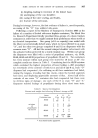
AEROSOL PROPELLANTS 411 used in valves and little or no effect on textiles, but this apart, it shares the disadvantages of methylene chloride listed above. Its pressure character- istics in mixtures with propellant 12 are very close to those of propellant 11. It is used as a solvent in aerosols (e.g. for cold cleaning, spotting) and to reduce the flammability of other solvents. Appreciably more costly than methylene chloride, it is not likely to be considered solely as a cheaper substitute for propellant 11. Vinyl Chloride (CH•:CHC1) Vinyl chloride is a liquefied gas, boiling at -13.9øC. Its vapour pressure is very similar to that of propellant 12/11 mixture. It has an MAC of 500 ppm v/v and, although not classified by the Underwriters Laboratories, its toxicity would appear to place it between Groups 4 and 5. At higher concentrations it has an anaesthetic effect but the quantities which might be used in aerosols are never likely to create a user hazard in this respect. Vinyl chloride is cheaper than the fluorocarbon propellants, is a stronger solvent and has a higher expansion ratio on evaporation. On the debit side, it is highly flammable and forms explosive mixtures with air in the range 4-22% by volume. It has a marked swelling effect on elastomers and possesses a pronounced odour. It is manufactured almost exclusively for polymerization to PVC and for the production of allied co-polymers published work 6 has recommended that it should contain a stabiliser if used in aerosols. To the best of my knowledge vinyl chloride has not been used com- mercially in aerosols in the United Kingdom. In a few European countries, and in Japan, it has been used as a primary propellant and two manufacturers in the U.S.A. offer blends of propellant 12 or 12/11 and VC. One of these firms 6 reports that vapour mixtures of vinyl chloride and propellant 12/11 50/50 are non-flammable if the VC content is below 45% v/v, i.e. 29.4% on a liquid weight basis because of fractionation the actual amount of VC that can be tolerated is 22ø/0 w/w, hence their blend is offered as 78% 12/11 50/50+22% VC. HYDROCARBON PROPELLANTS Propane (Calla), n-and isobutane (C•H•0) are liquefied gases. They are virtually non-toxic, being classified by the Underwriters Laboratories in Group 5b. Commercial grades vary in composition according to source, but mixtures of two or more of the hydrocarbons provide pressures suitable for aerosol dispensing. For example, a mixture of 50% nbutane, 25% isobutane and 25% propane gives about the same pressure as propellant 12/11 50/50. The hydrocarbon propellants are low-priced. They are immiscible with, and have a good stability in, water and, unlike the fluorocarbon propellants,

412 JOURNAL OF THE SOCIETY OF COSMETIC CHEMISTS have densities less than 1. These properties all favour the hydrocarbons for water-based applications such as iurniture polishes, where small pro- portions of propellant are used in three phase systems. The major disadvantage of the hydrocarbons is their high flammability and the fact that they form explosive mixtures with air at quite low levels (2% by volume). The U.S. Bureau of Mines 7 found that the flammability of pure nbutane could be suppressed by mixing it with three times its volume of prope!!ant 12. Work which we carried out with commercial butane has shown that about the same figure applies for propellant 12/11 mixture 3:1 by volume is equivalent to about 13% butane by weight in the mixture. A second serious disadvantage is that the hydrocarbons often present odour problems due to impurities which are sometimes difficult to remove from containers, etc., as well as affecting filled aerosols. I am not aware of any non-aqueous aerosols marketed in the United Kingdom with hydrocarbons as the only propellant. Such aerosols are, however, packed in France and a number of European fillers use a proportion of hydrocarbon with fluorocarbon propel!ants to reduce cost. In the U.S.A. one manufacturer markets two blends: 12/11/isobutane 45/45/10, and 12/114/butane 9.1/82.4/8.5--this last mixture being offered for perfume aerosols. Propane is occasionally used in the U.S.A. mixed with propellant 11 or methylene chloride to depress its pressure and suppress flammability. As yet, few of the water-based space sprays containing larger amounts of hydrocarbon propellant (Liquefied Gas System (c) above) have appeared on the United Kingdom market and it is too early to say whether their performance will equal that of the established space sprays or how much the extra cost of valve, lacquered container and formulation work will be outweighed by savings in solvent and propellant, also the extent to which special storage and transport conditions will be necessary in the distributive chain. FLAMMABLE VERSUS NON-FLAMMABLE PROPELLANTS A paper on the flammability of propellants is being read at this Sym- posium, so that I have deliberately avoided entering the lists and starting what our American friends call a "Hassle". National Aerosol Associations, Government bodies, fillers and propellant manufacturers throughout the world are debating what should or should not be done to ensure the safe transport of aerosols and the protection of the user. It is foolish to emulate the ostrich, but it is equally important to ensure that the good record of aerosols over many years is not endangered by departing too rapidly or radically from well tried practices. (Received: 1!tth March 11165)
Purchased for the exclusive use of nofirst nolast (unknown)
From: SCC Media Library & Resource Center (library.scconline.org)