J. soc. cos. CHEM. 15, 459-4-63 (1964) TWO-DIMENSIONAL DESCENDING PAPER CHROMATOGRAPHY AS A METHOD FOR THE SEPARATION OF THE AMINO ACIDS IN HAIR By ALBERT SHANSKY, P•.D.* ABSTRACT Results of paper chromatographic analyses of the amino acid com- position of normal, of reduced, and of reduced and oxidized human hair are presented. These preliminary data suggest that reduction of hair with alkaline thioglycolate not only splits disulfide linkages of cystinc but causes chemical changes in other amino acids. Human hair can be subjected to many chemical treatments in order to produce various physical effects. It appears likely that the changes taking place at the various bonds which structurally support the keratin molecule can be elucidated through amino acid analyses. A particularly promising analytical tool is two-dimensional paper chromatography (1) which can be applied readily to the qualitative microanalysis of protein hydrolysates or other amino acid mixtures. In the studies reported here, the protein hydrolysate was first separated into fractions comprising acidic, basic and neutral amino acids with the aid of ion exchange resins. These three fractions were then individually subjected to paper chromatography. MATERIALS AND EQUIPMENT Whatman No. 1 filter paper was used (standard sheet, 18 X 22.5 in.). The advancing front of liquid is yellowish-brown, but this contaminant of the paper moves so rapidly that it does not usually interfere. A com- mercially available trough for two-dimensional paper chromatography was employed. The chamber, a glass-sided lead box (about 75 X 75 X 12.5 cm.) was made airtight with a lead cover. The first solvent used was a phenol mixture which is prepared as follows: To a mixture of 100 mi. of water and 400 mi. of liquid phenol, made homo- geneous by warming, is added 20 mg. of 8-quinolinol. During chroma- * Rilling Dermetics Co., Bridgeport 7, Conn. 459

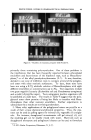
460 JOURNAL OF THE SOCIETY OF COSMETIC CHEMISTS tography with this solvent, a beaker containing 30 mi. of 0.3% ammonia is placed into the chamber. The second solvent is prepared as follows: To 55 parts of 2,6-1utidine are added 20 parts of isopropanol and 25 parts of water. To each 500 mi. of this mixture is added 3.3 mi. of diethylamine. During chromatography with this solvent a beaker containing 100 mg. of sodium cyanide in 4-6 mi. of water is placed into the chamber. EXPERIMENTAL Various hair swatches were exposed to the following treatments for comparative study: A--untreated hair. B--hair subjected to three minutes of total immersion in a reducing solu- tion of pH = 9.3 (alkali = 0.67 N thioglycolate = 6.62%). C--hair subjected to treatment B followed by a four-minute total immer- sion in 1.5% H202 at pH = 4.8. D--hair subjected to 8 minutes of total immersion in solution of B fol- lowed by a four-minute total immersion in 1.5% H20=at pH = 4.8. The hair swatches in all cases above were given final water rinses in order to remove residual matter and then were dried with a hair dryer. Two hundred rag. hair charges were placed in 5 mi. of 1:1 HCl in Pyrex test tubes. The tubes were sealed, and the hair was hydrolyzed in a para- fIin oven for 6 hours at 120øC. At the end of the hydrolysis, the tubes were allowed to cool, then cracked open. HCl removal was accomplished by re- peated evaporation in a vacuum oven. The hydrolysates were then filtered and made up to 5 mi. with deionized water. The filtered hydrolysates were separated into their acidic, basic and neutral fractions by means of ion exchange columns. The hydrolysate was first passed through a column of Amberlite IR-4B©* the acidic amino acids are adsorbed, and the neutral and basic amino acids pass through. The adsorbed acidic amino acids were eluted with N/10 HC1 and collected separately. (The column is conveniently regenerated with 4% NaOH.) The basic and neutral hydrolysate fraction was then passed through a column of Amberlite IR-50-C which was previously buffered at pH 4.0 with an acetate buffer. The basic amino acids are adsorbed, and the neutral amino acids pass through. The basic amino acids were eluted with N/10 HCl. (The column is regenerated with 4% NaOH and buffered at pH 4.0 with acetate buffer.) By buffering the Amberlite IR-50-C at pH 4.0, cystine appears in the neutral fraction of amino acids. That cystine * Amberlite is a trade name of Rohm & Haas Co., Philadelphia, Pa.
Purchased for the exclusive use of nofirst nolast (unknown)
From: SCC Media Library & Resource Center (library.scconline.org)