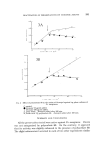
INACTIVATION OF PRESERVATIVES BY NONIONIC AGENTS 195 by altering the permeability properties, but it will also, and quite separately, bind with the chemicals and eliminate them from the system. When there is a low con- centration of polysorbate the binding phenomenon is slight, as compared to the sensitization of the cells. As one increases the polysorbate concentration, the cells are still made sensitive but the binding is such that there is virtually no chemical present to be harmful. In support of this hypothesis we have grown cells in nutrient broth, harvested them, washed them, and effectively removed the broth that was there, apart from any trace that might be adsorbed on the cell surface. We have also grown the cells in the presence of polysorbate 80. They were washed in each case. The washing may or may not remove any adsorbed layer on the cells, but it will certainly remove the bulk of the polysorbate. If the cells are then tested with chemicals, the cells that have grown in the presence of polysorbate are signi- ficantly more sensitive to chemical attack than the cells grown in its absence.

j. Soc. Cosmetic Chemists 17 197-211 (1966) •) 1966 Society of Cosmetic Cl•emists of Great Britain Particle size analysis using Counters Coulter W. M. WOOD and R. W. LINES* Presented at the Symposium on "Physical Methods," organised by the Society of Cosmetic Chemists of Great Britain, in Bristol on I6th November 1965. 1tyno10sis--A relatively new instrument for the size analysis of most forms of particulate material is described. The instrument senses particles suspended in an electrolyte by their momentary displacement of electrolyte, causing an increase of resistance to applied current, as each passes through a small hole, or orifice, in an insulator. Passage is essentially singly, although corrections can be applied for any coincidence loss. Counts at up to $,000 particles per second are possible, and the resulting size distribution is built up in some twenty minutes, including calculation time, although this can be reduced on a routine basis. A technique for the size analysis of wide range powders, i.e. those wider than the range of resolution of any particular orifice, is discussed. The range of new models available working on this same basic principle is reviewed. These reduce calculation time considerably, as well as incorporating many other refinements. A series of particle size distribution on a wide range of cosmetic materials illustrate the usefulness and versatility of the instrument. The realization that the size distribution of powders, and other particulate material, is of critical importance to the final product of that material has been achieved in every industry using powders. Particle size affects such things as the definition obtained from phosphors used to coat television tubes, the workability of a metal alloy, the grittiness of food products, the colour of pigments, the solubility and efficiency of pharmaceutical preparations, and the response of control systems in modern high speed aircraft. No less important are the particles in the cosmetics industry. Simple * Coulter Electronics Ltd., Dunstable, Beds. 197
Purchased for the exclusive use of nofirst nolast (unknown)
From: SCC Media Library & Resource Center (library.scconline.org)