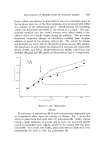
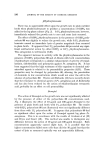
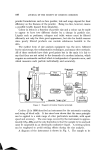
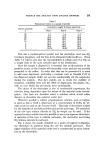
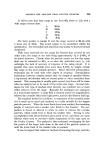
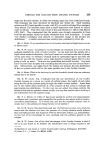
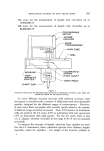
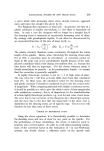
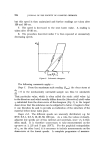
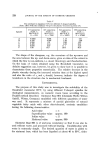
198 JOURNAL OF THE SOCIETY OF COSMETIC CHEMISTS powder formulations such as face powder, talc and rouge depend for their efficiency on the fineness of the powder. Being too fine, however, means a possible health hazard from inhalation. Colour in lotion is a function of particle size and a colour can be made to appear to have two different shades by a change in particle size. Liquids such as perfumes, colognes and toilet waters must be filtered efficiently not only for their good appearance, but also for health reasons since poorly filtered products can contain substances harmful to the skin.. The earliest form of size analysis equipment was the sieve, followed by the microscope, the sedimentation techniques, and many other methods. All of these methods have their good points but in the main it is fair to say that they are not suited to the demands of a modern industry, which requires an automatic method which is independent of operator error, and which measures each particle individually and accurately. Figure 1 Diagram of Coulter Counter principle Coulter (1) in 1956 described an instrument for the automatic counting and sizing of blood cells. It has since been shown that the same principle can be applied to a wide range of other particulate materials, with equal speed and accuracy. The size range covered by the instrument is approx- imately 0.5•-400• and the only limitation is that the sample to be analysed must be suspended in an electrically conductive liquid. A stirring system can be employed to avoid settling effects during the size analysis. A diagram of the instrument is shown in Fig. 1. The sample to be

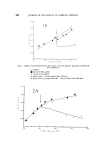
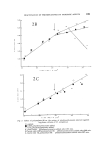
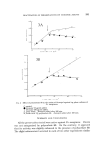
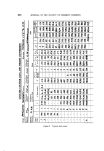
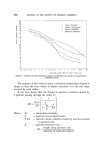
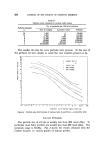
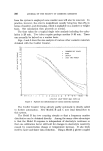
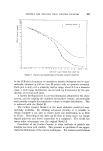
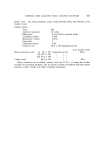
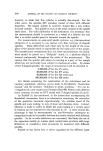
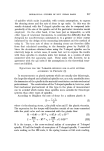
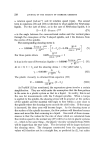
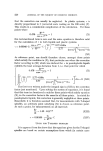
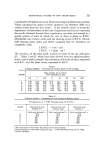
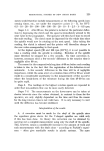
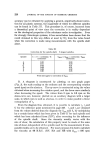
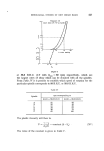
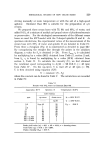
PARTICLE SIZE ANALYSIS USING COULTER COUNTERS 199 analysed is suspended in a suitable electrolyte in a beaker and placed on the beaker platform. A glass orifice tube, having an accurately made aperture in the lower end projects into the beaker, the inside of the tube being filled with the same electrolyte as in the beaker. On either side of the orifice is an immersed electrode. By applying a controlled vacuum to the orifice and the mercury manometer situated behind it, liquid and the suspended particles are drawn through the aperture. The passage of the particle through the orifice causes a momentary increase in the resis- tance to the current which is simultaneously passing through the orifice. This increase is detected as a voltage pulse, proportional to the volume of the particle. This pulse is then amplified, scaled, passed through an adjustable threshold and counted, if it exceeds that threshold level, when desired. Closing the top tap on the control piece cuts off the vacuum and the returning mercury column continues sample flow through the orifice. Set in the manometer are a series of electrodes which enable one to obtain a particle count in varying sample volumes (0.05, 0.5 and 2 ml). A single count above any given size can be made in some 15 sec, and by a repetition of this process a size distribution can be made over as many points as may be necessary in a very short time. Since the Coulter Counter measures the volume of the particles directly, conversion of particles to volume per cent or for particles of uniform density weight per cent, presents few calculation problems. An example of a typical data sheet is shown in Fig. 2. With the Coulter Counter one of the essential features is the quality of the dispersion, which is, of course, common to all other sizing methods using a suspension. The Counter will count and size anything that is presented to the orifice, so it is vital that one decides whether one requires the size of the particles in the powder or liquid as they are in the original sample, or the size of the discreet particles, and accordingly select the appropriate method of dispersion. Many methods are available for this purpose, but the one which is currently finding fayour is the use of ultrasonics. Small laboratory baths are now commercially available into which are placed the beaker, the sample together with the electrolyte plus some other dispersant, if needed. The time interval needed to obtain a reproducible dispersion is usually between 15 sec and 2 min, according to the ease or difficulty of dispersion. An example of the reproducibility of the method of dispersion, sampling and the Counter is shown in Table I:
Purchased for the exclusive use of nofirst nolast (unknown)
From: SCC Media Library & Resource Center (library.scconline.org)