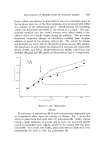
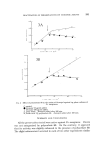
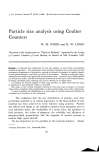
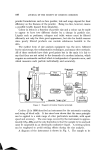
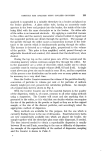
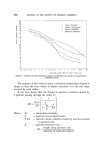
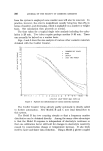
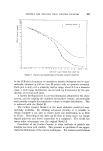
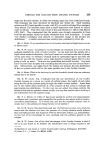
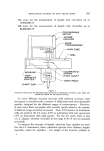
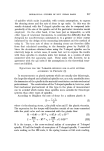
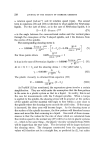
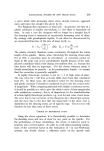
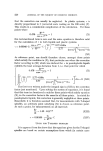
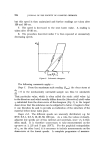
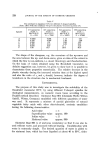
202 JOURNAL OF THE SOCIETY OF COSMETIC CHEMISTS CUMULttTIVE Woe1½I4T PERCENT A•OVE $Tt•ToeP .•IZE Figure 3 Particle size distributions of typical toothpastes and powders (Logarithmic-- probability plot) The response of the Coulter Counter is relatively independent of particle shape, in that the true volume is always measured over the size range covered by each orifice. It has been shown that the change in aperture resistance caused by a particle passing through the orifice is 1 Po.V 1 AR -- A • Po - •--A 1--•- Where: Po = electrolyte resistivity A = aperture area normal to axis V,P,a = particle volume, effective resistivity and area normal to aperture axis X = particle dimension ratio = 1/d = length along aperture axis diameter of equivalent sphere

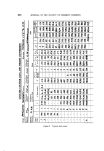
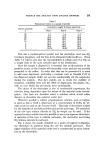
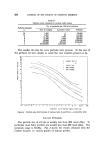
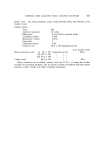
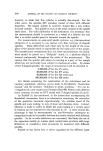
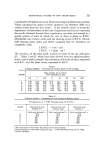
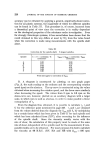
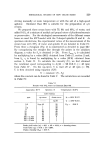
PARTICLE SIZE ANALYSIS USING COULTER COUNTERS 203 Thus for any given electrical condition and aperture size, response is essentially linear with particle volume, giving insignificant error (1%, on a volume basis) provided that the maximum size measured by any one orifice tube is below 40-50% of its physical diameter. Particle resistivity has also been proved to have no significant effect on instrument responses. All powders, once they are in suspension behave as non-conductors, this being attributed to either an oxide film on the particle surface or the Helmholtz Double Electrical layer, surrounding each particle. It can also be seen from the above equation that particle density cannot affect response. However, data reduction from volume to weight per cent cannot be made in the case of a mixed powder of varying densities unless the ratio of densities is known and can be attributed at each particle diameter. Temperature change mainly affects the response by the change in electrolyte resistivity. Under normal working conditions this is negligible but a simple correction can be made if necessary. Particle concentration used in the Coulter Counter is that which gives a maximum number count below the limit of coincidence effects for the orifice tube in use. In terms of sample amount used this is usually of the order of 20-30 mg in 150 ml of electrolyte. As the method involves the counting of particles suspended in a liquid it is obvious that for any desired accuracy the particulate counts must be significantly higher than that of the base electrolyte. Ideally this solution should be completely particle free but this is a practical impossi- bility. In practice, filtration is carried out with cellulose acetate membranes of the Millipore type, and these are satisfactory for aqueous solutions, but for non-aqueous media a glass fibre paper must be used. This, of course, must be supported on a glass sinter to prevent fibres from the paper getting into the electrolyte. Calibration of the Coulter Counter is usually made directly against particles of a known size such as polystyrene latices, spores and pollens, all of which have a fairly low standard deviation about their mean. As particle volume is measured directly by the instrument settings (threshold dial (t •) and aperture current switch (I)) then the calculation of particle diameter d, is equal to K x 3•/instrument settings, K being the calibration constant for that aperture tube and electrolyte system. Since the instrument produces number versus size it can be used for the on-stream control of solutions such as eau-de-colognes. A typical set of results are shown in Table II.
Purchased for the exclusive use of nofirst nolast (unknown)
From: SCC Media Library & Resource Center (library.scconline.org)