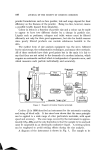
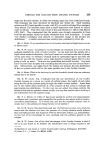
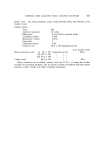
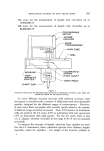
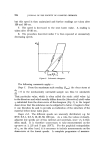
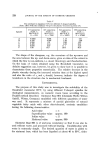
RHEOLOGICAL STUDIES OF NEW CREAM BASES 215 HA series for the measurement of liquids with viscosities up to 16,000,000 cP. HB series for the measurement of liquids with viscosities up to 64,000,000 cP. •---$ YNCIfRONOU$ •.%_../ MO TOR ' MOTOR HOU,•iNG Goe•R ATED '• I •-• •&)RING Figure 1 Schematic drawing of the Brookfield Synchro-Lectric viscometer (switches, gear shift, and clutch not shown for the sake of clarity). To cover different viscosity intervals with sufficient accuracy, each instrument is provided with a number of differently-sized interchangeable spindles, designed for the different ranges of measurements. Moreover, in each series there are models with variable speeds whereby the number of different ranges is further increased. Thus, LVO denotes an instrument with one speed in the LV series, LVF an instrument with four speeds and LVT an instrument with eight speeds. For the LV series, there is also a U.L. adapter, whereby viscosities in the range 0-10 cP can be measured accurately. To measure the viscosity of liquids, relatively large spindles are used. For the LV instrument, these cylindrical spindles have different heights (hereafter called LV spindles) - the height of the shortest cylinder is,

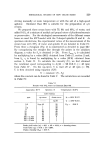
JOURNAL OF THE SOCIETY OF COSMETIC CHEMISTS however, so small that this cylinder is actually disc-shaped. For the other series, the spindles (RV spindles) consist of discs with different diameters. The largest spindle is, however, shaped like a low, hollow inverted cylinder. One spindle in each of the series consists of the spindle shaft alone. For valid calibration of the instrument it is necessary that the measurement should be performed in a vessel of a definite size and that a so-called spindle guard is mounted around the spindle. For measurements on semi-solid plastic systems, e.g. pharmaceutical ointments, it is necessary to use special, very thin, bar-type (T-shaped) spindles. These differ from each other only by the length of the cross- piece of the spindle which is responsible for the main part of the torque. The manufacturer recommends that, for these measurements, the instru- ment should be placed on a "Helipath" stand, i.e. a platform which is lowered continuously throughout the whole of the measurement. This ensures that the spindle will always be moving in a part of the sample which has not previously been subject to mechanical action. By means of the T-shaped spindles, the range of measurement will be extended to 3,330,000 cP for the LV series, 20,000,000 cP for the RV series, 40,000,000 cP for the HA series and 160,000,000 cP for the HB series. For details concerning the construction of the instrument and its auxiliary equipment, reference can be made to Brookfield's "Instruction manual" and the brochure "Solutions to sticky problems." For our in- vestigations of a new cream base (Ointment Base 601 Witten) with different water contents, we used an RVT model with T-shaped spindles B and E. As Fryk16f (1) has mentioned, in the instructions accompanying the Brookfield viscometers, there is no information concerning the conversion of the quantifies measured experimentally, viz. rotation speed of the spindle and scale reading, to rate of shear and shearing stress. Instead, reference is made to tables in which the scale reading at a certain speed of rotation can be converted to the viscosity in cP. A more serious dis- advantage is that in measurements on non-Newtonian substances no comparison is said to be possible between the results obtained with different spindles. As far as such substances are concerned, this limits the use of the apparatus mainly I to routine plant control since products with large differences in consistency must necessarily be measured with different spindles. Fryk16f (1) has shown how to derive equations for the different types
Purchased for the exclusive use of nofirst nolast (unknown)
From: SCC Media Library & Resource Center (library.scconline.org)