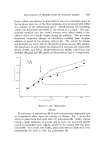
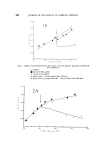
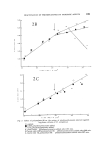
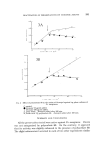
INACTIVATION OF PRESERVATIVES BY NONIONIC AGENTS 193 Introduction by the lecturer The main point to be made is that using the method described it is possible rapidly to assess antibacterial activity against log phase cells. Furthermore, about 10 cultures can be used at any one time so that a flexible experimental design is possible. Unfortunately, this method is not the answer to all our desires about testing chemical antimicrobial agents. There are several limitations to the method which are mentioned in the paper. In general, it may be said that these procedures are useful, mainly for preliminary screening purposes, but are not restricted exclusively to screening. It is possible to obtain precise quantitative relationships between growth rates and to compare the effects on growth rate of such variables as chemical concentration, reaction temperature, pH and cell concentration. DISCUSSION PROF. F. NEUWALD: Can you give me any idea why, in Fig. 2B, the bacterial effect after the addition of 0.1 •o phydroxybenzoates occurs about 30 min after the addition ? In all your other Figures, the growth rate decreases immediately after the addition of the chemical agent. Tu•. L•.CTUR•.R: What you say is quite true and is in fact rather interesting. For most of our work, and indeed in order for the method to be most useful, it is necessary that the conditions are such that when a chemical is added to a culture in the log phase its effects are immediately apparent. When this happens it is possible to get a quantitative relationship between the rates of growth. We have been able to show that there is a relationship between total cell numbers that are living or dead, and the viable count as well as with the optical density. In some cases, however, this does not happen, e.g. where we added 0.1 •o phydroxybenzoates to Pseudomonas aeruginosa growing in the presence of 0.02 •o Tween. This particular culture had the chemical added and about 25 rain later the growth curve tailed off and there was considerable lysis. Such a drop in optical density must be due to lysis unless there is some peculiar occurrence in the culture, such as clumping. This possibility was eliminated by examining the culture microscopically. Under these circumstances it is not possible to get any precise quantitative relationships between rates of growth and kill, but nevertheless from the practical point of view of preservation, I think this method can still tell us something useful. I have seen this delayed phenomenon before. It occurred when I was working with penicillin and E. Colt and the effect was reproducible in that it occurred but the extent to which it occurred and the length of the delay was not very reproducible. The delay in Fig. oeB does seem to correspond to approximately a generation time, but whether in fact this is significant I do not know. MR. N.J. VAN ABBr.: How does your work on the reported results relate to the usual concepts of bacteriostasis and bactericidal activity ? THe. LECTURER: I find the terms bacteriostatic and bactericidal activity a source of confusion. If tetracyclin is added to E. Colt, the cell count is about 108 and one plots log numbers against time and then, depending upon the concentration added to a log phase culture, there could be a reduction in count from 108 to l0 s. As far as those cells are concerned, I suppose the activity has been bactericidal. If the count remained at 102 one would say this is acting as a bacteriostat, i.e. no growth is

194 JOURNAL OF THE SOCIETY OF COSMETIC CHEMISTS occurring, yet this may be simply a function of time. If measured after three weeks one could get growth. It is acting as a bacteriostatic agent, even though possibly there has been a drop of 99.9999 •o and those cells are dead. I would suggest that in these circumstances, the words bacteriostatic and bactericidal are very often unhelpful. It would be better to say there has been a drop in count of six log cycles and that growth subsequently recurred. PROF. F. NEUWALD: Have you measured or do you have any idea about the concentration of the bactericidal agent, after its addition and in the presence of Tween 80 ? I think it possible that with the higher concentration of Tween 80, the chemical will be bound, perhaps partly, by the Tween 80. T•E L•CTUR•R: This is commonly accepted. The reason that we are getting no apparent effect upon the growth rate by the phydroxybenzoate mixture is because there is no phydroxybenzoate mixture there. It is bound by the nonionic. Several workers have published this, and I have given one or two references above. At Bristol we are extremely interested in Pseudomonas aeruginosa and are carrying out research into the reason for its resistance from several angles. We would be very interested if anybody happened to find anything that would cast a light on this relationship. MR. N.J. VAs ABBg: What happens if readings are taken for longer periods than shown in the paper ? T• L•CTURER: This method, although extremely rapid and relatively easy to learn, does have several serious limitations. It is measuring optical density and records the amount of light that is not scattered. If, therefore, you are measuring a system in which the chemical kills the cell, i.e., prevents it reproducing but does not cause lysis, it might sterilize the entire culture, but if there is no lysis then all one could observe is that the optical density remains constant. With Ps. aeruginosa using many common preservatives such as benzalkonium, chlorhexidine, phydroxy- benzoates and one or two others that we have tested, lysis occurs and the optical density does quite closely correlate with total and viable counts. MR. R. CL•RK: Would you like to make a hypothesis or give some explanation why you get an apparent synergism of 0.02 •o polisorbate with the phydroxybenzoate? You observed a similar behaviour with Dioxin at all concentrations. T• L•CTUR•R: We have found previously (4) that in the presence of 0.02•o polysorbate 80, the activity of benzolkonium, chlorhexidine and polimyxin were all enhanced. If the concentration of polysorbate was increased, the polymyxin was always enhanced. There appeared to be synergism. The activity of the chlor- hexidine and the benzalkonium decreased as the concentration of nonionic increased. Thus we had the usual and expected result that polysorbate 80 will bind with these chemicals and eliminate them biologically from the system. We do have a hypothesis to explain this. We think that Ps. aeruginosa is exceptionally resistant to chemicals because of its permeability properties, and the polysorbate 80 is affecting the per- meability properties to such an extent that chemicals get in which are normally kept out. In the case of the benzalkonium and the chlorhexidine the situation is com- plicated by the fact that not only is the polysorbate making the cells more sensitive
Purchased for the exclusive use of nofirst nolast (unknown)
From: SCC Media Library & Resource Center (library.scconline.org)