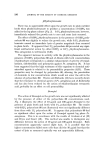
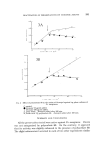
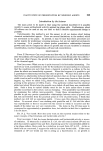
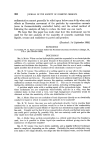
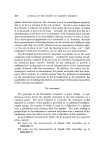
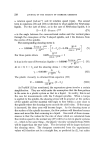
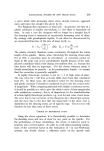
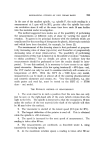
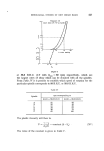
RHEOLOGICAL STUDIES OF NEW CREAM BASES 219 a curve which with increasing shear stress should, however, approach more and more the straight line given by (I). The Bingham flow represents an ideal case. In practice, the flow of a plastic substance is usually non-uniform, i.e. the shear is dependent on time. In such a case the rheogram will no longer be a straight line if the shearing stress is measured at successively increasing rates of shear. By analogy with pseudoplastic liquids, U can often be characterized by an exponential function of the rate of shear d¾/dt, i.e. ß (/d__Y']-n (IX) U o =uatd¾=0 U=Uø k, dt,/ d-• The plastic viscosity therefore varies continually throughout the whole length of the spindle. Hence, when calculating the shearing stress using (V) or (VI), a correction must be introduced. A correction cannot be made in the same way as for pseudoplastic liquids because of the com- plicated conditions which exist during non-uniform flow, i.e. because the time factor will then be important. For the chosen reference point, it should nevertheless be possible - as for pseudoplastic liquids - to assume that the correction is generally negligible. In highly thixotropic systems, n can be 1 at high rates of shear. The true value for ß will then probably differ more from that calculated from (V). In these cases, the calculated values for the shearing stress and plastic viscosity U should be considered to give only the correct order of magnitude •. When comparing materials with similar consistency curves, it should be possible as a rule to give the relative ratio of these magnitudes with satisfactory accuracy this is of importance in the standardization of certain highly thixotropic products, e.g. wool fat and some cream bases. The error due to the curvature of the rheogram for a thixotropic system,. and the error due to the fact that the magnitude of the shear zone is dependent on the shearing stress, are of opposite sign. The net error will therefore be less than each of these errors. CHOICE OF REFERENCE POINT Using the above equations, it is theoretically possible to determine the sheafing stress and rate of shear for any point on the spindle. For the performance of these calculations, the choice of reference point is, however, not a trivial matter. In order to avoid time-consuming calcula- tions of the correction factor in the evaluation of ß in non-Newtonian systems, one should choose a reference point on the spindle such

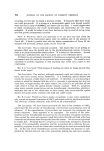
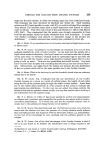
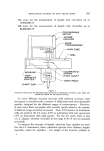
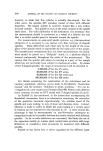
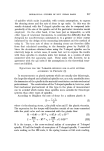
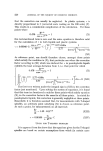
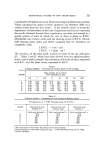
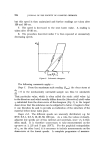
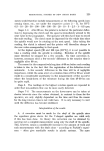
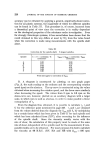
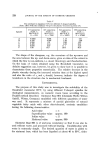
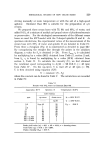
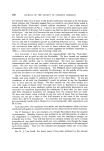
22O JOURNAL OF THE SOCIETY OF COSMETIC CHEMISTS that the correction can usually be neglected. In plastic systems, • is directly proportional to C (corrected scale reading on the 100 scale) (V). This results in a considerable complication of the calculation. For those points where 0.69 0.478. 10.69 = 1 (X) COS o• ß this last-mentioned term is zero and the same equation is therefore valid for the calculation of z in both liquids and plastic systems. •: 0.00346. G cos 0•- 1 ø'69 (•)ø'69n 2.77-0.69n r. R "7' 2.77 (cos ig)n• /a(cosoc)•_ndc1 As reference point, one should therefore choose, amongst those points which satisfy the condition in (X), that particular one where the correction factor according to (XI) which was deduced for • in pseudoplastic liquids exhibits the least average deviation from 1, i.e. that point for which RO.69 0.478. = 1 (X) COSO(,ß 1 ø'60 0.69n 2.77-0.69n 1 - 1 dn =0 (XII) ß ' f•/•(cos 2.77 (cos 0c) n 0c) •-nd 0• The first term written under the integral sign in (XII) is the correction factor just mentioned. Upon solving the system of equations, it is found that this term is a function of n only for those points which satisfy equation (X), i.e. the correction factor is the same for all these points. As stated for pseudoplastic liquids, this correction is generally negligible at these points. Henceforth it is therefore assumed that, for measurements with T-shaped spindles, an arbitrary point satisfying (X) is chosen as reference point. At such a point, for measurements on all materials d¾ _ 1.52-i• R ø.6• (XlII) dt G ß = 0.00165. R,.O • . C (XlV) r' UNITS FOR T-SHAPED SPINDLES It is apparent from the above that the equations given for the T-shaped spindles are based on certain assumptions from which (in certain cases
Purchased for the exclusive use of nofirst nolast (unknown)
From: SCC Media Library & Resource Center (library.scconline.org)