J. Soc. Cosmetic Chemists 17 213-233 (1966) •) 1066 Society of Cosmetic Chemists of Great Britai• Rheological studies of new cream bases with the Brookfield Synchro- Lectric viscometer F. NEUWALD* Presented at the Symposium on "Physical Methods," organised by the Society of Cosmetic Chemists of Great Britain, in Bristol on 17th November 1965. Synopsis--The Fryk16f method for studying plastic systems, using the Brookfield Synchro- Lectric viscometer with T-shaped spindles, is reported. 1Rheological studies of o/w creams show the suitability of the instrument and the Fryk16f method for plastic systems, e.g. pharmaceutical and cosmetic ointments and creams. Rheograms were constructed from which the yield value and the plastic viscosity could be calculated and from which, in addition, the occurrence of thixotropy or rheodestruction could be observed. The rheological properties of pharmaceutical and cosmetic ointments and creams are important product dimensions - to describe them completely is to describe consistency, pourability, penetrating characteristics or the ease with which the product may be handled or used. The interrelation between flow properties and other product dimensions often makes measure- ment of rheological properties the most sensitive or convenient way for the development of a more or less solid preparation and of detecting changes of the preparation in density and stability. For rheological measurements on plastic systems, e.g. ointments and creams, a cup or capillary, orifice, sonic, or failing weight viscometer will fail to give a complete picture of flow properties and, in many cases, will present erroneous results. The viscosity of a Newtonian liquid is independent of the shearing stress and rate of shear. For studies on such a liquid it is therefore unnecessary to know the exact values of these quantities. After the instrument has been calibrated with a liquid of known viscosity, other NewtonJan liquids can be determined relative to this liquid. For non-Newtonian liquids and *University of Hamburg, Germany. 213

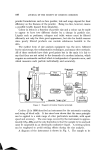
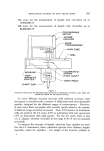
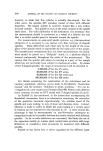
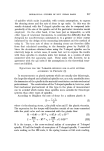
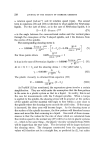
214 JOURNAL OF THE SOCIETY OF COSMETIC CHEMISTS plastic materials, however, the viscosity is not an unambiguous quantity but is, in fact, a function of the rate of shear. In such a case, a figure for the viscosity is without any definite value unless the rate of shear, at which it is measured, is given at the time. Actually the interest here lies in a determination of the flow curve or rheogram of the material which necessi- tates measurements at several definite shearing stresses or rates of shear. For a more general application of a viscometer it is, therefore, deskable that measurements of shearing stresses can be carried out at different rates of shear and that the results obtained can be expressed in absolute units, i.e. the rate of shear in sec -• and the shearing stress in dyne. cm -•. Only multispeed rotational viscometers can be used for such measurements. The Brookfield Synchro-Lectrlc viscometer is probably one of the most commonly used rotational viscometers. A relatively large number of pub- lications provide evidence of its use both for scientific investigations and for industrial plant control. FryklSf (1) has attempted to provide a mathematical background for correct interpretation of the experimental results obtained with this viscometer. In addition, the author has de- developed a method of measurement for plastic materials with this intru- ment which exploits, in a better manner than the methods recommended by the manufacturer and used in the investigations so far published, the possibilities for obtaining information concerning the rheological properties of the material investigated. The instrument The principle of the Brookfield viscometer is quite simple. A syn- chronous motor drives the spindle, immersed in the test material, at a constant speed. The force required to overcome the resistance of the material to rotation of the spindle is provided by a calibrated beryllium- copper spring, the tension of which is read as a deflection of a pointer over a graduated scale rotating with the spindle. The scale reading is proportional to the resistance to rotation and hence also a function of the consistency since the latter is in its turn a function of this resistance. Several different models exist which can be grouped into four separate series, namely: LV series for the measurement of liquids with viscosities up to 2,000,000 cP. RV series for the measurement of liquids with viscosities up to 8,000,000 cP.
Purchased for the exclusive use of nofirst nolast (unknown)
From: SCC Media Library & Resource Center (library.scconline.org)