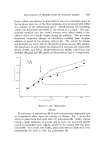
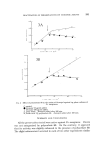
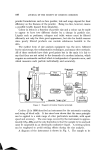
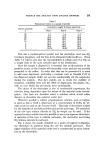
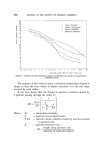
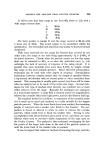
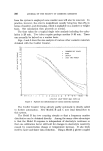
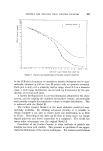
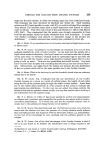
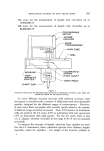
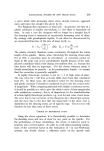
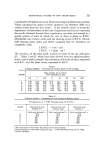
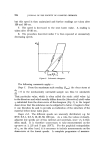
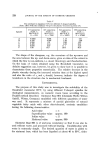
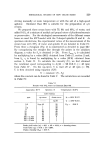
RHEOLOGICAL STUDIES OF NEW CREAM BASES 227 ioo • 5o d. •: 43 2C-- 10-- 0 0 •-- Rheagram I B -- Cre,•m base with 75 % of i / 50 78 • S scale reading / ß I ß 20 30 50 So Figur• 3 or 58.8 B.R.U. (LV with f•,ax ---- 60 rpm) respectively, which are the largest rates of shear which can be obtained with all the spindles. From Table IV it is possible to establish which speed of rotation for the particular spindle corresponds to 98 B.R.U. or 58.8 B.R.U. Table IV Spindle rpm corresponding to dy/dt = 58.8 B.R.U. 21 26 31 38 46 6O d¾/dt = 98.0 B.R.U. 35 43 52 63 77 100 The plastic viscosity will then be U -- • - • -- constant (S - So) ß dy/dt The value of the constant is given in Table V. (xv)

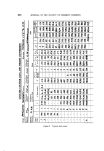
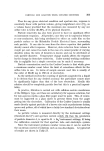
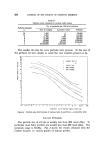
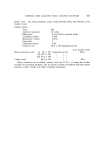
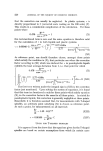
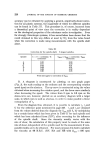
228 JOURNAL OF THE SOCIETY OF COSMETIC CHEMISTS Table V The constant in equation (XV) for different T-shaped spindles. Note: (XV) with this constant will give the plastic viscosity in poises (P). LV-apparatus I[V-apparatus HA-apparatus HB-apparatus Spindle d¾/dt = d¾/dt ----- d¾/dt = d¾/dt = 58.8 B.R.U. 98.0 B.R.U. 98.0 B.R.U. 98.0 B.R.U. G ---- 674 G = 7190 G = 14370 G = 57500 A 0.0882 0.564 1.13 4.51 B 0.156 0.997 1.99 7.98 C 0.298 1.91 3.82 15.3 D 0.495 3.16 6.32 25.3 E 0.870 5.57 11.1 44.6 F 1.56 10.0 20.0 80.0 The shape of the rheogram, e.g. the curvature of the up-curve and the area between the up- and down-curve, gives an idea of the extent to which the flow is non-uniform, i.e. about thixotropy and rheodestruction. On the basis of values obtained using the Brookfield viscometer, no definite suggestion can, however, be given to show how it is possible to characterize these properties numerically. The relative decrease in the plastic viscosity during the increased rotation time at the highest speed and also the ratio of % and •f should, however, indicate the degree of breakdown in the structure due to mechanical treatment. EXPERIMENTAL The purpose of this study was to investigate the suitability of the Brook field viscometer RVT, by using different T-shaped spindles for rheological measurements, on cosmetic cream bases according to the Fryk16f method described. Ointment Base 601 (Chemishe Werke Witten GmbH, Witten, Germany) emulsified with different quantities of water was used. It represents a mixture of partial glycerides of natural vegetable fatty acids with other skin-tolerated, nonionic emulsifiers having the following characteristics: Acid value Saponification value Iodine value Hydroxyl value 1 approx. 100 5 approx. 300 Ointment Base 601 is of unctuous consistency so that it can also be used without water, and processed without heating. Emulsification with water is extremely simple. The desired quantity of water is added to the ointment base, which has been liquefied at about 40 to 50øC, either
Purchased for the exclusive use of nofirst nolast (unknown)
From: SCC Media Library & Resource Center (library.scconline.org)