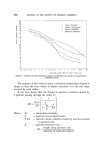
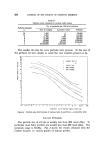
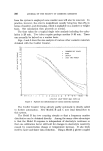
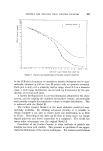
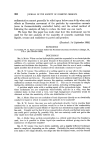
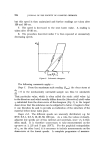
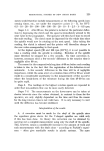
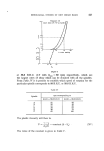
210 JOURNAL OF THE SOCIETY OF COSMETIC CHEMISTS proper one, or whether it is changing, one can always go back over points previously counted. One can see by a change in counts at various size levels, whether anything such as aggregation, flocculation, etc., is occurring. MR. T. A. BROCK: In Fig. 5 a distribution is shown for particles present in a lip- stick. What do you consider that you were measuring, as presumably the system presented to the Counter was a suspension of the pigments present in an artificial emulsion of the base in the electrolyte ? MR. W. M. WOOD: As the electrolyte system was lithium chloride in methanol we have assumed that this would probably dissolve the lipstick base, and that we were actually counting the pigment dispersion. DR. M. I•. W. BROWN: IS it not true that a particle passes between the electrodes, displaces an equal volume of the electrolyte solution, which causes a change in the electrical properties of the system, in this case the resistance, and this is recorded ? MR. W. M. WOOD: That is so. DR. M. R. W. BROWN: Every deduction which you make from your measurements therefore depends upon the premise that a particle is displacing an equal volume of an electrolyte, and that an inert particle is displacing an equal volume of an electrolyte solution. Do you have any experience of the electrolyte solution being displaced by something which is not inert, such as a cell coated with a chemical which is intended to kill it, and give it a charge ? MR. W. M. WOOD: The response of the Coulter Counter is in no way affected by the particles going through the orifice. It does not matter whether it is a biological cell or a ceramic particle. The charges on the particle itself, or the resistance of the particle, in no way affects the response of the instrument because one is measuring a volume displacement. The U.S. National Bureau of Standards claim that once particles go into the suspension they form a very thin electron shield or oxide film around them, which is perhaps only 1-22k thick, and this renders the particle relatively inert within a chosen electrolyte system. Biological material in no way affects the count, and it is possible to size blood cells, bacteria, the larger viruses, etc., without getting a wrong answer due to this charge on the particle itself. MR. G. PROUT: In our laboratories, the Coulter Counter has been used to count tissue culture cells and bacteria. The bacteria used were a Leuconostoc species approximately 0.8p by 0.Sp, often in chains up to 4 or 8 cells long. As no satisfactory method could be found to separate these cells into single units the suspensions were counted without any attempt to achieve separation except stirring, using the stirrer attached to the Coulter Counter. The electrolyte used was 0.9 • sodium chloride dissolved in nt•trient broth and this medium was used to culture the organism. Treating the bacterial population with 1.0 •o phenol or tannic acid solution in order to affect surface potential, did not affect the reproducibility of the count. The bacteria were also counted using serial dilution and plating out to give a viable count, and by hemocytometer after dilution and subsequent staining by Gram's method, giving a total count of viable and dead cells. Invariably the viable count was slightly lower (about 10 •o) than the hemocyto-

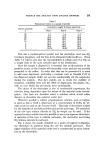
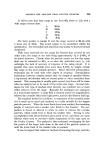
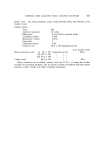
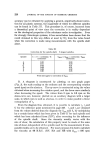
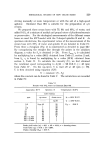
PARTICLE SIZE ANALYSIS USING COULTER COUNTERS 211 meter count. The hemocytometer count varied between 97•o and 101.8•o of the Coulter Count. Sample Results Tube 50[• Aperture resistance 21.1 K• Electrolyte 0.9 •o NaC1 in nutrient broth Coincidence factor 3.125 Manometer volume 0.5 ml Gain index 3 Calibration factor 2.42 Count per ml 60.4 x 10⁶ organisms per ml Hemocytometer count (i) 61 X 106 organisms per ml (it) 59.7 X 10⁶ ...... (iii) 61.5 X 10⁶ ...... Viable count 56.4 X 10⁶ ...... 93.4 •o of Coulter Count 101.0 Many references are available, mainly from the U.S.A., of using the Coulter Counter for biological particles, and in several of these correlation has been shown between Coulter results and other counting techniques.
Purchased for the exclusive use of nofirst nolast (unknown)
From: SCC Media Library & Resource Center (library.scconline.org)