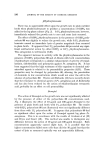
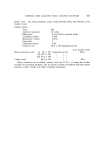
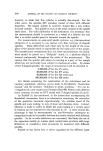
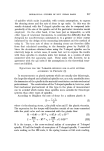
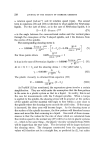
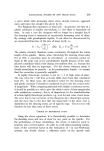
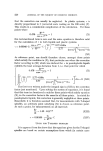
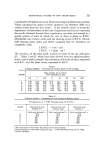
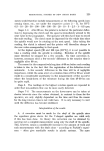
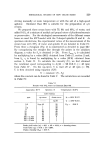
RHEOLOGICAL STUDIES OF NEW CREAM BASES 221 considerable) deviations can occur when measuring non-Newtonian systems. Values calculated by means of these equations can therefore differ to a certain extent from the true values. It has seemed correct to stress the dependence of these values on the type of apparatus used, by not expressing the results obtained through these equations in cgs units but instead in a special system of units in which the rate of shear is given in B.R.U. (Brookfield rate of shear units) and the shearing stress in B.S.U. (Brook- field shearing stress units) and where, assuming that the equations are completely valid, 1 B.R.U. ---- 1 sec -• and 1 B.S.U. = 1 dyne. cm-'. The viscosity, on the other hand, is given in terms of the cgs unit-poise (P). Tables I and II, which have been derived from the equations given above, can be used to simplify the calculation of the rate of shear, expressed in B.R.U., and the shear stress, expressed in B.S.U. Table I T-shaped spindles. Conversion of rotation speed to rate of shear. Rate of shear (D) in B.R.U. Spindle RVT-apparatus •, rpm 0.5 1 2.5 5 10 20 50 100 1.39 2.77 6.93 13.9 27.7 55.4 139 277 1.15 2.30 5.75 11.5 23.0 46.0 115 230 0.94 1.87 4.67 9.35 18.7 37.4 93.5 187 0.78 1.55 3.87 7.75 15.5 31.0 77.5 155 0.64 1.27 3.17 6.35 12.7 25.4 63.5 127 0.49 0.98 2.45 4.90 9.80 19.6 49.0 98 Table II T-shaped spindles. Conversion of scale reading to shearing stress. RV-apparatus, G ---- 7190: Shearing stress ('r) in B.S.U. Spindle Uncorrected scale Uncorrected scale Corrected scale reading, S•, 2 reading, Smax • reading, C Each scale division a = Each scale division a ---- Each scale division A 55.4 55.5 55.6 B 97.8 98.1 98.5 C 187 188 190 D 310 316 321 E 546 577 592 F 980 1160 1230 The cross-piece 10 mm below the surface of the test material. Does not apply to conversion of Smax tO 'rmax. Cf the following section of the Table. On the 100 scale.

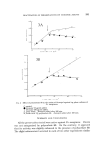
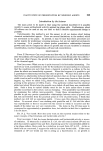
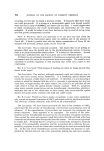
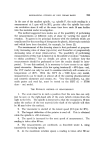
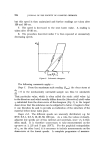
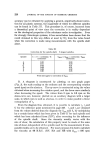
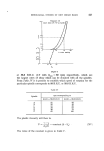
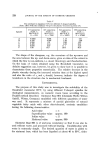
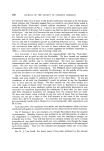
222 JOURNAL OF THE SOCIETY OF COSMETIC CHEMISTS MEASUREMENTS ON PLASTIC SYSTEMS From measurements on a plastic system, it should be possible - pro- vided the range of the rates of shear is not too limited - to construct a rheogram from which the yield value (-q) and the plastic viscosity (U) can be calculated. It should also be possible to perform the measurements in such a way that information can be obtained about other matters of interest such as, for example, the existence of thixotropy. An important advantage with the Brookfield viscometer is that measurements can be performed on plastic systems by means of the T-shaped spindles which satisfy the demands stated above and, above all, that the zone of measure- ment - in contrast to the situation with other types of spindles - is not subjected to mechanical pretreatment when immersing the spindle in the test material. If a spindle is rotated at constant speed in a thixotropic material, the scale reading progressively decreases. This is a sign that the flow is non-uniform and thus gives important information concerning the material. It seems, however, as though it has been considered a disadvantage that the scale reading does not remain constant during measurements on thixotropic systems. Thus Brookfield's brochure recommends that such measurements should be carried out with a Helipath stand so that the measurement will then always be occurring in a mechanically unpre- treated part of the material thus the scale reading will be independent of the time. Several points of criticism can be levelled against this method of measurement. 1. The method involves a "one-point" measurement. It is then im- possible to characterize a plastic material. Two materials, for which the same result is obtained in a one-point measurement, may have completely different rheological properties. It is often found that one-point measure- ments are unsuitable even as a means of checking the manufacture of one and the same product. 2. The conditions under which the measurement is performed are not accurately defined. The measurement is not carried out in a mechanically unpretreated material. Because the spindle works continuously down- wards in a helical path the measurement, in fact, takes place in a material the structure of which is broken down in a significant, though undefined, manner. 3. Constant results are not obtained. As the spindle moves down through the material, the torque exerted on the spindle shaft will increase.
Purchased for the exclusive use of nofirst nolast (unknown)
From: SCC Media Library & Resource Center (library.scconline.org)